

We have an honest review policy, but this page contains affiliate links. If you buy through these, we may earn a commission. This helps fund our research at no cost to you.

In this Canva Pro vs Free comparison, I highlight the main differences between two key versions of this popular DIY graphic design tool, and help you decide whether you can get away with using the free version of Canva — or if it’s better to upgrade to the paid version.
Quick verdict on Canva Free vs Pro
If you just need to create simple graphics, presentations or social posts occasionally, Canva Free is likely all you need. It provides access to over 1.6 million templates, 5GB of storage, and a decent selection of stock images — making it a good option for personal or small-scale projects.
However, if you create designs regularly, need to manage multiple brands, or want professional-level tools like background removal, AI features, brand kits, and automated resizing tools, Canva Pro is easily worth its small monthly fee. It gives you access to 100GB of storage, millions of free images, templates and videos, and advanced export formats that you won’t find on Canva Free — making it a much better fit for most freelancers and small businesses that need to produce professional content regularly, quickly and at low cost.
And ultimately, thanks to its generous free trial, it’s hard not to see Canva Pro as the best way to try out the platform.
Canva is a graphic design tool that aims to make it easy to produce visual assets without needing any graphic design skills.
Increasingly popular with small business owners and solopreneurs, it comes with a huge number of customizable templates, graphics, images and videos; these can all be used to create a wide range of marketing materials (social media graphics, videos, presentations, slides, posters, business cards and even printed products).
Now, for many people starting out with Canva, there’s a key decision to be made — between the ‘Canva Free‘ and ‘Canva Pro‘ plans. Which version is right for you?
Let’s find out, starting with a look at Canva Free.
Canva Free features
As its name suggests, this plan is entirely free. And it’s surprisingly feature-packed.
On the plan, you get free access to:
- 1.6+ million free templates
- over 4.7 million free graphics, fonts, photos, videos and audio
- 5GB cloud storage that you can use for keeping your own design assets on Canva (i.e., uploaded logos, your own photos, etc.).
- some AI design features (copywriting, image generation, mockups and chart creation tools)
- the option to export your work into various file formats.
- the option to collaborate with others on your designs in real time.
You can use the free plan indefinitely, and as you can see from the feature set above, it’s pretty functional too. So Canva Free definitely represents a good option for anyone who is starting a new business but doesn’t have a huge budget to put into graphic design.

There are some significant downsides to the free Canva plan, however — with three worth singling out as particularly strong reasons for upgrading to Canva Pro.
First, its branding tools are very limited. On Canva Pro, you can create 5 ‘brand kits’ — these let you upload a logo, define your brand color palettes, add your own fonts, photos, graphics and icons and incorporate all these easily into designs — but on the free Canva plan, you can only create one brand kit. What’s more, this can only make use of three colors.
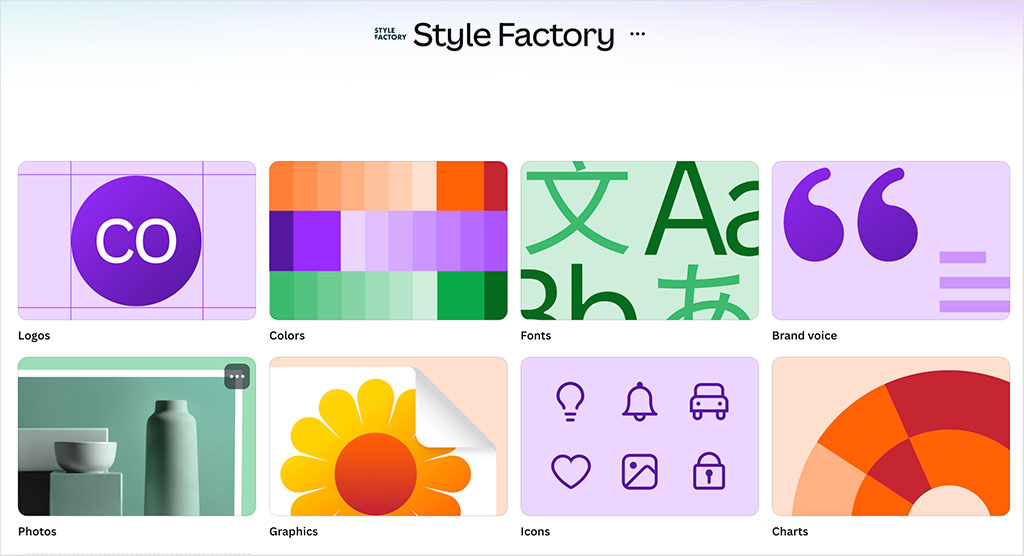
(Canva Pro also lets you use brand templates, create reusable components and lock brand elements — none of this is possible with the free Canva plan.)
Second, on the free Canva plan, there are no filters for showing only the free design elements. When you search for a design element (for example, a photo, icon, graphic, etc.), Canva Free shows you all the relevant results for these – i.e., it includes all the elements that you only get on Canva Pro.

There’s no way to filter out these paid-for results, which can result in a rather lengthy trawl through assets you can’t use before you find a free element you can.
Technically, you can insert a premium stock image or graphic into a design created with Canva Free, but it will contain a Canva watermark — see my screenshot below for an example.

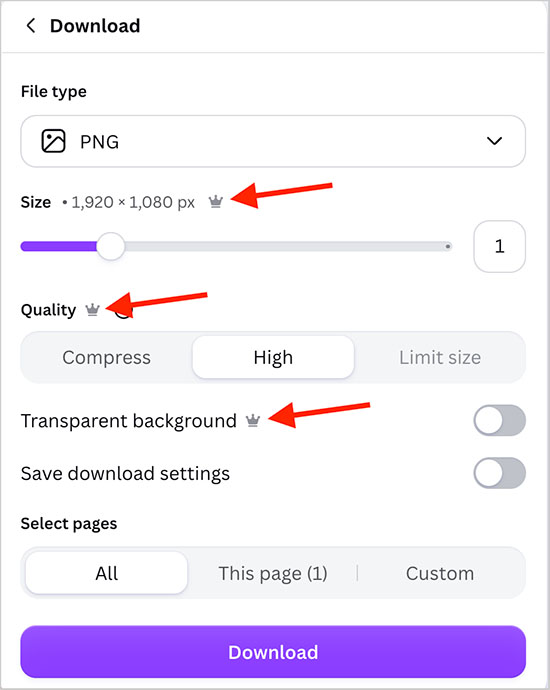
And finally, as you can see from my screenshot below, the free plan gives you rather limited output options. For example, it doesn’t let you change image size, adjust compression settings, or specify a limit for your downloaded files, and you can’t download SVGs (vector graphics), PNGs with transparent backgrounds, or print-ready CMYK files.
Now let’s take a look at Canva Pro.
Canva Pro features
Canva Pro is available as a monthly or annual subscription. The tool costs $18 per month if paid for on a monthly basis, or $144 if you pay upfront for a year.
Either way, a Canva Pro account unlocks a huge number of additional important features — for me, the key ones are…
More stock photos, videos and graphics
The free version of Canva, while generous in terms of the royalty-free images and graphic elements it provides, limits you to a more basic library of stock images and graphics.
But with Canva Pro, you get access to an exhaustive range of additional stock photos and graphics (over 141 million); and you also get access to a much more extensive library of audio and video content.

Given how much stock photography, video and audio generally cost, access to such a large content library for such a low monthly fee is one of the most compelling reasons for upgrading to Canva Pro. To put things in context, purchasing a single Getty or Shutterstock image can cost considerably more than a month’s subscription to Canva.
More templates
Although the free Canva plan gives you a lot of professionally designed templates to work with — over 1.6 million — you get far more of them on the paid-for version: over 3.6 million.
You can browse Canva’s templates here.
The Magic Resize tool
Another tempting aspect of Canva Pro is its Magic Resize feature — this lets you repurpose existing designs for different platforms really easily.

You simply open an existing design, and then use Canva Pro’s Magic Resize tool to automatically reformat it to suit different social media channels or purposes. You can then output all your resized versions in one go — a huge time-saver.
Canva Pro’s ‘Magic Resize’ feature doesn’t just let you alter your designs for different channels and sizes, though. It also lets you translate your design into multiple languages.
You simply click the ‘Resize’ button at the top of the Canva interface, navigate to the ‘Magic Switch’ controls, choose the language you want to translate your design into, and click ‘Translate.’ Canva then creates a translated version of your design for you.
This is ideal when you have to create multiple versions of the same design for use in different countries or regions.

Background removal
On the Canva Pro plan, you get access to a background removal tool. This is particularly useful for creating headshots for social media and websites, or thumbnails for YouTube videos.

More AI-powered design tools
Canva includes an increasingly impressive range of AI-powered design tools, but the amount of AI functionality you get varies considerably between its Free and Pro plans.
On Canva Free, you can use AI to generate images, create designs, write text and perform basic image-editing tasks — but usage is restricted.
With Canva Pro, by contrast, you get 10 times more AI usage, along with access to some more advanced features that aren’t available on the free plan.
These include ‘Canva Code,’ which lets you create interactive content such as quizzes and calculators from text prompts; ‘Highlights,’ which automatically identifies and extracts interesting moments from longer videos; and advanced AI video generation tools. You also get considerably more access to features like ‘Magic Layers,’ which converts flat images into editable, layered designs.
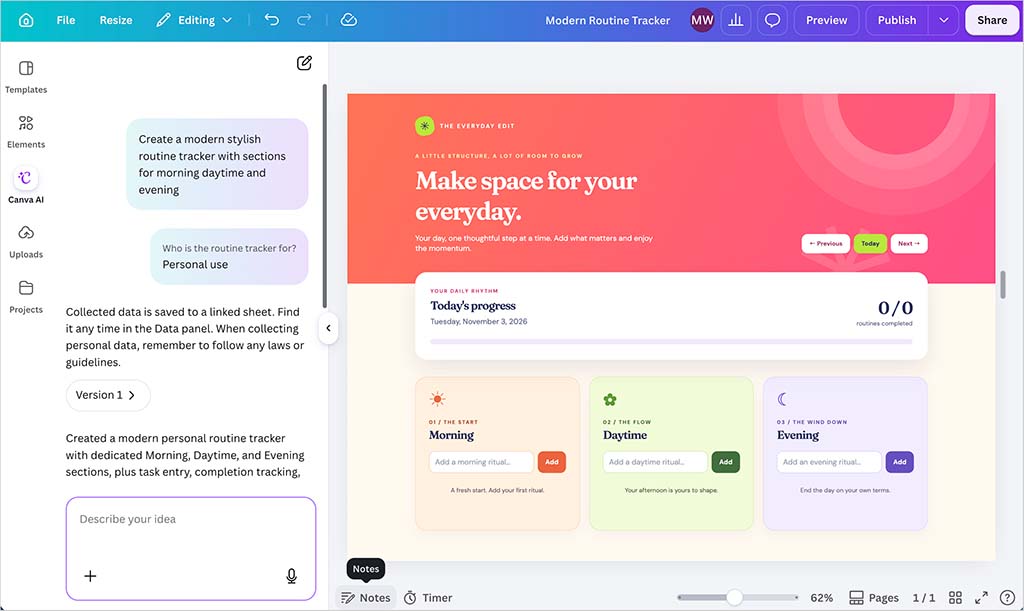
Canva divides its AI functionality into three categories: Standard, Premium and Ultra. On Canva Free, you get limited access to Standard and Premium tools, while Ultra tools aren’t available at all.
On Canva Pro, by contrast, you can use Standard AI tools without reducing your monthly AI allowance (subject to fair-use limits), and you get a much larger shared allowance for Premium and Ultra tools.
ℹ️ A Canva Pro subscription also unlocks some of the AI features in its sister ‘Affinity‘ product (a desktop design software suite that offers vector, photo and page layout editing tools). When you have a Canva Pro account, you can make use of Affinity’s background removal, generative fill, and image generation tools.
Customizable templates
While the free version of Canva only lets you work with pre-designed Canva templates, in Canva Pro, you can create fully customizable templates. This means that you can create reusable, fully on-brand templates that work better for your organization.
Storage and folders
With Canva Free, you get 5GB of storage, which can be used to store your own multimedia assets (photos, videos, logos, etc.). However, this can be used up quickly if you are working with large assets, particularly video and audio.

Canva Pro gives you a much more generous 100GB storage limit.
Customer support
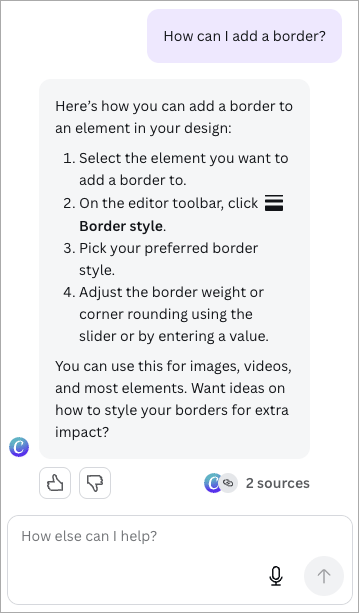
All Canva plans provide access to an AI help assistant chatbot, and my experience of using this during product tests was pretty good — certainly where simple ‘how-to’ questions were concerned (see screenshot below for an example).
As for ‘human help’ via support tickets, Canva Free users can access this, but only for ‘select issues’ (unfortunately, it’s not clear what sort of problems are covered by these). By contrast, if you’re on Canva Pro, you can submit a support ticket about any difficulty you’re encountering with the product (and in more ways too — live chat support is provided on paid Canva plans, not just support tickets).
Users
Both Canva Free and Canva Pro are single-user plans. However, this doesn’t mean that you can’t collaborate with other people when using them.
On either plan, you can share individual designs with other Canva users, invite them to view or edit your work, and collaborate on projects in real time. This is useful if you occasionally need feedback from a colleague or want to work on a design with a client.
But if you need to manage a team of designers or content creators, you’ll need to use ‘Canva Business’ plan. This costs $25 per month per user, or $250 per year per user if paying annually.
The key difference is that Canva Business gives you a shared team workspace, where multiple users can access and organize designs, work from shared folders and collaborate on projects. It also provides more advanced management features, including team member permissions, design approval workflows and brand controls.
So, while Canva Free and Pro are perfectly adequate for occasional collaboration, Canva Business is the better option for organizations that need to manage design work across multiple users.
Try Canva Pro for free – for 30 days
Canva is currently making a 30-day free trial of Canva Pro available to Style Factory readers. This gives you full access to all the Canva Pro features and assets for several weeks, and lets you export all your designs too. You can access this extended trial by clicking here — but please note that this offer will be available for a limited period only.
(You can find out more about the 30-day free trial of Canva Pro here).
Canva Pro vs Free — side-by-side comparison table
Below you’ll find a side-by-side comparison of Canva Free vs Pro. This aims to help you quickly work out which version is right for you.
| Feature | Canva Free | Canva Pro |
|---|---|---|
| Cost (US) | Free | $18/month or $144/year |
| Users | 1 | 1 |
| Templates | 1.6+ million | 3.6+ million |
| Photos, graphics, fonts, video and audio | 4.7+ million assets | 141+ million assets, including premium content |
| Cloud storage and folders | 5GB; unlimited folders | 100GB; unlimited folders |
| Brand Kits | 1 (up to 3 colors) | 5 (no three-color restriction) |
| Custom fonts | Cannot upload your own | Upload and use your own fonts |
| Brand templates and reusable components | No | Yes |
| Element locking | No | Yes |
| Bulk design creation | No | Yes |
| Export controls | Basic downloads | More sizing, compression and download options; transparent PNG, SVG and print-ready CMYK exports |
| Magic Resize and translation | No | Resize designs for multiple formats and translate designs into other languages |
| Photo and video background removal | No | Yes |
| Advanced photo editing | Basic editing | Magic Eraser, Magic Expand, Magic Grab, Magic Edit and other advanced tools |
| Animations | Basic animations | Additional animation tools, including Magic Animate |
| Mockups | Limited; excludes mockup templates | Full access. |
| Magic Charts | Yes | Yes |
| Video and audio editing | Basic editing and manual Beat Sync | Additional tools including automatic Beat Sync, Video Highlights and Enhance Voice |
| Sound effects library | No | Yes |
| Social publishing and scheduling | Share and publish designs; no content scheduler | Share, publish and schedule social posts |
| Custom short links | No | Up to 5 |
| Design insights | Basic | Basic and advanced |
| AI usage allowance | Limited shared allowance | 10× Canva Free’s shared AI allowance |
| Standard AI tools | Limited use | Do not consume the shared monthly allowance; fair-use limits apply |
| Premium AI tools | Limited access | Greater access; uses shared allowance |
| Ultra AI tools | No | Yes; uses shared allowance |
| Magic Write and AI design generation | Limited access | Higher AI allowance |
| Canva Code | Limited AI access | Higher AI allowance |
| Magic Layers | Limited AI access | Higher AI allowance |
| AI image, video and audio generation | Limited image/audio options; no Ultra AI video generation | Greater image/audio access, plus Ultra AI video generation |
| Affinity premium AI tools | No | Yes; subject to shared AI allowance |
| Canva AI connectors | No | Yes |
| Apps and data connectors | Apps Marketplace and data connectors | Both, plus access to premium apps |
| Collaboration | Share designs; real-time editing and comments | Share designs; real-time editing and comments |
| Team administration and approvals | No — Canva Business or above | No — Canva Business or above |
| Offline editing | Limited offline capabilities | Limited offline capabilities |
| Customer support | Help center and AI assistant; limited ticket/live chat support | Help center and AI assistant; ticket and live chat support |
| Free trial | Forever free | Free for 30 days (note: this offer is available for a limited time only) |
So, should you upgrade to Canva Pro?
Given that there is a lot of functionality available in Canva Free, not everybody will need to upgrade. Ultimately, to make a decision on Canva Pro vs Free, I’d suggest asking yourself these questions:
- Do you regularly need to work on designs for more than one brand?
- Do you need extensive control over the output formats of your designs?
- Is creating vector graphics a key part of your design requirements?
- Do you need a background removal tool, or transparent PNGs?
- Do you need access to a really large library of videos and stock images?
- Does your design work need to be translated into multiple languages?
- Do you need regular access to AI design features, including advanced image and video generation tools?
- Would features like bulk design creation and reusable components save you time?
If the answer to most of these questions is ‘yes,’ then of the two versions of Canva available, I’d recommend going with a Canva Pro subscription.
If you need more than 1 account, then you’ll have to use Canva Business.
Otherwise, a Canva Free account should suit you just fine.
Canva alternatives
Direct alternatives to Canva include Visme, Adobe Express, Kittl and VistaCreate (formerly Crello). These are similarly affordable graphic design tools that run in a browser and allow non-professional designers to create visual material easily.
(Our Visme vs Canva comparison, VistaCreate vs Canva comparison and Adobe Express vs Canva comparison might be of interest here.)
A particularly notable alternative is Kittl — a design platform that has been gaining traction thanks to its focus on typography, illustration and templates tailored to branding projects. Like Canva, it’s browser-based and beginner-friendly, but it places particular emphasis on detailed text effects and vintage-style design elements. You can learn more about this product in our Kittl vs Canva comparison.
Desktop applications like Adobe Photoshop, Illustrator and Premiere (and other graphic design software that you get as part of an Adobe Creative Cloud subscription) can also serve as alternatives to Canva. But whereas Canva offers you a built-in library of royalty-free photos, graphics and videos, you usually have to source assets ‘outside’ of these Adobe apps.
(Check out our Canva vs Photoshop comparison for more details on the differences between Adobe’s flagship image editor and Canva).
Now, over to you: got any questions about Canva Pro vs Free? Just scroll down and leave them in the comments section below. We’ll do our best to answer any queries you may have 🙂
Canva Pro vs Free FAQ
Can I try Canva Pro for free?
Yes. For a limited time, you can avail of a 30-day trial of Canva Pro.
How much does Canva Pro cost?
Prices vary by country, but in the US, a Canva Pro account costs $18 per month if paid for on a monthly basis, or $144 if paid for annually. This plan gives you one user account.
Can I export my designs with Canva Free?
Yes, you can export your designs with the free version of Canva — however, you won’t get access to compression tools and you won’t be able to export in SVG and transparent PNG formats.
What are the main advantages of using Canva Pro over Canva Free?
The main advantages of Canva Pro are its much larger library of royalty-free photos, videos, graphics and audio; more advanced design tools; and considerably greater access to AI-powered features. It also lets you create multiple Brand Kits, upload custom fonts, remove image and video backgrounds, export designs in additional formats (including SVG and transparent PNG), and automatically resize designs for different platforms. Other useful benefits include bulk design creation, reusable components, social media scheduling and 100GB of cloud storage (compared to just 5GB on Canva Free).
What is Canva Business?
Canva Business (formerly ‘Canva Teams’) is aimed at larger businesses than Canva Pro or Canva Free. It costs $25 per user per month (or $250 per user per year when billed annually). Canva Business provides more controls over your team members’ access, workflow, design approval and publishing rights on social media platforms. It also lets you use ‘team-only links’ that can only be viewed by team members.
Do I need to install any software to make Canva work?
Canva is primarily a browser-based app — you don’t need to install anything to use it (that said, downloadable versions for Macs, PCs, Chromebooks and mobile devices are also available). You’ll usually need an internet connection to use Canva. However, the desktop and mobile apps now include a limited offline mode that lets you edit designs you’ve made available offline in advance. AI features, collaboration, stock assets, exports and creating new designs still require an internet connection.
What are the main alternatives to Canva?
The most direct competitor to Canva is Adobe Express — it boasts a similar feature set at a similar price point, and integrates tightly with the professional tools provided by Adobe’s Creative Cloud suite of products. Other platforms that compete against Canva include Kittl (a strong option for typography-based work), Visme (good for HTML5 output) and Figma (a good choice for any prototyping work).
Related Canva resources
- How to make a logo on Canva
- How to make digital art in Canva
- How to draw in Canva
- How to remove the background from a picture in Canva
- How to make business cards in Canva
- Canva for Education — all you need to know
- Canva for Nonprofits – all you need to know
- Canva vs Visme — which is better?
- Canva pricing — the essential guide
- Canva statistics — latest facts and figures
- What is Canva?
- Canva resource hub
Update details
This article was updated on 3 November, 2026. The following key updates were made:
- Annual Canva Pro pricing was updated to $144.
- New Canva screenshots were added.
- Details of Canva’s latest AI features and usage allowances were added.
- Information about Canva’s branding, collaboration and design tools was updated.
- The Canva Free vs Pro comparison table was expanded and revised.
