

We have an honest review policy, but this page contains affiliate links. If you buy through these, we may earn a commission. This helps fund our research at no cost to you.
In this guide to Canva Education, you’ll learn about the benefits of using this popular visual communication and learning platform in your classroom, what the eligibility criteria are, and how to get started with it.
What is Canva Education?
Canva Education is the classroom version of Canva’s easy-to-use web-based graphic design tool.
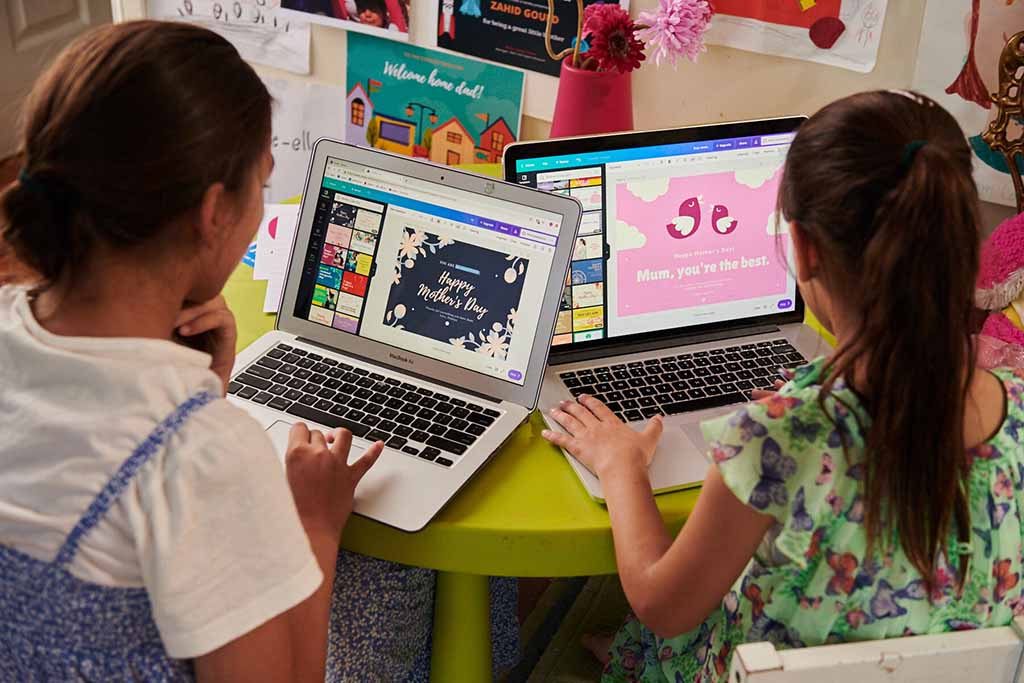
Like the main version of Canva, the classroom version can be used to create presentations, slides, posters, simple videos, drawings, art and a wide range of other visual assets — and it includes a large number of customizable templates for classroom settings.
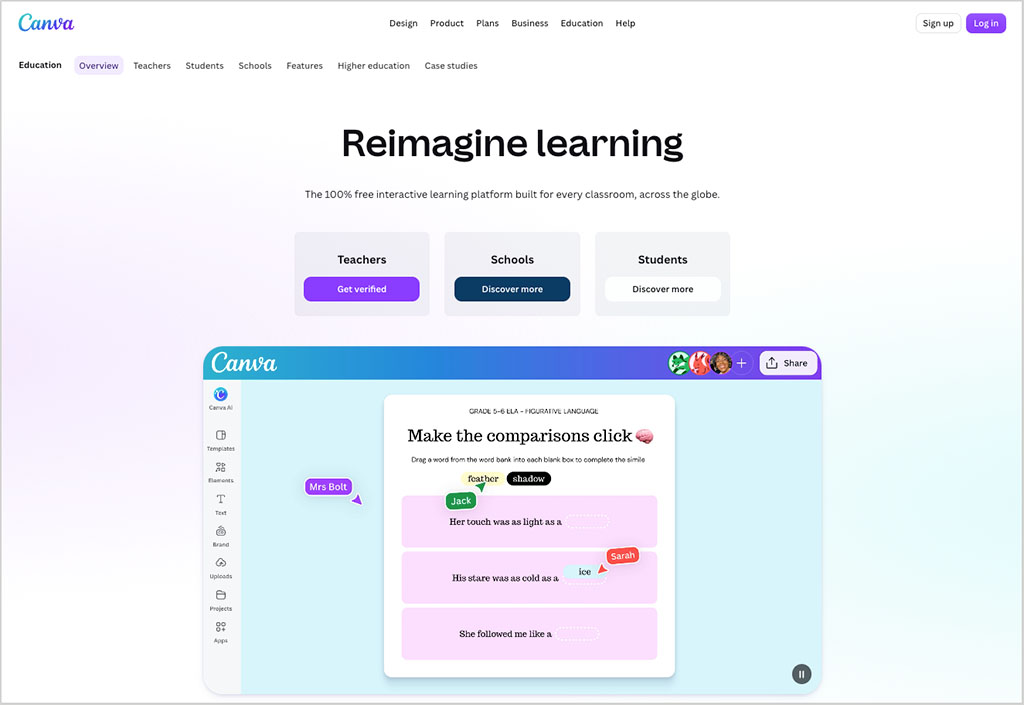
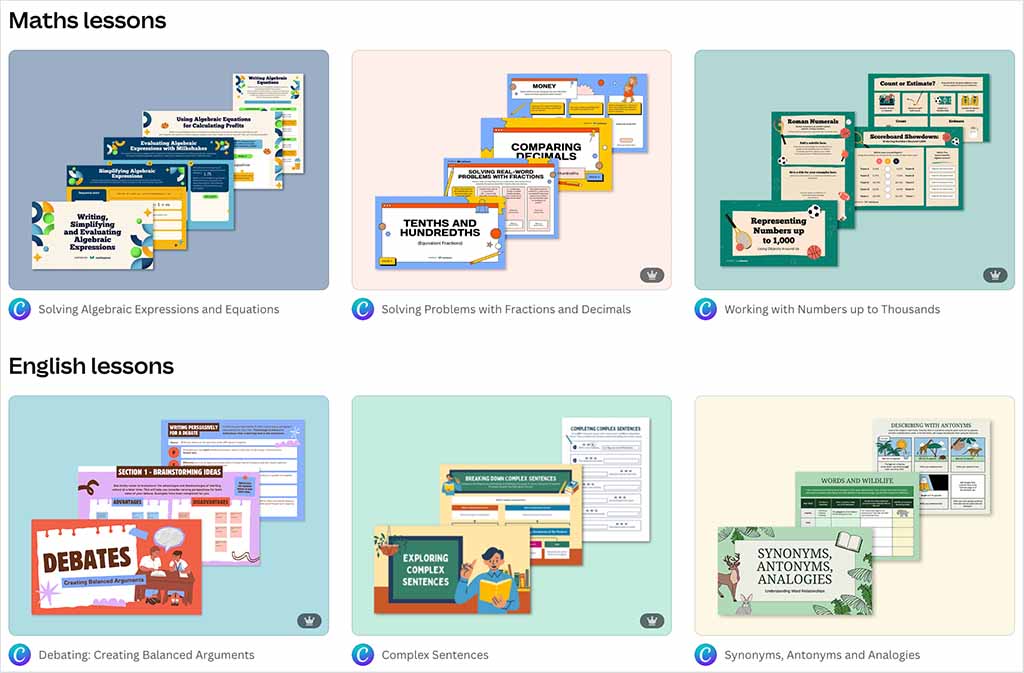
Teachers can use the design tools and thousands of educational templates in the tool to easily design visually attractive lesson plans, class resources and classroom decorations.
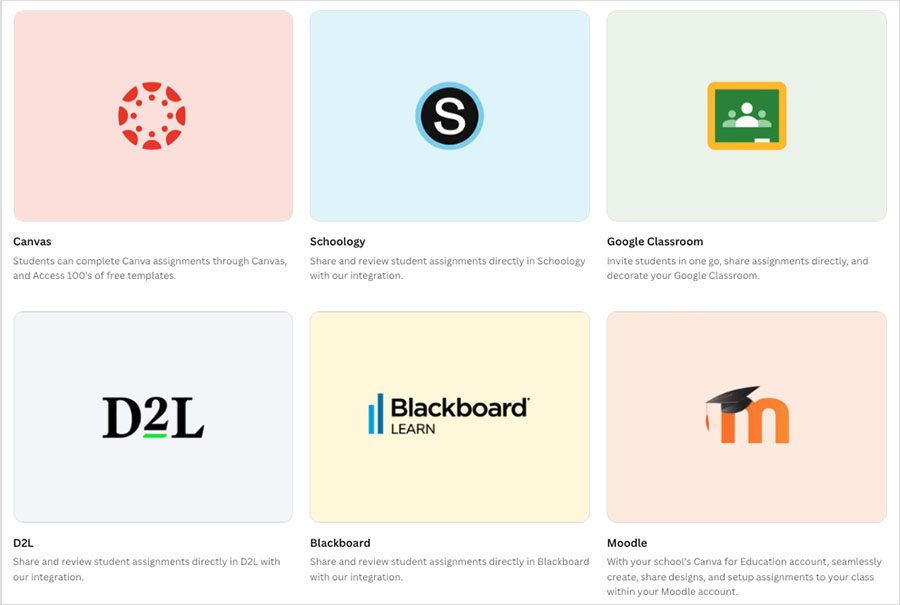
Canva Education integrates with popular learning management systems and education platforms too, including Google Classroom, Schoology, Canvas, ClassLink and PowerSchool. This lets teachers incorporate Canva activities into their existing classroom workflows.
Teachers can add Canva-based assignments to their students from within their LMS, and students can complete work and receive feedback on Canva tasks — all without leaving their regular LMS learning environment.
And Canva Education increasingly incorporates AI-powered teaching tools. These can be used to generate classroom activities and presentations, create and adapt educational materials and help teachers plan lessons.
For schools, Canva also provides controls over how students can access its AI features. Generative AI features are disabled for students by default and can be enabled by school administrators, with Canva also providing additional moderation, sharing and account-management controls for educational organizations.
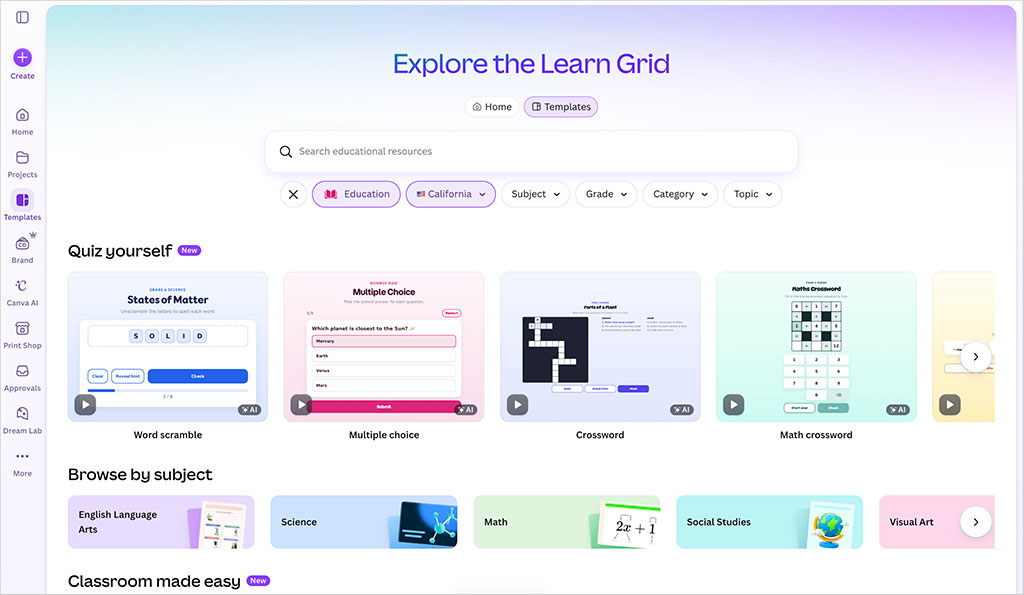
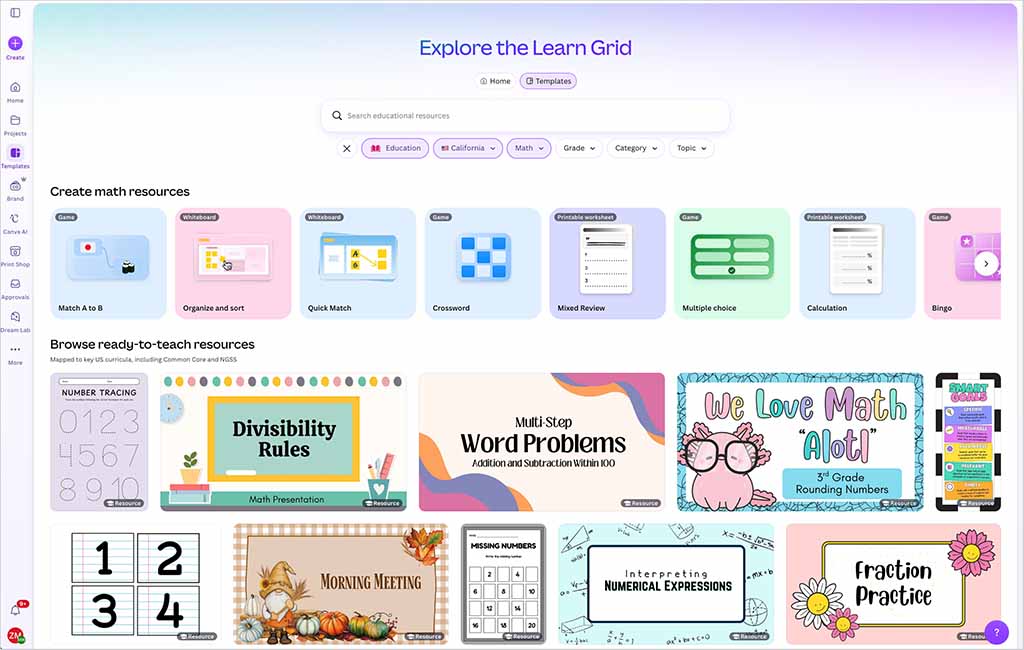
Canva has also introduced Learn Grid, a learning hub containing more than 50,000 curriculum-mapped resources. Verified teachers can use this to find teaching materials, generate activities with AI, deliver lessons and collect student responses.
Importantly, Canva Education is 100% free for eligible primary and secondary educators and their students.
At time of writing, Canva Education is used by more than 100 million students and teachers in over 800,000 schools and 16,000 school districts.
Who is eligible to use Canva Education?
While Canva Education is available in 190 countries around the world and can be used in over 130 different languages, Canva applies strict eligibility criteria to the teachers, students and educational organizations that can actually use it.
At the moment, the tool is available to certified education workers who are currently active in primary or secondary education. This generally means teachers and other eligible education professionals working in accredited K-12 schools (or their international equivalents).
The full list of eligibility criteria is:
- Certified K-12 teachers from formally accredited schools who are currently in teaching positions
- Certified K-12 school librarians
- Certified K-12 learning support assistants or teachers
- Certified K-12 curriculum specialists
- Certified teachers at technical or vocational schools serving primary or secondary students (or equivalent).
The following organizations are also eligible for Canva Education:
- Government-recognized, formally accredited K-12 (primary, secondary or pre-college) schools
- School districts
- Departments of education
- Other global school systems.
Canva Education is not available to certified teachers who are no longer in teaching positions, uncertified homeschool educators, private or online tutors, colleges and universities, university students, continuing or further education institutions, adult education institutions and certain other organizations.
(There is a specific Canva plan available for nonprofits which is also free — you can find out more about this here. There is also a special Canva plan available for third-level institutions called ‘Canva for Campus’; this requires a paid plan for university staff, who can then give students free access to Canva through their paid staff accounts.)
As for student access to Canva Education, primary and secondary students generally access it through their teacher or school. Teachers can invite students to join Canva Education from their Canva Education accounts, while schools and districts can also provide access through managed deployments.
It’s worth noting that Canva requires eligible teachers and organizations to re-verify their credentials every three years in order to retain access to Canva Education.
Finally, teachers and educational institutions must obtain any necessary parental or guardian consent before inviting students to use Canva Education, in accordance with applicable laws. For children under 13, Canva can also rely on a school or district to provide or obtain the appropriate authorization and consent.
💡 Tip: If you’d like to try Canva out before you go through the process of applying for the educational version, we recommend starting a free Canva Pro trial. This gives you full access to most of the platform’s key features and assets, and helps you work out if the platform’s going to be a good fit for your educational needs.
How do I sign up for Canva Education?
Signing up for Canva Education is straightforward. Go to the Canva Education signup page, and follow the steps to create an account and verify your status as an educator.
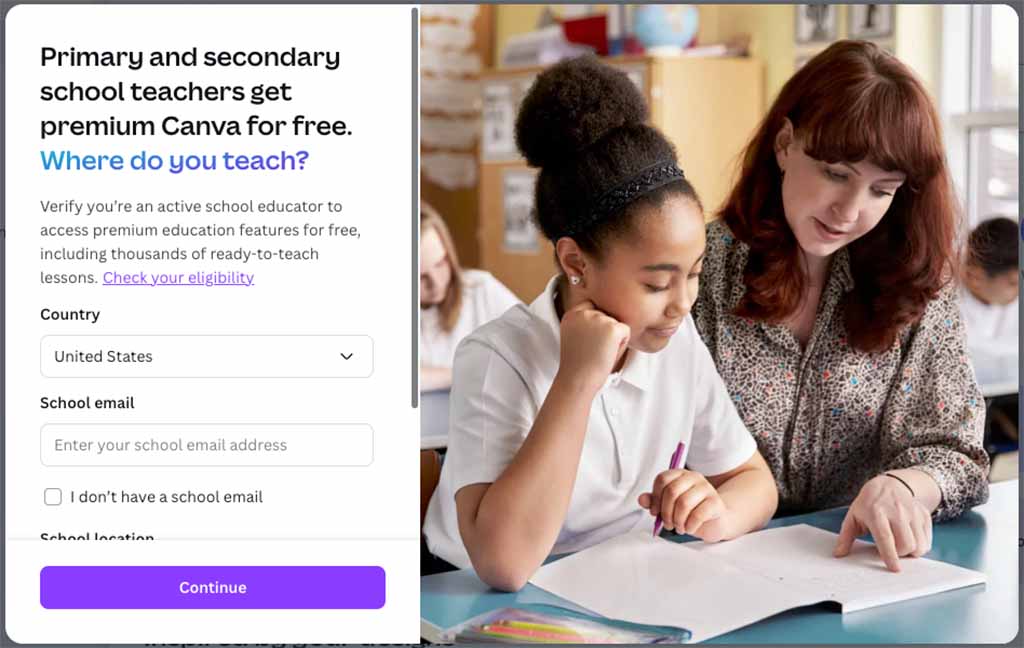
If you sign up using an email address from a verified educational domain, you can get access to Canva Education immediately. You can also sign up using your school’s or district’s Google, Microsoft or Clever account.
If Canva can’t verify your educational email address automatically, you’ll need to upload a photo or scanned copy of an approved document showing that you’re currently eligible to use Canva Education.
The following documents can be used for verification purposes:
- a teaching license or certification
- proof of current employment at a school, where requested by Canva
- a school ID indicating your teaching status
- documentation showing that an organization is a government-recognized, formally accredited primary or secondary educational institution.
* Teachers in Japan, Australia, Canada, New Zealand, the United Kingdom, the United States, South Korea and Europe only need to provide a copy of their teaching license.
Canva states that applications requiring document verification are typically reviewed within 48 hours. However, its teacher signup page advises that verification may take up to seven days during busy periods.
Once your eligibility has been verified, you’ll get full access to Canva Education for free.
And if you already have a Canva Free or Canva Pro account, you don’t need to create a new one — you can upgrade your existing account to Canva Education by completing the verification process.
You can learn more about signing up for Canva Education as a teacher in the video below.
Is Canva Education free?
Yes — Canva Education is 100% free for eligible educators and their students, with no hidden fees, paywalls or trial periods.
Eligible users, as discussed above, include certified education professionals who are currently active in primary or secondary education, as well as qualifying schools and school districts.
And despite being free, Canva Education isn’t a cut-down version of Canva. It includes all the premium features available in Canva Pro, along with additional tools designed specifically for educators — including education templates, LMS integrations, classroom collaboration features and safe-for-school content filtering.
If you don’t meet the eligibility criteria, you can still use the regular version of Canva by signing up for a Canva Free account. This gives you access to 1.6+ million design templates, 4.7+ million stock photos, videos, graphics and audio assets, and 5GB of cloud storage.
Alternatively, you can upgrade to Canva Pro to access Canva’s full range of premium design features and content. This gives you 3.6+ million templates, 141+ million premium stock assets and 100GB of cloud storage, along with premium features including background removal, resizing and translation tools, advanced AI features and expanded brand tools.
You can find out more about the differences between the free Canva plan and Canva Pro in our full Canva Pro vs Free comparison.
What’s the difference between Canva Education and Canva Pro?
In terms of design templates, editing features and stock imagery assets, Canva Education and Canva Pro are identical in every way. And just to be clear, this means that on a Canva Pro account, you can access all of the education-based templates in the Canva template library.
The key differences between Canva Education and Canva Pro are:
- Price: Canva Education is entirely free, whereas Canva Pro costs $18 per month.
- User numbers: Canva Pro can only be used by an individual user. Canva Education, by contrast, can accommodate a full classroom or more (there is no longer an official published limit on Canva Education participants on the Canva website).
- Free trials: There is no free trial version of Canva Education. By contrast, Canva Pro comes with a 30-day free trial, which you can access here if you use this link.
- Access to certain education features: Canva Education includes additional educational add-ons, including full integrations with several leading learning management apps as well as the ability to create and manage ‘class spaces’.
The table below highlights the full set of differences between the two versions of the tool.
| Feature | Canva Education | Canva Pro |
| Cost | Free | $18 per month |
| Users | Multiple | 1 |
| Templates | 3.6+ million | 3.6+ million |
| Images, video and audio | 141+ million | 141+ million |
| Cloud storage | 100GB | 100GB |
| Magic Resize tool | Yes | Yes |
| Custom templates | Yes | Yes |
| Brand kit feature | Yes | Yes |
| AI design tools | Yes | Yes |
| Social scheduling | Yes | Yes |
| Free trial length | No free trial available | Free for 30 days (note: this offer is available for a limited time only) |
| Class spaces | Yes | No |
| LMS integrations | Yes | No |
| Support | Support emails answered within 48 hours | Support emails answered within 24 hours |
Can designs created in Canva Education be used for commercial purposes?
Canva normally permits its Free and Pro content to be used for a wide range of commercial purposes, including marketing materials, online publications, book covers, posters and merchandise.
However, different rules apply when using Pro Content through Canva Education. Canva Education users may only use Pro Content for educational, non-commercial purposes.
Canva’s Content License Agreement states:
“Canva Education users may only use Pro Content for educational, non-commercial purposes.”
So, if you want to use Canva to create designs for commercial purposes, you shouldn’t create them using the Pro Content provided through your Canva Education access. Canva advises Education users to use a separate Canva account for commercial design work.
What is Canva’s ‘Education Creators’ program?
Canva’s Education Creators program lets teachers and other eligible educators create, publish and earn money from educational resources on Canva.
It’s part of the wider Canva Creators program, through which designers, artists and educators can contribute content to Canva’s library and earn royalties from their work.
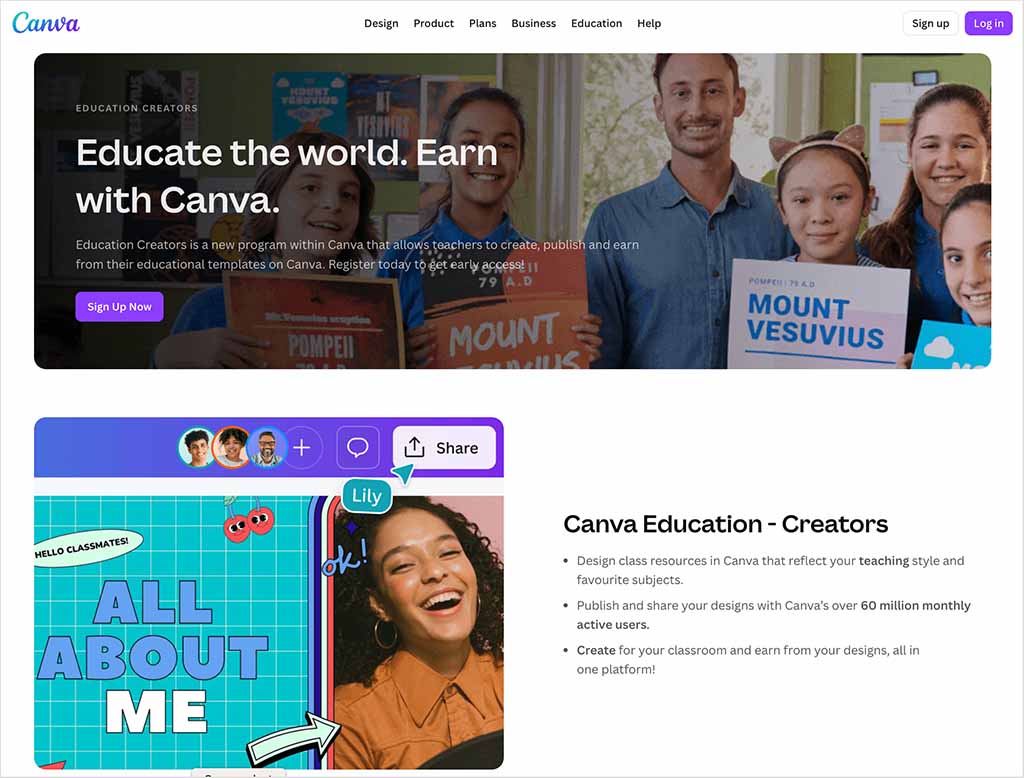
Education Creators produce customizable, curriculum-aligned resources for teachers and students, including classroom activities, assessments and other teaching aids. Content submitted to the program is reviewed by Canva to ensure that it meets the company’s design and content guidelines.
Creators can then earn royalties from their published content, with Canva making payments to eligible participants through its Creators program.
To become an Education Creator, you need to apply to Canva and be accepted into the program. Applicants must be verified educators and are asked to provide a portfolio containing 5–10 examples of curriculum-aligned, classroom-ready educational resources that demonstrate both their teaching expertise and design skills.
You can submit your application to be a Canva Education Creator here.
Where can I get help with Canva Education?
In addition to the standard resources in the Canva Help Center, Canva provides a wide range of guides, courses and teaching resources specifically for Canva Education users.
One of the best places to start is Canva’s Teacher Essentials course. This free, self-paced course covers the key aspects of using Canva Education, including setting up and managing a classroom, finding and adapting teaching resources, creating activities with AI, delivering lessons and assignments, and reviewing student work.
Teachers who complete the course and pass its assessment can also earn a Canva certification.
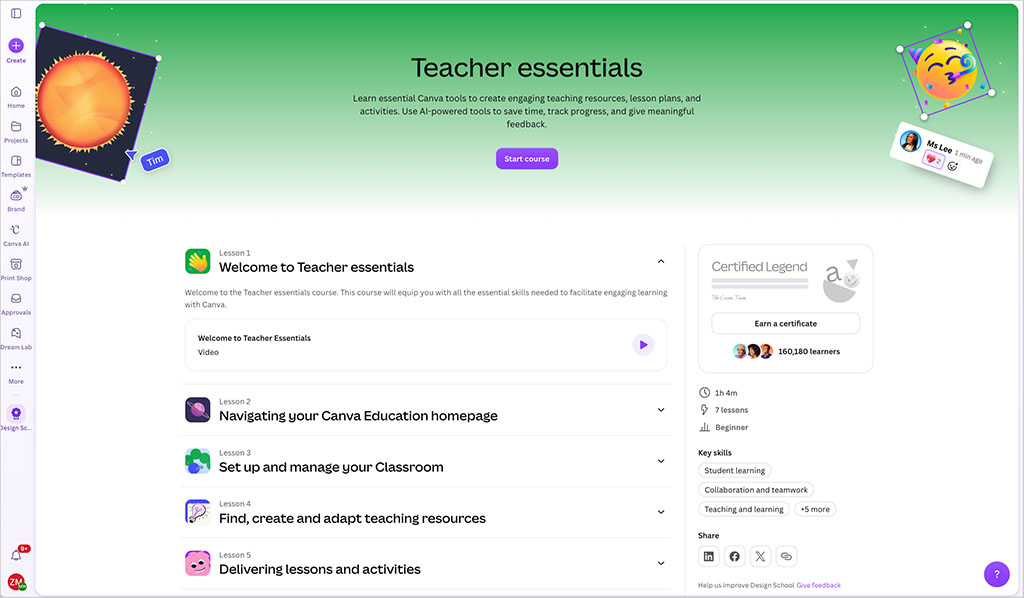
Canva also provides an AI in the Classroom course. This covers practical ways to use AI for lesson planning, creating teaching materials and developing more personalized learning experiences.
Another particularly useful resource is Learn Grid, Canva’s dedicated learning platform. It brings together more than 50,000 curriculum-mapped resources with AI-powered tools for creating classroom activities.
Teachers can browse ready-to-teach resources by subject and grade level, or use AI to generate their own activities. Learn Grid supports more than 30 activity formats and 16 languages, and verified teachers can use it to plan lessons, assign activities, deliver them live and review student responses.
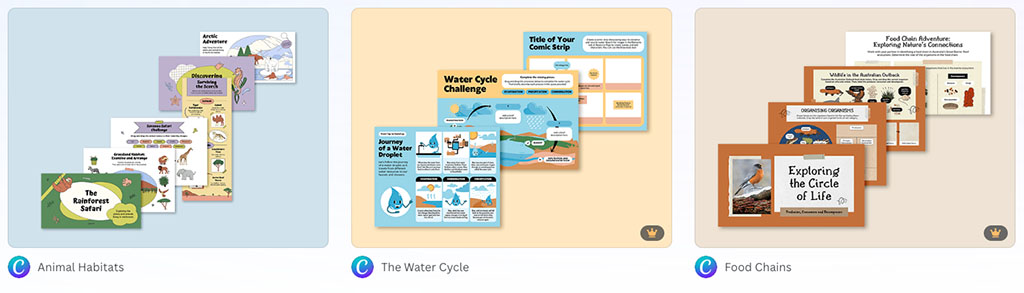
Canva also provides a broader library of ready-to-teach lessons and classroom resources, covering subjects including Math, Science, English and Art. These can be customized in Canva and combined with presentations, videos, whiteboards, worksheets and other content to create complete lessons.
For teachers who want to improve their Canva skills more generally, Canva Design School provides additional courses, tutorials, activities and guides, including education-specific resources and courses on AI.
For support and advice from other teaching professionals, educators can also make use of the official ‘Canva Teachers Community’ group on Facebook.
Finally, if you need general technical support with the platform, you can contact Canva via email — education queries are usually answered within 48 hours.
Where can I learn more about Canva?
We have lots of other Style Factory resources about Canva available to help you learn more about the platform:
- Canva review (blog post)
- Canva review (YouTube version)
- Canva pricing guide
- Canva Pro vs Free
- Adobe Express vs Canva
- Adobe Photoshop vs Canva
- Kittl vs Canva
- Figma vs Canva
- Visme vs Canva
- VistaCreate (formerly Crello) vs Canva
- Microsoft PowerPoint vs Canva
- How to make a logo on Canva (blog post)
- How to make a logo on Canva (YouTube tutorial)
- How to make business cards in Canva
- ‘What is Canva?’ guide
- Canva for Nonprofits
- Canva Resource Hub
Update details
This article was updated on September 28, 2026. The following updates were made:
- References to ‘Canva for Education’ were updated to reflect the platform’s current ‘Canva Education’ naming.
- Canva Education eligibility and teacher verification information was updated.
- Information on student access and parental consent was updated.
- Details about Canva Education’s free features and commercial-use restrictions were updated.
- Information on the Canva Education Creators program was updated.
- Information about teacher resources was updated, including details on Canva’s Learn Grid and Teacher Essentials course.
- Canva Education usage statistics were updated.
- Product screenshots were updated.

Comments (2)