


In this article I’m going to show you how you how to increase blog traffic. Below you’ll find 14 simple steps you can take to generate a much larger readership for your posts.
(These are the same strategies we use to drive hundreds of thousands of readers to the Style Factory blog each year.)
1. Do your keyword research
It’s really easy to sit down and write blog posts which cover, in considerable depth, topics that nobody is remotely interested in!
Similarly, it’s easy to write a blog post covering something that people are really interested in — but to give it a title containing words and phrases that nobody ever searches for.
Keyword research is your friend here: it can help you generate good blog post ideas and ensure that there is a sizeable target audience for your content.
By using keyword research tools — for example Semrush or Ahrefs — you can discover the number of monthly searches for various keywords — and find out how difficult it is to rank for particular phrases.
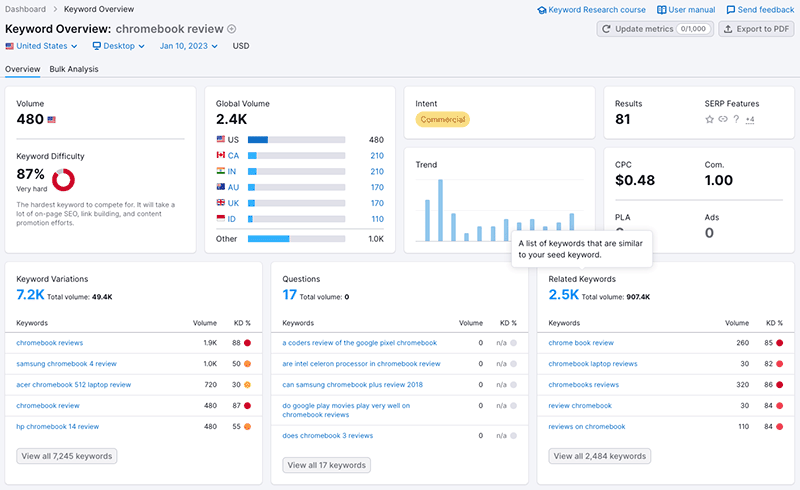
The trick with keyword research is to identify phrases that you can use in your blog that generate a reasonable amount of traffic — but for which there isn’t massive competition.
The video below shows you how this is typically done.
💡 Tip: consider writing about trending topics
A lot of topics have already been covered exhaustively on blogs and the keywords associated with them are consequently very hard to rank for in search results. This is not necessarily the case with trending topics however, because of their newness.
You can use tools like Google Trends and Exploding Topics to discover these trending topics — and be the first to blog about them.
2. Find the right writer (hint: that might not be you!)
At the heart of getting your blog noticed — and driving lots of traffic to it — is writing superb content.
And that content is going to be all the more ‘superb’ if the person writing it is both knowledgeable and passionate about what they are writing about.

Blog posts that are written from the heart – and not by a content farm – are more likely to be the posts that interest people, and crucially, get shared.
BUT…it might be the case that you personally are not the best person to write the posts for your site.
❌ Perhaps you’re not a great writer.
❌ Perhaps you don’t have time to devote to blogging.
If either of those statements sounds like it might apply to you, consider hiring a writer who is capable of creating truly exceptional blog posts and putting in the hours to do so.
3. Focus on creating long-form content for your blog
Studies show that ‘long-form content’ performs better in search results than short or ‘thin’ posts.
(Important caveat here though: the long-form content has to be good and relevant).
Long-from content refers to posts with high word counts that go into a lot of depth on a particular topic.
Now, there are a few reasons why long-form content can help generate higher positions in search results.
First, longer posts will naturally be more keyword-rich — and therefore more likely to crop up in search results for ‘long tail’ keywords (search queries involving combinations of several words).
Second, the in-depth nature of a long post may be more likely to satisfy readers who come across it — it will be more likely to answer your visitor’s query, or solve their problem. As a result, the post is more likely to get shared on social media platforms or get linked to from other sites, with positive implications for traffic.
And third, longer content can keep people reading longer, thus increasing ‘dwell time‘ on your content. This is the amount of time between the moment a user clicks on a search result and the moment they return to the search engine results, and studies point to a correlation between longer dwell time and higher search rankings.
The video below gives you some tips on how to increase it.
⚠️ But…don’t overdo length!
Although long-form posts typically attract more readers than very short ones, it is important not to get too carried away with length.
If you are creating huge articles just for the sake of ticking a ‘long-form’ box — at the expense of producing useful content — it is unlikely that you will be rewarded by either readers or search engines for doing so.
Quality and relevance are key, as Google repeatedly makes clear in its documents about how it ranks content. Although long-form content often outranks ‘thin,’ short posts, there is no ‘ideal’ length for a blog post.
4. Accompany your blog posts with great images
It’s important to use good images in any blog posts you publish. There are four main reasons for this.
First, doing so helps readers get a sense of what you are writing about (this is particularly important if you are discussing difficult concepts in your posts – visual aids can really help simplify matters).
Second, the main picture accompanying your post will often show up whenever your visitors share one of your posts on social media — and if this is a dull picture, it’s less likely to generate clickthroughs to your site.
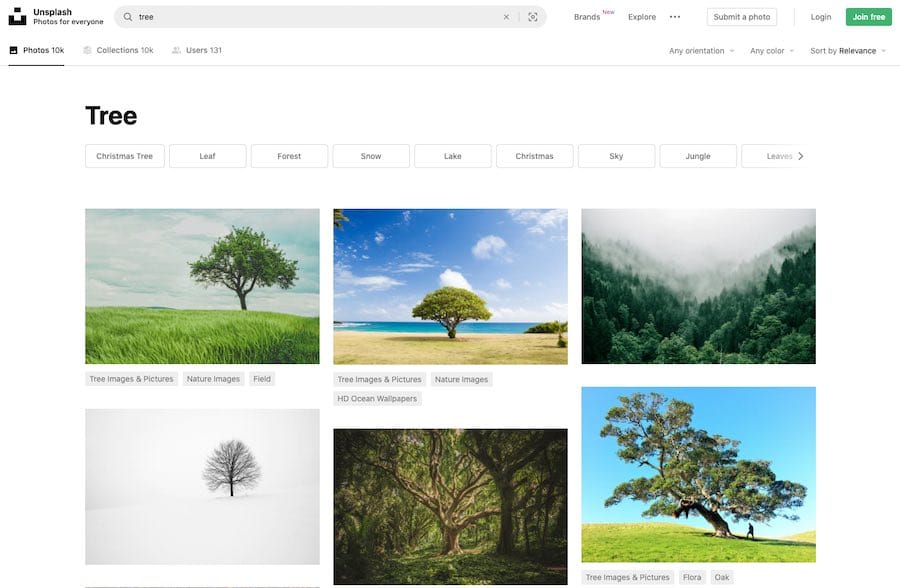
Third, as with text, images can be optimized to help your content appear in search results.
By adding suitable keywords to a picture’s ‘alternative text‘, file name and caption, you can help search engines gain a better understanding of what your post is about (which in turn can help your post appear more often in relevant search results).
And finally, good images help to make your content look authoritative. If you use a great piece of photography instead of a cheap-looking piece of clip art in a blog post, that post is far more likely to be taken seriously — or read in the first place — by people who stumble across it.
💡 Key tips on how to add images to your blog posts
When adding images to your blog posts…
- Keep an eye on file size — large picture files can increase page load time, which can in turn affect how search engines treat your content in search. Quick-loading pages are often given priority over slower-loading ones by search engines.
- Only use images that you have the rights to — if you don’t have a license for an image, you can end up getting fined hundreds of dollars for breaching copyright. You can source ‘royalty-free’ imagery from lots of places these days, including design tools like Canva and image libraries like Pexels and Unsplash.
- Use original images if you can, especially if reviewing products on your blog (Google is on record as saying it prefers original images to widely-used ones in that context).
5. Optimize your blog posts for search engines
There is a series of technical steps — collectively known as ‘on-page SEO‘ — that you should take to give your blog posts the best chance of performing well in search.
You should always:
- create blog post titles that reflect your keyword research, and accurately describe what you are writing about
- include keywords in each post’s URL that reflect the content
- use keyword-rich headings (H1, H2, H3, H4 etc.) to break up content
- use keyword-rich alt text and file names for your images.
For a few more tips on this subject, you might like to check out my post on how to make your content more visible in Google search results, or watch the video below.
💡 Tip: remember to optimize your content for real readers too…
- Avoid jargon and complex language — a large proportion of the the people reading your blog posts will be entirely new to the topic you’re discussing, so use plain language wherever possible and explain concepts clearly.
- Use relatively large, easy-to-read fonts on your blog.
6. Capture email addresses on your blog, and promote your posts via enewsletter
Once you’ve attracted visitors to your blog, you should do your best to capture their email addresses.
This allows you to notify visitors via enewsletter about new blog posts — and this can result in significantly more traffic to your posts, along with more social shares.
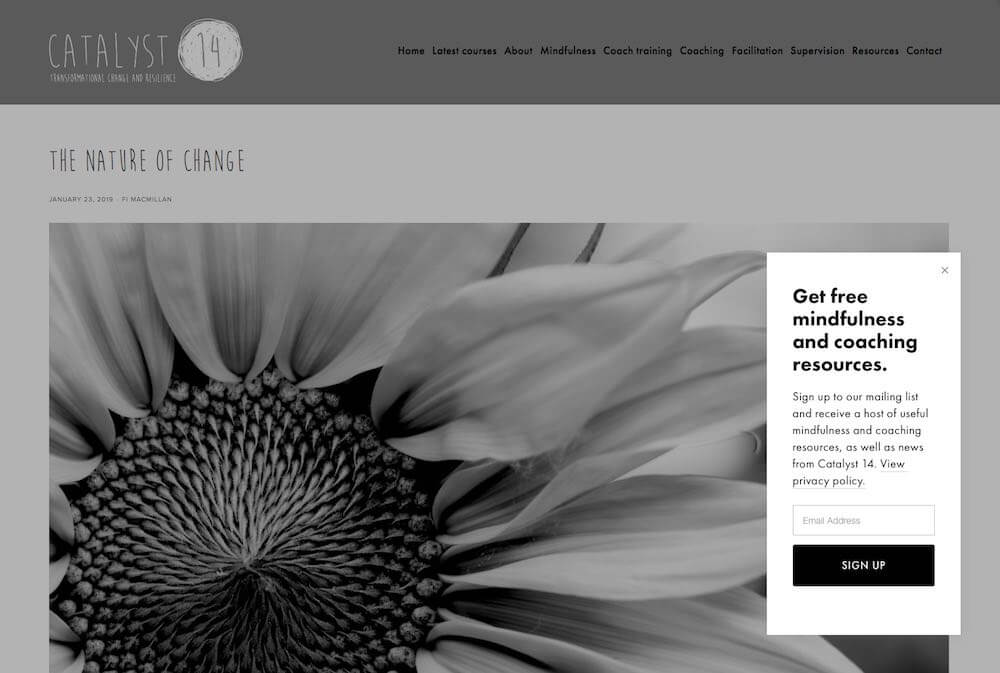
To capture email addresses effectively, you need to ensure that there is a email list sign-up form on every blog post.
You can do this using a sidebar, pop-up box or a simple text call-to-action to encourage people to join your mailing list.
When creating this sign-up form, remember to spell out the benefits of joining the list — the value that your a site visitor will get out of becoming a subscriber.
For example, rather than using a boring ‘join our mailing list’ call to action, highlight the sort of amazing resources a subscriber can expect to receive, the skills they’ll learn etc.
7. Encourage comments and user engagement
Encourage people to add their own views at the bottom of your posts. There are three reasons why this is beneficial:
- It creates more keyword-rich content on your website (content that can be indexed, and ranked, by Google).
- It can help encourage return visits to your blog, as discussions take hold in your comments section.
- Some search engine optimization experts believe that Google treats blog posts which generate a lot of community discussion preferentially to those without any comments.
However, always make sure you moderate these comments carefully — search engines can penalize sites containing spammy comments, user-generated content or links.
💡 Always respond to blog post comments!
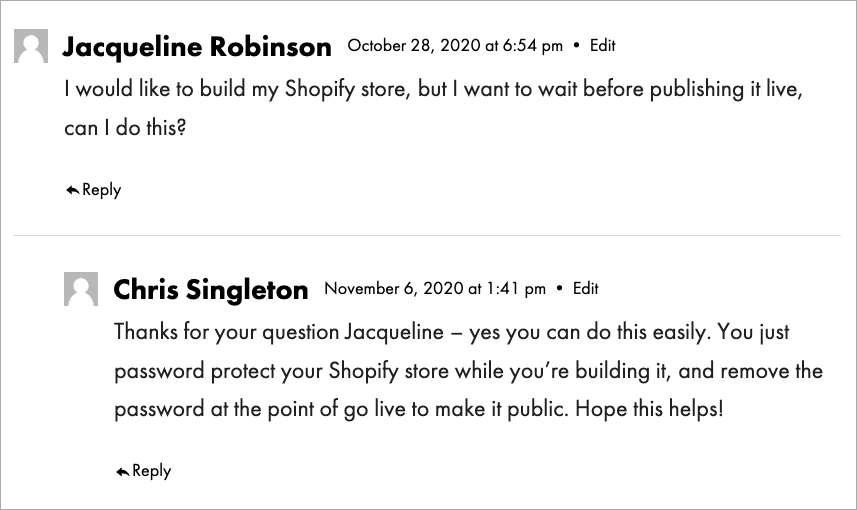
Wherever possible, reply to people who comment or ask questions on about your blog posts. This brings your readers back to your blog (as they’ll usually be notified of your reply), helps you build a relationship with them and generates more keyword-rich content on your site.
In the image below you’ll find an exchange I had with one of my readers recently.
8. Encourage social sharing
Actively encourage your readers to share your blog posts — be explicit with your requests for people to post your content on their preferred social networks.

If your readers follow these encouragements, not only should you see a rise in traffic to your posts, but you may also be sending subtle ‘signals’ to search engines regarding the popularity and quality of your posts.
(The jury is out on whether social sharing has a direct impact on search results, but there does seem to be a correlation of sorts).
9. Build quality backlinks to your posts
Fundamentally there are two key ingredients to ensuring a blog post ranks in search:
First, your post has to contain quality content.
Second, it has to have a decent number of quality backlinks — links from other reputable websites — pointing to it.
We’ve covered the ‘quality content’ bit earlier — you need to focus on producing long-form posts that cover the topic you’re writing about clearly, and in considerable depth.
Getting backlinks is usually a much harder task, because it involves reaching out to lots of bloggers and website owners, asking them to include a link to your content on their posts, or letting you publish guest posts.
(It’s like an online PR campaign of sorts.)
This sort of outreach is a time consuming affair, but it’s important, and if you take a thorough approach to it, it can prove very fruitful.
Another option with regard to backlink generation is to hire an agency to do perform link building on your behalf — but you have to be careful here, as hiring an agency or consultant who then goes onto place (or worse, buy) links on low-quality sites can often do more harm than good.
When building links,
- focus on websites that have a good reputation (you can use the ‘domain authority scores’ provided by SEO tools like Ahrefs, Moz and Semrush to find out which ones do or don’t)
- only build them on topically relevant sites
- always ensure that the links you’re building make sense in context (for example, if you’re building a link to a site about shoes, don’t build links on posts about ice cream).
10. Create internal links to your posts
If you have an existing blog post that has a lot of backlinks pointing to it, you can leverage the power of these by creating links on it pointing to other posts on your site. Internal links pass some of a page’s ‘link juice’ onto other pieces of content, and can help them climb up the search rankings.
It’s important however to make sure that any internal links you add are topically relevant (as with my backlink building example above, don’t link internally to a post about shoes from a post about ice cream), and that you don’t overdo it in terms of quantity. Having too many internal links on a page can send negative signals to Google.
11. Keep your content fresh by updating existing blog posts
If you do any research into blogging or SEO, you’ll come across loads of articles that stress how vital it is to create ‘fresh’ content.
And yes, freshness is a ranking signal.
However, I’d caution against interpreting this as an instruction to only produce new posts.
With my own content, I’ve generally found it more useful to focus on quality over quantity — rather than blogging every day just for the sake of it, I invest a lot of my time in keeping my existing content as strong (and as in-depth) as possible.
I do this by continuously reviewing older posts and enhancing them with the most up-to-date information available. This is particularly important when it comes to product reviews — but even ‘evergreen content’ (posts containing facts that don’t change often, if at all) can benefit from being revisited and improved from time to time.
Not only does this send the ‘freshness’ signals to Google that the search engine’s algorithms approve of, but it typically increases the length of posts and helps provide the ‘long-form’ content that often performs better in search results.
That said, there is definitely value in creating new posts periodically — because obviously the more content you have on your site, the more keywords you can theoretically rank for.
But again, only if the content is strong!
12. Repurpose your blog posts for YouTube
Most bloggers focus — understandably — on creating content that ranks highly on Google. It is, after all, the world’s most popular search engine.
However, it’s easy to forget that YouTube is the world’s second biggest search engine, with around 3 billion searches conducted on it each month.
(And these days, it’s arguably a bit easier to get visibility for your content on YouTube than it is on Google).
The great thing about an interesting blog post is that it often can be used as basis for a great video script too; and repurposing your post as a YouTube video can expose a lot more people to your ideas.
And you can of course promote your original blog post — or related ones you’ve written — in your video content or its description.
Similarly, you can promote your YouTube videos on your blog too, by embedding them in relevant posts.
A virtuous circle!
13. Ensure your blog has a great design
The design of your blog can significantly affect how people can access and respond to your content. Even if your blog copy is great, a poor layout, bad font choices or garish colours can send readers running for the hills.
Here are my top tips on how to create a great custom design for your blog:
- Use large, easy-to-ready fonts
- Accompany your posts with attractive and relevant images
- Make use of clear headings and separators
- Use bullet points to break down key information
- Use infographics and icons where appropriate to explain key concepts to readers
- Make your content accessible to visually-impaired reader.
In short, don’t think of your blog just as a piece of text, but as an experience.
14. Build a brand around your blog
In 2023 Google released a search algorithm update — its notorious ‘Helpful Content Update’ — that made it a lot harder for bloggers without brands to get traffic.
Studies show that Google increasingly wants to see evidence of people searching for your brand before it will send a significant chunk of traffic your way.
You can build an online brand in various ways, including:
- appearing on podcasts
- guest blogging
- launching a YouTube channel
- increasing your personal profile through use of social media
- providing access to something that people need to access and search for regularly (i.e news, tools, discussion forums, products etc.)
Good luck with getting more blog traffic, and if you have any questions about the topic, do feel free to leave them in the comments below.
Don’t miss out on our free SEO toolkit
For a limited time only we’re offering our readers some excellent free SEO tools and resources. Sign up now to immediately receive:
- our downloadable cheatsheet containing the 20 key steps to ranking highly in search results
- extended free trials and discounts for leading SEO tools
- our downloadable cheatsheet on how to grow organic traffic to a blog
- 2 in-depth guides to SEO
- ongoing free tips and advice on SEO and growing your business
Related reading on blogging and SEO
You may find some of these other posts about website traffic generation and blogging helpful:
Keyword research resources
We also have some detailed review and comparisons of keyword research tools available:

Comments (21)