

We have an honest review policy, but this page contains affiliate links. If you buy through these, we may earn a commission. This helps fund our research at no cost to you.

In this Gelato review, I explore the main pros and cons of this popular print-on-demand platform and help you work out whether it’s the right fit for your ecommerce business.
Quick verdict on Gelato
Of all the print-on-demand platforms I’ve tested, Gelato stands out as one of the easiest to use. It combines an intuitive interface with strong personalization features, excellent international fulfillment capabilities and a sustainability-focused approach that doesn’t appear to come at the expense of competitive pricing.
There are some drawbacks to consider, however. Gelato’s product catalog is not quite as large as those offered by some rivals, it provides fewer ecommerce integrations than market leaders like Printful, and sellers looking for maximum control over fulfillment partners may find its automated production model a little restrictive.
But overall, for merchants looking for a user-friendly print-on-demand platform that can scale internationally while keeping fulfillment local, Gelato is an excellent choice.
| Key Pros | Key Cons |
| ✅ Gelato is one of the easiest print-on-demand platforms to use | ❌ Its product catalog is smaller than those of some rivals |
| ✅ Excellent product personalization features | ❌ Provides fewer ecommerce integrations than some competing POD services |
| ✅ Strong sustainability credentials and transparent reporting | ❌ No built-in storefront for selling products directly |
| ✅ Local fulfillment doesn’t come at a pricing premium | ❌ Less control over fulfillment partners than some alternatives |
| ✅ Excellent visibility into costs and margins | ❌ No dedicated recurring sample-order program |
| ✅ Free plan available, with a 14-day premium trial | ❌ Some rival POD services provide greater embroidery flexibility |
Our overall rating
4.3 out of 5 | ⭐⭐⭐⭐
I’ll start my full comparison with a quick look at Gelato’s background.
What is Gelato?
Founded in Norway in 2007 and headquartered in Oslo, Gelato is one of the world’s largest print-on-demand (POD) platforms. It enables entrepreneurs, artists and ecommerce merchants to sell customized products online without having to purchase inventory, manage production facilities or handle shipping logistics themselves.
Like other POD services, Gelato lets users create products featuring their own designs and sell them through online stores and marketplaces. When an order is placed, Gelato automatically routes it to one of its production partners for printing, packing and delivery.
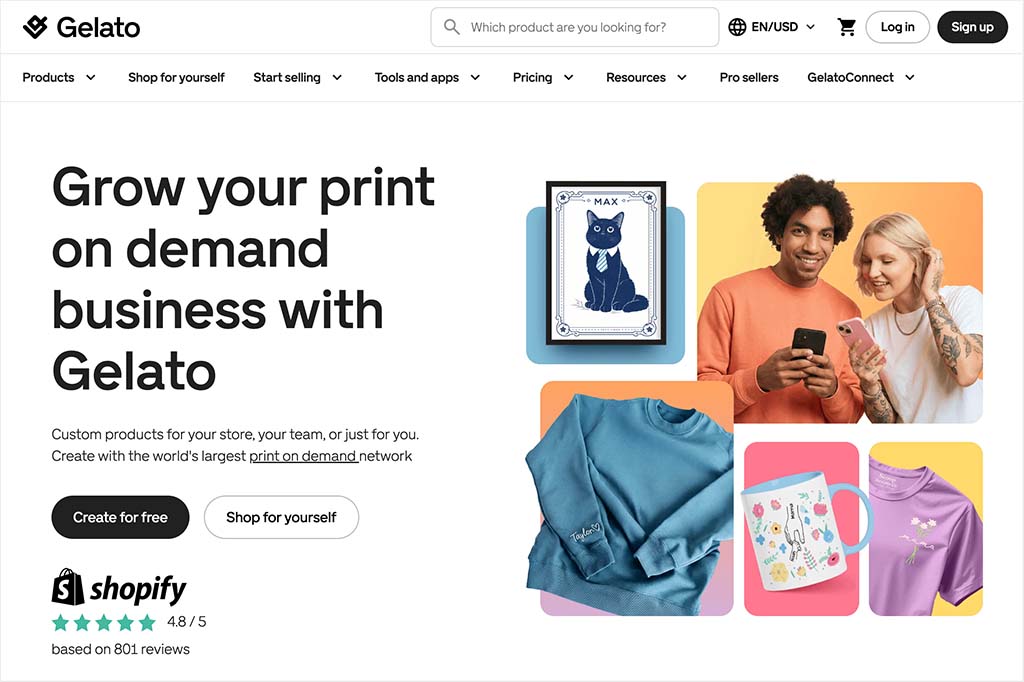
What sets Gelato apart from many competing print-on-demand platforms is its emphasis on local production.
Rather than manufacturing products in a small number of centralized facilities and shipping them around the world, Gelato aims to produce orders as close to the end customer as possible. To achieve this, the company works with a network of more than 140 production partners across 30+ countries, helping merchants reduce shipping distances and delivery times while supporting more localized fulfillment.
Today, Gelato is used by more than 10,000 active sellers and offers a catalog of approximately 400+ customizable products spanning apparel, wall art, drinkware, stationery, accessories and more. The platform integrates with leading ecommerce solutions including Shopify, Etsy, WooCommerce, Wix, Squarespace and BigCommerce.
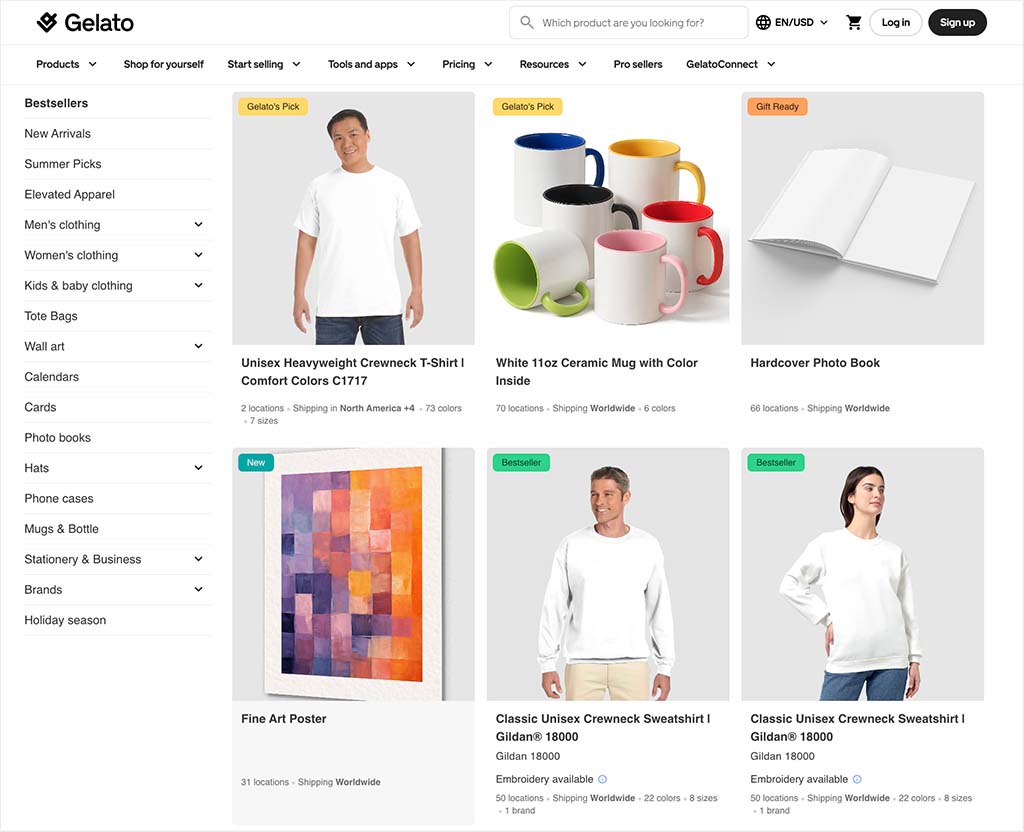
In what follows, I’ll take a balanced look at Gelato’s strengths and weaknesses. I’ll start by discussing the things the platform does particularly well, before moving on to the areas where some competing print-on-demand services offer more compelling features.
Let’s kick things off with Gelato’s main advantages.
Advantages of using Gelato
1. Gelato is one of the easiest print-on-demand platforms to use
Of all the POD solutions I’ve tested, Gelato is one of the easiest to use.
It features a clean, uncluttered interface that is easy to navigate, even for beginners. Its product designer comes with hundreds of built-in fonts, supports custom font uploads and includes a wide range of useful text styling options and effects. It also supports all the major file formats most merchants are likely to work with, including JPG, PNG, SVG, HEIC and PDF files.
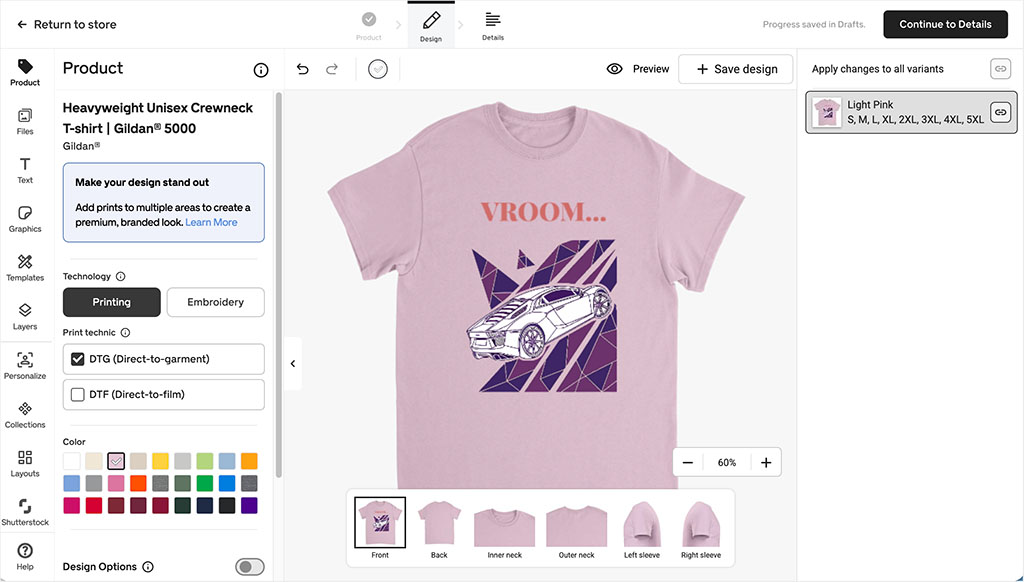
Another thing that makes using Gelato particularly straightfoward is the fact that — unlike key rival Printify — you don’t have to choose your own suppliers. Gelato handles this for you, and this saves you a lot of time, because you don’t have to compare a host of suppliers, fulfillment locations, shipping rates and production costs before publishing products to your store.
That said, when it comes to POD, there is always some evaluation to be done. And Gelato excels here, making it really easy to research products and understand fulfillment costs before you start selling — its product listings are among the most informative and well laid-out I’ve encountered in the print-on-demand market. They provide a wealth of information that helps merchants make better decisions about product selection and pricing — but without things ever feeling overwhelming (as they can do, for example, in Printify).
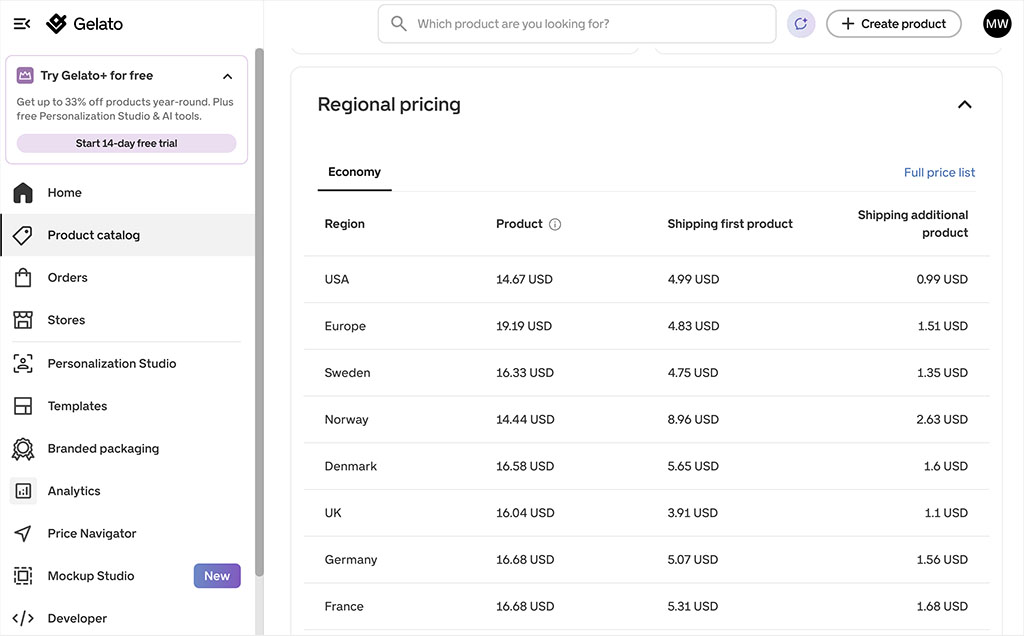
For example, every product listing includes detailed regional pricing information, showing not only product costs but also shipping fees and the cost of shipping additional items to different markets around the world. Merchants can also see exactly where a product can be produced, with Gelato clearly highlighting the countries and regions in which local fulfillment is available.
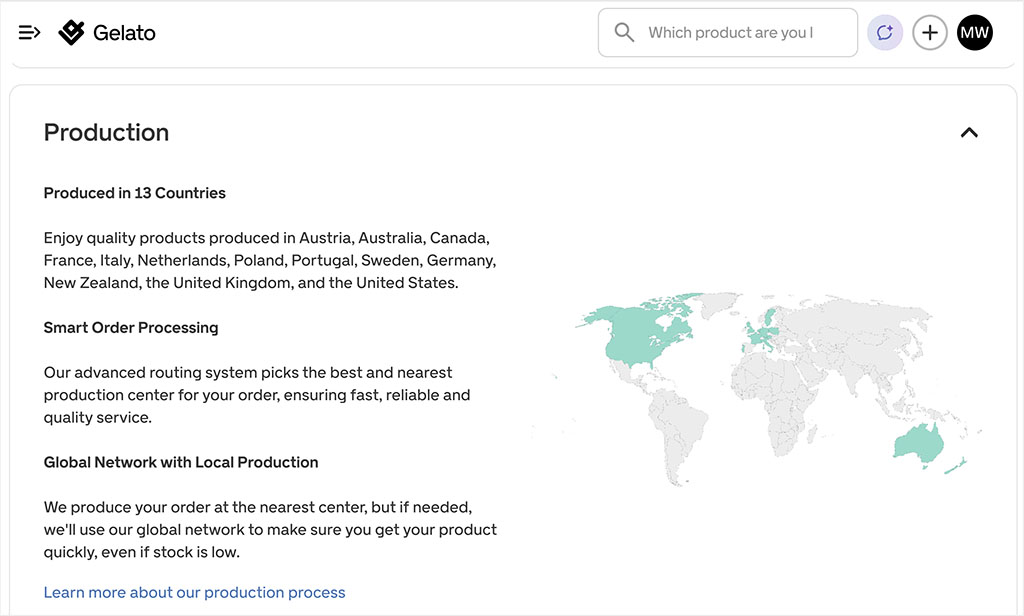
This is particularly useful for sellers targeting international markets, because it makes it much easier to assess profitability, shipping costs and fulfillment options before committing to a product.
In addition, product listings include information on production locations, stock availability, size guides, print specifications, artwork requirements, print area diagrams and care instructions. I particularly like the way that Gelato surfaces much of this information directly within its catalog listings — this reduces the need to jump between product pages, help documentation and pricing calculators.
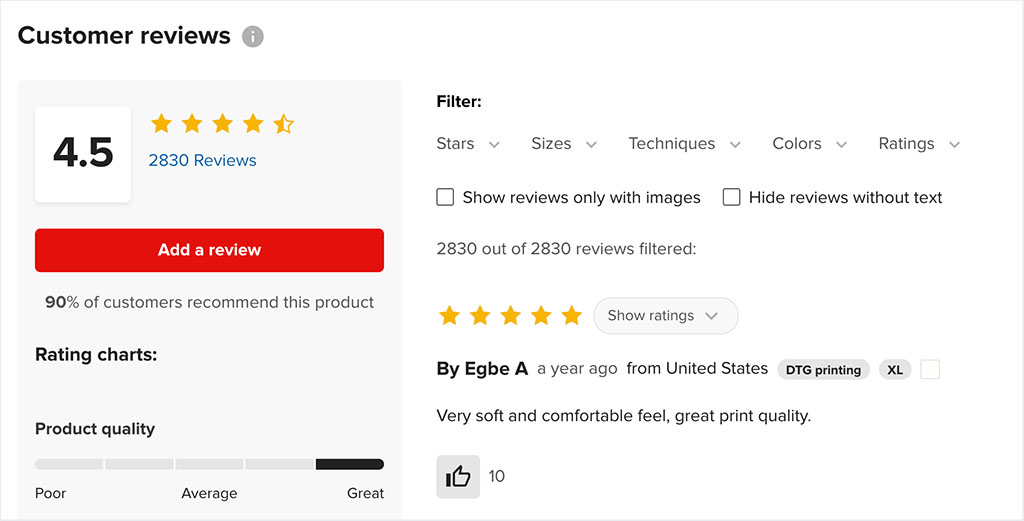
The only significant piece of information I felt was missing from Gelato’s product information was user feedback. Some rival print-on-demand services give you access to product reviews and ratings from merchants — these can provide useful insights into product quality, print consistency and customer satisfaction. Adding similar data would make Gelato’s already excellent product information even more useful.
2. Its product personalization features are excellent
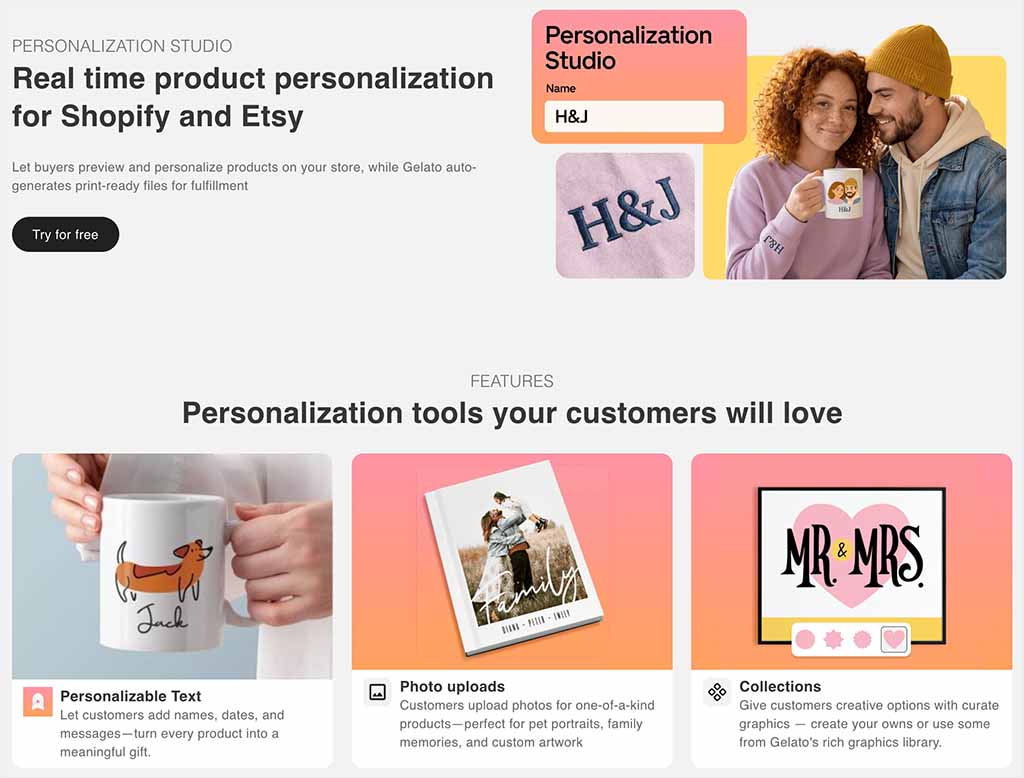
Gelato is a particularly good solution for merchants who want to let their customers customize their products (by adding their own photos or text to designs).
This is thanks to its built-in “Personalization Studio.” Available for Shopify and Etsy users, it’s one of the best personalization systems I’ve come across in a print-on-demand platform.
When creating a product to sell, you simply choose which elements of your design you want customers to be able to personalize. You can then specify whether shoppers can edit text, upload their own images, or both. The whole process is intuitive and can be completed in just a few clicks.
(It’s worth noting that several competing solutions require you to deal with complex setup processes or third-party tools to facilitate this sort of product personalization.)
Gelato’s support for “layers“, “collections” and “conditions” when selling personalized items adds a huge degree of flexibility too.
Layers let you decide exactly which parts of a design can be customized.
Collections are pre-defined items that users can use in their design — for example, illustrations, backgrounds, colors or graphic styles.
Conditions are smart ‘if/then’ rules that can be used to show customers different options depending on their previous choices. For example, if your customer opted for a black shirt, conditions could be used to ensure that the rest of the design elements they could add were light in color.
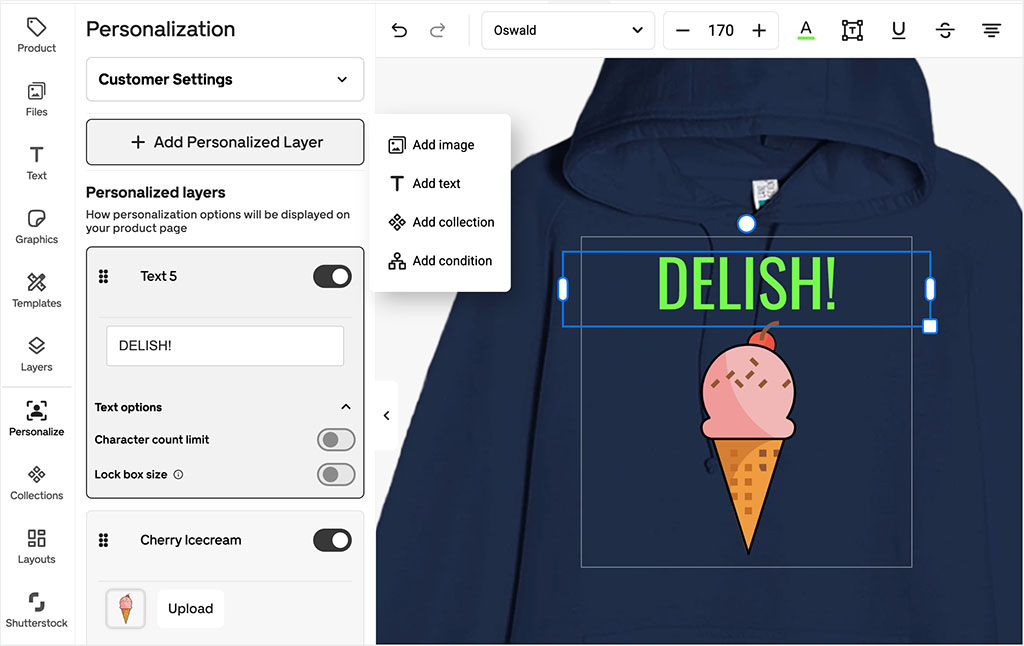
Overall, Gelato strikes an excellent balance between ease of use and functionality here. Yes, some dedicated personalization platforms offer more advanced customization options, but Gelato’s built-in feature makes everything considerably easier to set up and manage — while still offering a large degree of design flexibility to the customer.
3. The product quality is good
For the purposes of this review, I placed a selection of sample orders with Gelato — I personalized and bought some t-shirts, a framed print, and a phone case for an iPhone 15 Pro. In all cases the delivery was prompt and the product quality was good. I was especially impressed with the framed print — the print quality for this was excellent, and the image I used in the design looked really vibrant in the frame provided (see my photo below).

The phone case was the only item where I felt there was a bit of room for improvement. As with the other items I ordered, the print quality was very good, but there were two white stripes at the top and bottom of the case that were not present in the design I’d created in the Gelato dashboard. I also felt that that case was a bit tight against my phone (it was hard to get the phone out of my case once I’d inserted it), and it didn’t support magsafe.

I contacted Gelato’s support team about this problem and they were very quick to send out a replacement — this addressed the printing issue, but not the case’s other deficiencies.
📚 Related resource: How to sell art online
4. It’s a great choice for sustainability-conscious sellers
As a result of growing consumer focus on environmental issues and the rising scrutiny being placed on retail supply chains, sustainability is becoming an increasingly important consideration for ecommerce merchants. And one of the advantages of the print-on-demand model is that products are only manufactured after they have been ordered, helping to reduce the waste generated by traditional, inventory-based retail models.
Gelato takes this concept a step further, however. Rather than manufacturing products in a small number of centralized locations and shipping them around the world, the company aims to produce orders as close to the end customer as possible. It does this via via its extensive network of 60+ logistics partners.
This helps reduce transportation distances, shorten delivery routes and lower the environmental impact associated with shipping.
According to Gelato’s latest sustainability report, 88% of its orders are fulfilled in the same country as the customer, while 99% are fulfilled within the same region. These figures are made possible by the company’s network of more than 140 production hubs spread across 30+ countries.

The benefits of this model are not purely environmental. Because Gelato can often manufacture products in or near the customer’s market, merchants may also benefit from faster delivery times, fewer cross-border shipping complications and reduced exposure to import duties or tariff-related costs when selling internationally.
This is particularly relevant for POD sellers shipping to the US, where apparel and textile imports can attract significant duty rates depending on product type, fiber content and country of origin.
For merchants looking to reduce the environmental footprint of their ecommerce operations, this localized fulfillment model is one of Gelato’s most compelling features.
As you can see from my table below, Gelato’s local-production footprint is particularly strong in North America, the UK, and several major ecommerce markets:
| Region | Gelato production hub coverage |
| US & Canada | 39 production hubs |
| United Kingdom | 17 production hubs |
| Australia & New Zealand | 10 production hubs |
| Germany | 8 production hubs |
| Additional European countries | Local production in 16 further countries, including Austria, Belgium, Czech Republic, Denmark, France, Ireland, Italy, Netherlands, Norway, Poland, Portugal, Spain, Sweden, Switzerland and turkey. |
| Asia | 6 production hubs |
I also particularly like the transparency with which Gelato reports its sustainability figures.
While many print-on-demand companies make broad sustainability claims, relatively few publish detailed data showing how their fulfillment networks actually operate. Gelato provides concrete information about its production practices, supply chain standards and fulfillment network — making it easier for merchants to assess the environmental impact of using the platform.
(This emphasis on transparency may partly reflect Gelato’s Norwegian roots. As an Oslo-headquartered company, it is subject to the Norwegian Transparency Act, legislation that requires larger businesses to conduct due diligence on human rights and working conditions within their supply chains, and to provide information about these efforts when requested.)
To be fair, Gelato is not the only major print-on-demand provider taking sustainability reporting seriously — Printful also publishes detailed environmental and social impact reports.
However, Gelato’s combination of local production, transparent reporting, strong coverage in major ecommerce markets and measurable localized fulfillment data makes it a particularly attractive option to sellers who want to run a more environmentally conscious — and operationally efficient — ecommerce business.
5. Gelato’s local fulfillment approach doesn’t come at a premium
One of the most interesting things about Gelato is that its sustainability-focused approach doesn’t appear to come at the expense of competitive pricing.
Given the company’s emphasis on local production and fulfillment, it would be reasonable to assume that its products might cost noticeably more than those offered by competing print-on-demand platforms. However, my research into pricing suggests this isn’t really the case.
To see how Gelato compared to its biggest rivals from a pricing perspective, I looked at a selection of popular POD products, including apparel and wall art, for orders produced and delivered within the United States. The results are shown in the table below:
| Product | Gelato | Printful | Printify |
| Gildan 5000 t-shirt | $9.59 + $4.99 shipping ($14.58) | $9.25 + $4.75 shipping ($14.00) | $9.50 + $3.99 shipping ($13.49) |
| Bella + Canvas 3001 t-shirt | $10.69 + $4.99 shipping ($15.68) | $11.69 + $4.75 shipping ($16.44) | $11.29 + $3.99 shipping ($15.28) |
| Gildan 18500 hoodie | $21.59 + $7.39 shipping ($28.98) | $22.19 + $8.49 shipping ($30.68) | $21.58 + $7.39 shipping ($28.97) |
| Gildan 18000 sweatshirt | $16.47 + $7.39 shipping ($23.86) | $18.79 + $8.49 shipping ($27.28) | $17.97 + $7.39 shipping ($25.36) |
| Rabbit Skins 3301T kids t-shirt | $13.21 + $4.99 shipping ($18.20) | $12.75 + $4.49 shipping ($17.24) | $10.05 + $3.99 shipping ($14.04) |
| Yupoong 1501KC cuffed beanie | $12.56 + $3.99 shipping ($16.55) | $12.79 + $4.49 shipping ($17.28) | $12.79 + $4.99 shipping ($17.78) |
| Canvas print (8”x8”) | $12.95 + $11.09 | $16.27 + $6.49 | $19.00 + $9.19 |
| Matte poster (8”x10”) | $4.89 + $4.90 ($9.79) | $6.89 + $4.99 ($11.88) | $4.95 + $5.19 ($10.14) |
| Matte Paper Wooden Framed Poster (11”x14”) | $35.51 + $13.90 ($49.41) | $32.13 + $10.49 ($42.62) | $32.46 + $10.34 ($42.80) |
Despite their very different fulfillment models, there was surprisingly little variation in the overall costs.
Gelato was the cheapest option in three of the nine comparisons, came a very close second in four others, and was only substantially outperformed once. Notably, it offered the lowest overall cost for both the Gildan 18000 sweatshirt, the Yupoong 1501KC cuffed beanie, and the matte poster, while narrowly missing out to Printify on products such as the Gildan 18500 hoodie by just a single cent.
What surprised me most, however, was how rarely Gelato was the most expensive option. Despite operating one of the largest localized production networks in the print-on-demand industry, its pricing was generally comparable to that of both Printful and Printify. In some cases, it was actually the cheapest provider in my tests.
For sellers concerned that sustainability and local production might come at the expense of competitive pricing, that’s reassuring. Based on my tests, Gelato delivers a strong balance between affordability, fulfillment efficiency and environmental considerations.
Gelato shipping times
Pricing is only part of the fulfillment equation — shipping is, of course, key too. And in my testing, Gelato performed well when it came to estimated delivery times. For example, when I ordered a Bella + Canvas 3001 t-shirt for delivery within the United States, Gelato typically quoted a delivery window of 4–6 business days, compared to 4–8 days for Printify and 7–9 days for Printful.
I got similar results when testing shipping for wall art products. A Gelato canvas print was estimated to arrive to a US address within 5–6 business days, which compared positively to Printful’s 5–8 days. (Printify looked to provide a quicker option that either in this particular case, however, giving an estimated delivery window of 2–5 days.)
While its delivery estimates ultimately depend on product and destination, Gelato’s extensive local production network appears to give it a genuine advantage when it comes to fulfillment speed.
6. Gelato provides excellent visibility into costs and margins
While many print-on-demand services provide basic information for calculating margins, Gelato helps you understand the true financial implications of your selling decisions.
This starts in the product catalog itself. As I discussed earlier, Gelato’s product listings provide detailed regional pricing information, including product costs, shipping fees and the cost of shipping additional items.
This makes it much easier to evaluate whether a product is likely to be profitable in different markets before adding it to your store.
For merchants looking for even more insight, Gelato provides a dedicated “Price Navigator” tool on its paid plans. This lets users explore product costs, shipping fees and estimated margins across different countries and currencies, and helps them understand how profitability can vary between markets.
This can be particularly useful for international sellers. For example, an Etsy shop owner selling personalized wall art can quickly compare the profitability of selling to customers in the United States, Australia and the UK, taking local fulfillment and shipping costs into account. Likewise, a Shopify merchant selling globally can identify markets where margins are strongest and adjust pricing strategies accordingly.
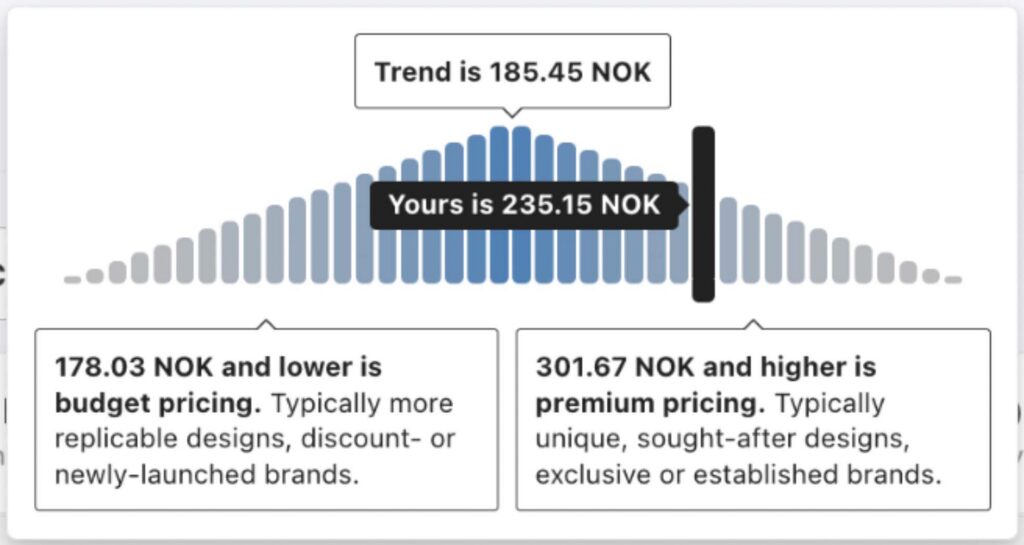
I was also impressed by Price Navigator’s bulk-editing capabilities. Rather than having to update products individually, merchants can apply pricing changes across entire product ranges in just a few clicks.
Other useful features include a pricing history tool that keeps track of previous pricing adjustments, helping merchants understand how their pricing strategy has evolved over time. There’s also a “Price Guide” feature that provides pricing recommendations, customizable profit calculations that factor in costs such as shipping, and a Shopify-specific ‘compare-at pricing’ tool that makes it easy to create sale prices and promotional offers across multiple products.
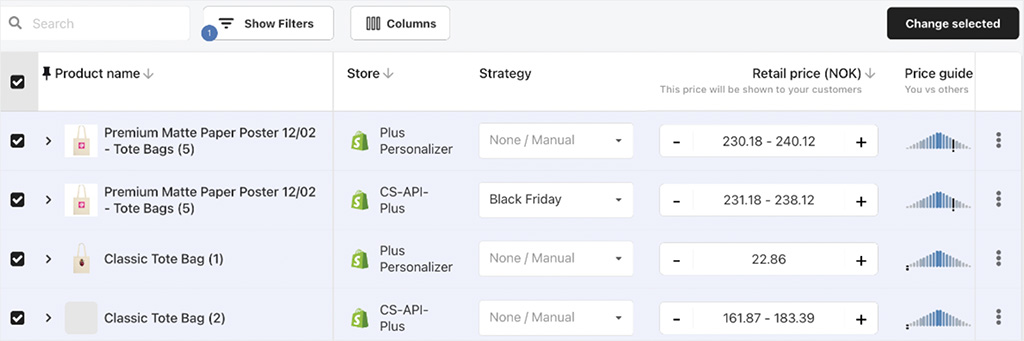
What I particularly like about all these tools is that they become increasingly valuable as a business grows. While it’s relatively easy to price a handful of products manually, managing margins across hundreds or thousands of products sold in multiple countries is much more challenging. By providing clear visibility into costs, shipping fees and profitability throughout the platform — and letting you bulk update prices easily — Gelato makes inventory management and pricing strategy much easier.
7. You can use Gelato for free (and try its premium features via a 14-day free trial)
Like many print-on-demand platforms, Gelato offers a free plan that lets merchants create and sell products without paying a monthly subscription fee.
Unlike some competing services, however, it also provides a 14-day free trial of its premium features, giving users the opportunity to test its more advanced functionality before committing to a paid plan.
For many sellers, Gelato’s free plan will be perfectly adequate when starting out. It provides access to Gelato’s global production network, integrations with major ecommerce platforms, product design tools and the ability to sell an unlimited number of products. This makes it possible to launch a store and begin generating sales without any upfront subscription costs.
As a business grows, however, Gelato’s paid plans become increasingly attractive. The premium version of the platform, “Gelato+” costs $29 per month, or $19.99 per month when billed annually; this unlocks product discounts of up to 33%, access to the Personalization Studio, branded labels and packaging inserts, premium mockups, larger design libraries and a range of additional design and business tools.
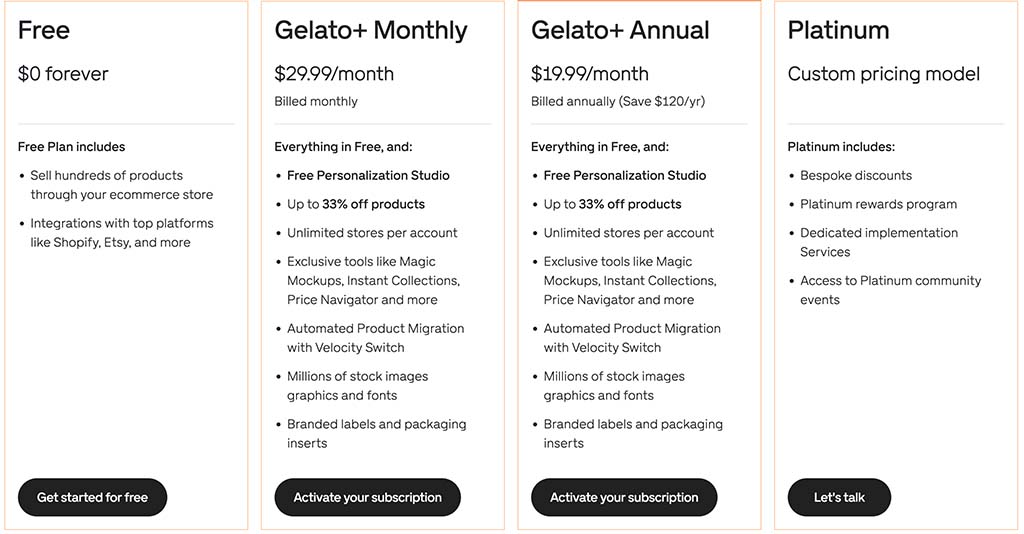
What I particularly like about Gelato+ is that many of its benefits can have a direct impact on profitability. For example, the product discounts alone could potentially offset the cost of the subscription for merchants generating a reasonable volume of sales each month. And access to tools such as Personalization Studio and Price Navigator can help sellers increase margins and unlock additional revenue opportunities.
Gelato+ also compares favorably with the premium plans offered by some competing POD services. Printful’s comparable “Growth” plan costs $24.99 per month, while Printify’s “Premium” plan costs $39 per month. Gelato is also one of the few major print-on-demand platforms to offer a free trial of its premium tier, and this makes it easier to evaluate whether the upgrade is worthwhile before paying for it.
So those are the key reasons to use Gelato as your print-on-demand supplier. But where does it fall short?
Well, let’s take a look at the disadvantages of using Gelato.
Get a host of excellent free resources now

For a limited time, we’re offering Style Factory readers some excellent free tools. Sign up below and immediately receive:
- our online store comparison chart
- extended free trials and discount codes for essential business apps
- a downloadable cheatsheet on how to create an online store
- our SEO, blogging and ‘how to start a business’ cheatsheets
- our latest newsletters on ecommerce and growing a business
Disadvantages of using Gelato
1. Its product catalog is smaller than those of some rivals
Gelato’s product catalog will be perfectly adequate for most merchants. The platform caters to all the major print-on-demand categories, including apparel, wall art, drinkware, accessories, stationery, photo books, and home decor.
However, compared to some competing POD platforms, Gelato’s catalog is relatively modest in size. At the time of writing, the platform’s product catalog contains around 400 products; a smaller number than Printful’s 500 or Printify’s 1,300.

This smaller catalog size becomes more apparent when you look at individual product categories (see my comparison table below):
| Gelato | Printify | Printful | |
| T-shirts | 82 items | 200+ | 70+ |
| Hoodies | 45 items | 77 items | 47 items |
| Wall art | 34 items | 44 items | 14 items |
| Hats | 46 items | 60 items | 47 items |
| Drinkware | 10 items | 104 items | 22 items |
*Note — The figures above are based on my own manual count at the time of testing and may change as Gelato continues expanding its catalog.
In addition to offering more products overall, better-stocked competitors also provide a wider variety of product types.
On competing platforms, you’ll find products that are simply not available from Gelato — such as stickers, magnets, blankets, bedding, mousepads, keyrings, umbrellas and pins.
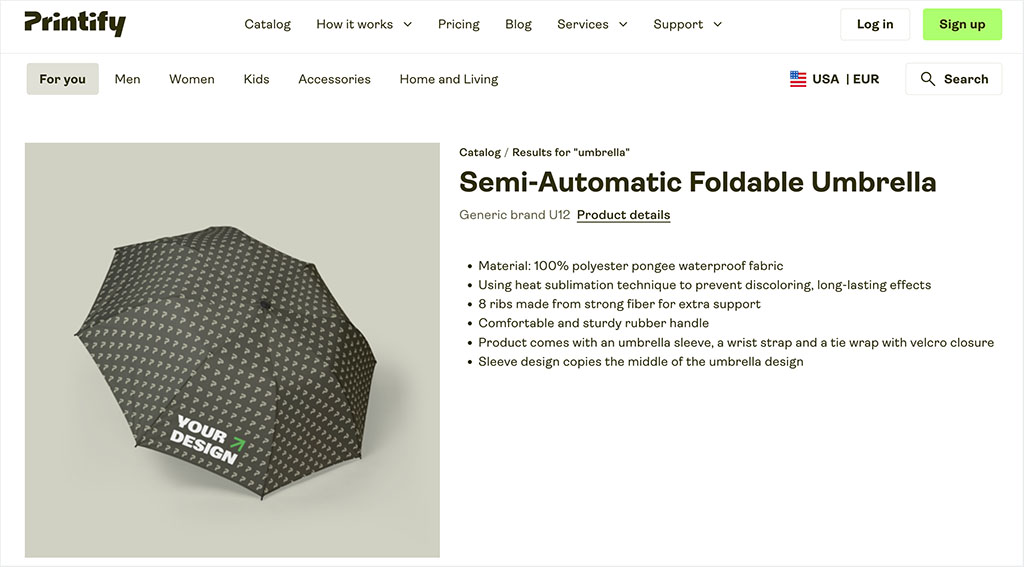
Interestingly, Gelato’s catalog size may be one of the reasons the platform feels easier to navigate than some competing POD services.
But merchants who want access to the widest possible range of products — or who enjoy testing new product categories regularly — will enjoy more flexibility elsewhere.
2. It integrates with fewer ecommerce platforms than some of its competitors
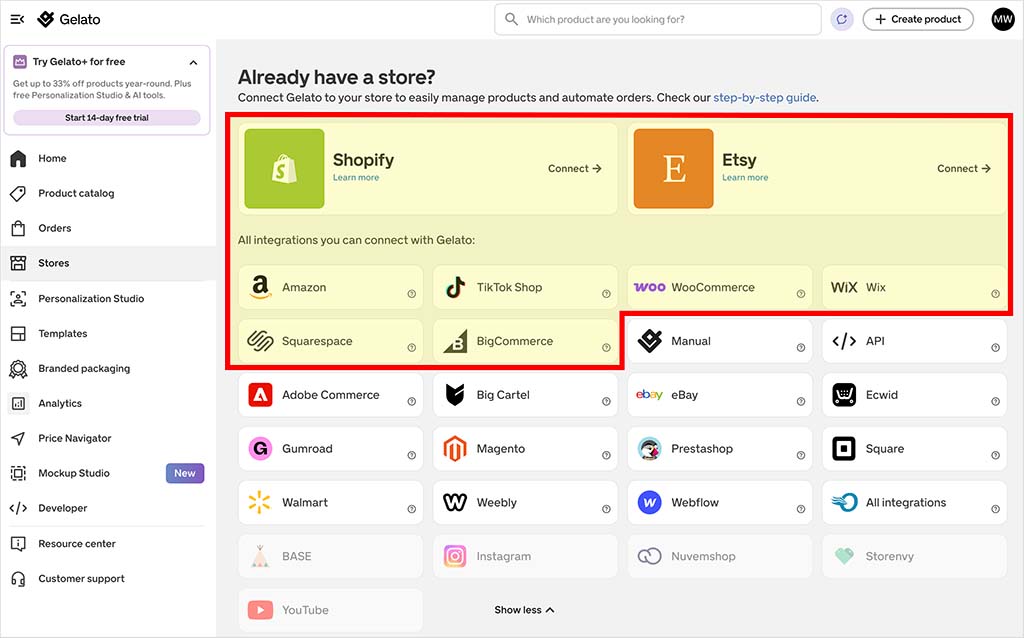
Gelato supports integrations with most of the ecommerce platforms that the majority of merchants are likely to use. At the time of writing, it offers built-in integrations with:
- Shopify
- Etsy
- WooCommerce
- TikTok Shop (US and UK)
- Amazon (beta)
- Wix
- Squarespace
- BigCommerce.
Merchants can also connect custom stores via Gelato’s API, or submit POD orders manually through its dashboard.
For many sellers, Gelato’s integration options will be more than sufficient, especially since Shopify and Etsy — arguably the two most important sales channels in the print-on-demand market — are catered for. A large proportion of Gelato’s target audience will probably never encounter any integration-related limitations.
But that said, compared to competing POD services, Gelato’s native integration offering is relatively limited. It currently provides eight built-in integrations, compared to around 11 for Printify and more than 20 for Printful. This means merchants using less mainstream ecommerce platforms have fewer options available to them.
To its credit, however, Gelato does offer a workaround via the Order Desk automation platform. This extends compatibility to a range of additional ecommerce solutions and marketplaces, bringing the total number of supported integrations to around 17.
The downside here is that Order Desk is not a free solution. In addition to requiring you to pay for a subscription, it charges transaction fees of around $0.25 per order.
3. You can’t build a standalone online store with Gelato
To start selling with Gelato, you need to connect it to an ecommerce platform such as Shopify, WooCommerce, Wix, or Squarespace, or sell through a supported marketplace (for example, Etsy).
By contrast, some competing POD platforms provide a much lower-friction route into online selling. Both Printify and Printful now offer free hosted storefronts — a “Pop-Up Store” and “Quick Store” respectively — that allow users to start selling POD products without the need for an external ecommerce platform.
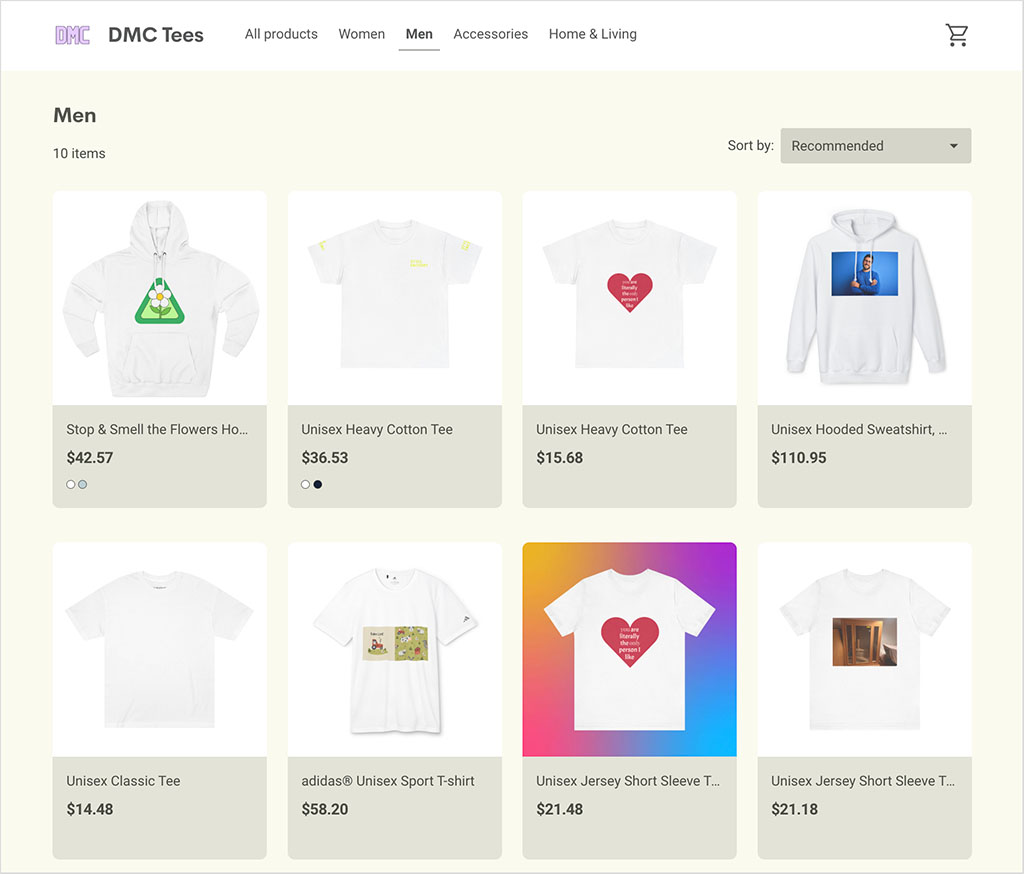
To be fair, these storefronts are relatively basic and shouldn’t be viewed as substitutes for a professional ecommerce website built with a platform like Shopify or WooCommerce. The design options available in these tools are limited, and they don’t provide advanced branding, marketing or customization features.
However, these built-in storefronts do give you a useful way to test product ideas, validate demand or begin selling designs online, without paying for a separate ecommerce platform.
Personally, I’d like to see Gelato add a simple hosted storefront option in the future. While most established sellers would likely outgrow it fairly quickly, it would provide a useful entry point for beginners who want to start experimenting with print-on-demand before investing in a full ecommerce setup.
Note: there is a feature called “Custom Store” in Gelato. This is not to be confused with an online storefront — rather, it’s a private “sandbox” for testing your product designs before pushing them live to customers (using a separate ecommerce platform).
4. You have less control over fulfillment partners than on some rival platforms
One of Gelato’s key selling points is its automated fulfillment model. Rather than requiring merchants to choose a specific print provider for each product, Gelato automatically routes orders through its global production network, selecting what it considers the most appropriate fulfillment partner (based on factors such as customer location, production capacity and delivery speed).
For many sellers, this approach will be perfectly adequate — and arguably preferable. It simplifies order management and helps ensure that products are produced as close to the customer as possible, reducing both shipping times and transportation distances. It’s also one of the reasons Gelato feels more streamlined and easier to use than some competing print-on-demand platforms.
However, merchants who like to have complete control over their fulfillment operations may find this approach a little restrictive.
Some competing platforms, like Printify, allow users to choose exactly which production partner should manufacture each product. In practice, this means merchants can compare multiple suppliers offering the same item and select one based on factors like pricing, production location, customer ratings or fulfillment speed.
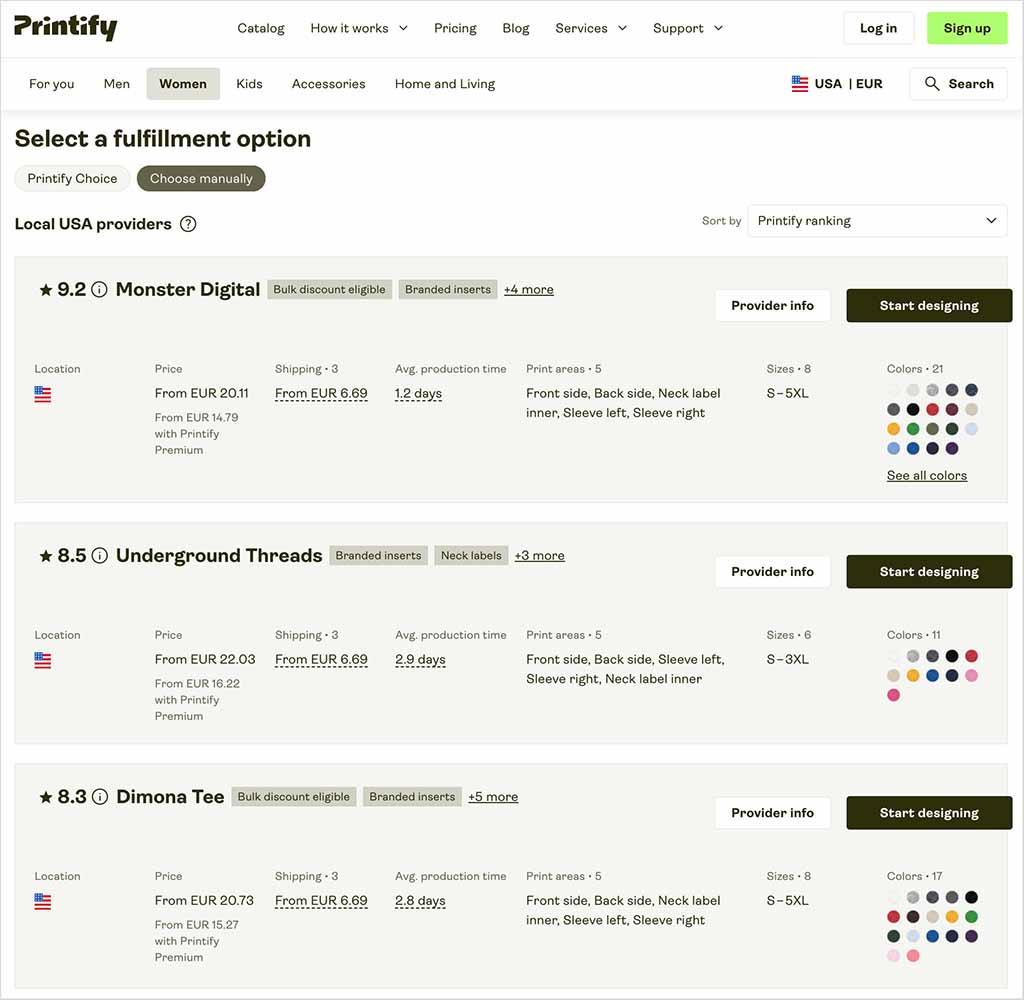
This sort of flexibility can be particularly useful for experienced sellers who like to optimize every aspect of their business.
5. Gelato’s sample-order program is less useful for ongoing product testing
Ordering samples is an important part of running a print-on-demand business. Because a third party is manufacturing and shipping products on your behalf, it’s important to check print quality, product materials and the overall customer experience before making products available for sale.
To Gelato’s credit, it offers one of the more generous introductory sample-order incentives in the print-on-demand market.
New users can typically receive 30% off their first order if it is placed within 48 hours of creating an account — a bigger discount than the 20% sample discounts offered by some competing platforms. Better still, Gelato doesn’t restrict the number of products that can be included in this order, making it possible to test a large number of items at once.
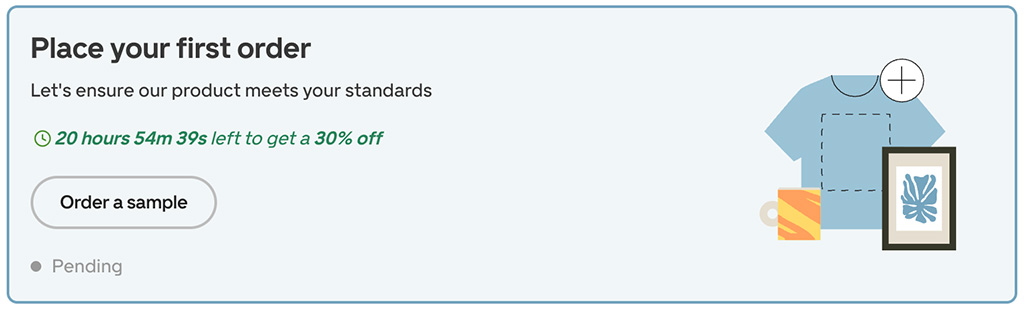
However, I think the value of this approach depends largely on how you build your store. Merchants with a large catalog of designs ready to launch can use Gelato’s generous first-order discount to order a wide range of products in one go. For those sellers, the ability to include as many items as they like in a heavily discounted order is a significant advantage.
But in my experience, print-on-demand stores are often built more gradually. Many merchants start with a handful of products and then slowly expand their catalogs as they create new designs, experiment with new product categories and learn what resonates with customers. In these situations, I’d personally find recurring discounted sample orders more useful than a larger one-off discount at the start.
And I have to add that when placing a test order, I ran into problems with orders containing certain combinations of product types (in my case, a mix of t-shirts and a flask), and this limited the offer’s usefulness. I ended up having to create separate orders for my samples, and could only avail of the 30% discount on my first sample order.
Paid Gelato subscribers can, of course, offset some of these costs through ongoing product discounts of up to 33%. However, merchants who regularly test new products and designs may still find platforms that offer dedicated recurring sample-order programs a little more convenient.
6. Some rival POD services provide greater embroidery flexibility
Embroidery is becoming an increasingly important part of the print-on-demand market. In fact, the global embroidered apparel market is projected to reach $6.1 billion by 2035, driven by growing demand for premium, personalized clothing and accessories.
For many merchants, embroidered products also command higher selling prices than their printed equivalents, particularly when it comes to items such as hats, beanies, sweatshirts and corporate apparel.
The good news is that Gelato’s embroidery offering is generally very solid. The platform supports professional embroidery techniques including satin stitch and tatami stitch, and offers embroidery across a range of apparel and accessories.
It also uses the same digitization approach employed by many leading embroidery providers (the process of converting artwork into a digital “stitch file” that embroidery machines can read).

The main limitation is that Gelato restricts embroidered designs to a maximum of six thread colors (selected from a predefined palette of 15). For many merchants, this won’t be an issue: text-based designs, simple logos and minimalist artwork generally work perfectly well within these constraints.
However, some competing print-on-demand platforms now support embroidery with an unlimited number of thread colors. This makes it easier to print highly detailed artwork, subtle color transitions and designs that rely on gradient effects.
As a result, merchants who plan to make embroidery a major part of their product offering may find greater creative flexibility in other platforms.

User reviews
So far, you’ve heard my take on Gelato. But what do its users think?
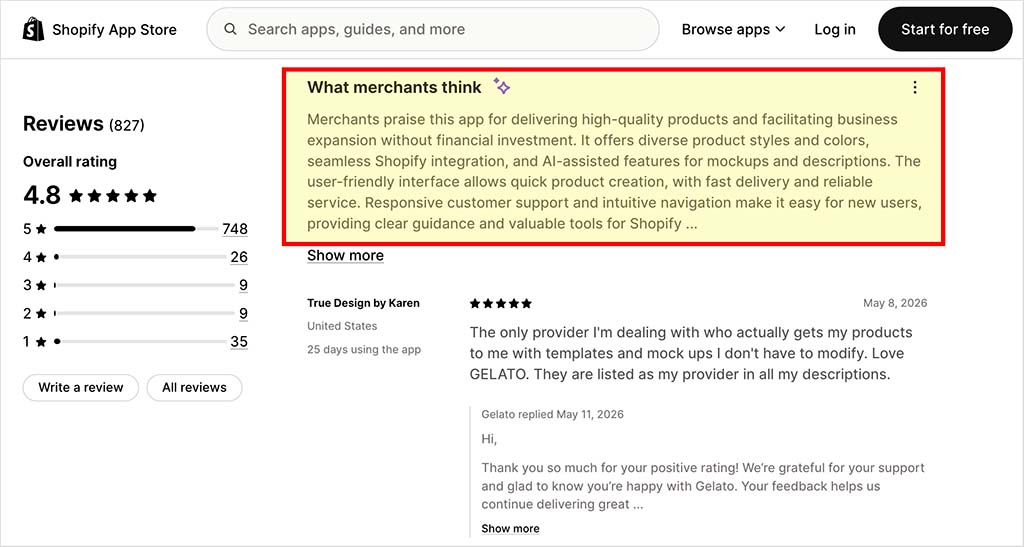
Well, user reviews and ratings for Gelato are generally very positive. As you can see from the data I’ve collated below, the platform scores highly across most major review sites.
| Review platform | Rating | Number of reviews |
| Trustpilot | 4.4/5 | 3,136 |
| G2 | 4.5/5 | 11 |
| Shopify App Store | 4.8/5 | 827 |
| Wix App Market | 2.3/5 | 15 |
| WooCommerce Marketplace | 3.3/5 | 12 |
Looking beyond the scores, several themes emerge consistently in user feedback. Shopify merchants frequently praise Gelato’s ease of use, straightforward product publishing workflow and seamless Shopify integration. Many reviewers also highlight the quality of Gelato’s print products, fast fulfillment times and extensive global production network.
I also checked user perspectives on Reddit. While views of Gelato there tend to be more critical than those found on dedicated review sites, the overall sentiment was still broadly positive. The most common criticisms I encountered related to bulk product management and occasional fulfillment problems; praise focused on print quality, international fulfillment and competitive shipping costs.
Gelato review: the verdict
Gelato is one of the most polished print-on-demand platforms I’ve tested. While it doesn’t offer users the largest product catalog or the widest range of integrations, it excels in several areas that many merchants will arguably find more important: ease of use, international fulfillment, sustainability and business-friendly pricing.
What impressed me most about the platform was how thoughtfully designed it feels. From its informative product listings and straightforward design tools to its personalization features and profitability insights, Gelato does an excellent job of helping merchants make informed decisions without overwhelming them with complexity.
Its local fulfillment network is another major strength, allowing sellers to reduce shipping distances, improve delivery times and potentially avoid some of the costs and complexity associated with cross-border fulfillment — and all without paying a significant pricing premium.
The platform won’t be the perfect fit for everyone, however. Merchants who want access to the widest possible product range, complete control over production partners or dedicated sample-order programs may find some competing services more appealing. And for sellers working heavily with embroidery, there are more sophisticated options available elsewhere.
Overall, though, Gelato strikes an excellent balance between simplicity and capability, and is particularly well-suited to Shopify and Etsy sellers looking for a reliable print-on-demand solution that can be used to scale an ecommerce business internationally. If ease of use, localized fulfillment, transparent business tools and sustainability are high on your priority list, Gelato is definitely worth considering.
If you’d like to try Gelato out for yourself, you can create a free account here. You can also access a 14-day free trial of its premium features below.
Alternatives to Gelato
If Gelato doesn’t quite feel like the right fit for your business, there are plenty of alternative print-on-demand platforms worth considering.
Printful
Printful offers high-quality print-on-demand services and integrates with all the major ecommerce platforms. Compared to Gelato, Printful provides a larger product catalog, more ecommerce integrations, a dedicated sample-order program and greater flexibility for embroidery. It’s a particularly strong choice for merchants who value branding features, supplier consistency, and access to a large range of products.
To learn more about Printful, check out our full Printful review and our Printful vs Printify comparison.
Printify
Printify is another major player in the print-on-demand market. Its biggest advantage over Gelato is the size of its product catalog, which contains more than 1,300 products. Printify also gives merchants direct control over which fulfillment partners manufacture their products, making it a good choice for sellers who want to optimize costs, shipping times or product quality on a product-by-product basis.
For more information about Printify, read our in-depth Printify review.
Spring
Spring (formerly Teespring) is aimed primarily at content creators, influencers and online personalities. The platform integrates directly with services such as YouTube, Twitch, Linktree and OnlyFans, making it particularly attractive to creators who already have an established audience and want a simple way to monetize it through merchandise sales.
To find out more about Spring, see our detailed Spring vs Printful comparison here.
SPOD
If fast fulfillment is your top priority, SPOD is worth considering. The company claims that around 95% of orders are printed and ready for shipping within 48 hours, making it one of the fastest print-on-demand services available. Like Gelato, SPOD focuses heavily on efficient fulfillment, and its production-speed guarantees may appeal to merchants operating in time-sensitive markets.
For a closer look at this platform, check out our SPOD vs Printful comparison.
Canva
Although Canva isn’t a dedicated print-on-demand platform, it can still be an interesting alternative for some merchants. In addition to offering a growing range of printable products, Canva provides one of the most powerful and user-friendly design environments available. Its extensive stock image library, photo-editing tools and design features make it an excellent option for creating artwork that can subsequently be sold through Gelato or other POD services.
To learn more about Canva, do check out our Canva review and Canva Pro vs Free comparison.
Gelato review FAQ
Is Gelato good?
Yes. Gelato is one of the strongest print-on-demand platforms currently available, particularly for merchants who value ease of use, international fulfillment and sustainability. Its product catalog is smaller than those offered by some competitors, but it provides an excellent user experience, strong personalization tools and a highly localized production network.
How much does Gelato cost?
Gelato offers a free plan that lets you create and sell products without paying a monthly subscription fee. Paid plans start at $29 per month, or $19.99 per month when billed annually. These plans include benefits such as product discounts, advanced design tools and access to Gelato’s Personalization Studio.
Does Gelato integrate with Shopify?
Yes. Gelato offers a direct Shopify integration that lets merchants automatically sync products, orders and fulfillment information between the two platforms. Shopify users consistently give Gelato some of its highest review scores, with many praising the integration’s ease of use and reliability.
Where does Gelato print its products?
Gelato works with a global network of more than 140 production partners across 32 countries. The platform automatically routes orders to production facilities located as close as possible to the end customer, helping to reduce shipping times and transportation distances.
Can you make money with Gelato?
Yes. But like any print-on-demand platform, profitability depends on factors such as product selection, pricing, marketing and customer demand.
Is Gelato better than Printful?
That depends on your priorities. Gelato generally provides a stronger focus on localized fulfillment, sustainability and ease of use, while Printful offers a larger product catalog, more integrations and greater flexibility in some areas, such as embroidery and sample ordering. Both platforms are among the strongest options available in the print-on-demand market.

No comments