

In this Riva review, I take a close look at the main pros and cons of this AI visibility tool — and explain where I think it fits in an increasingly crowded market.
First up, you’ll find my quick verdict on Riva, followed by a detailed look at how it works, where it performs well and where its limitations lie.
Quick verdict on Riva
Riva is one of the more interesting AI visibility tracking tools I’ve tested, because it takes a different approach to this area than many competing platforms. Rather than focusing primarily on broad brand-mention and citation tracking, it concentrates on diagnosing how well AI systems can access and understand a business — and on suggesting specific changes that could improve its visibility in them.
I particularly like its detailed business information analysis, editable visibility tests and unusually actionable “Improvement Center.” Its methodology is also more transparent than that of many competing tools, with individual rules often backed by academic research and detailed explanations.
There are some important limitations to be aware of, however. Riva currently tracks ChatGPT only, its visibility scores are based on relatively small query sets, and its automatically generated offerings and queries need checking before too much weight is placed on the results. Some recommendations can also feel overly prescriptive, and its readiness checks should be treated as diagnostic guidance rather than a proven formula for improving AI visibility.
| Key Pros | Key Cons |
|---|---|
| ✅ Detailed analysis of how AI systems understand a business | ❌ Currently tracks ChatGPT only |
| ✅ Highly actionable improvement recommendations | ❌ Visibility scores are based on relatively small query sets |
| ✅ Editable offerings and visibility queries | ❌ AI-generated setup requires human review |
| ✅ Transparent, research-backed methodology | ❌ Competitor data isn’t always based on direct commercial rivals |
| ✅ Strong reporting and agency features | ❌ Some recommendations can be too prescriptive |
Riva is an AI visibility and optimization tool from XOVI (an SEO platform owned by the WebPros group). Its goal is to help businesses see if they appear in AI-generated answers, why this is the case, and what they can do to improve their visibility. Although Riva’s owners plan to support multiple AI systems in future, for now the platform only works with ChatGPT.
That makes Riva somewhat different from better-known AI visibility platforms such as Semrush, Ahrefs Brand Radar, Moz, SE Ranking and Profound. Those tools tend to put more emphasis on broad monitoring: tracking large numbers of prompts, mentions, citations, competitors and visibility across multiple AI platforms.
Riva takes a narrower but more diagnostic approach: rather than simply measuring AI visibility, it examines the chain leading up to it.
It checks whether ChatGPT can access a site and whether it can clearly understand the business behind it; it also examines how well individual products or services appear for relevant ChatGPT queries and what changes might improve the situation.
Riva summarizes this process as:
Access → Understanding → Visibility
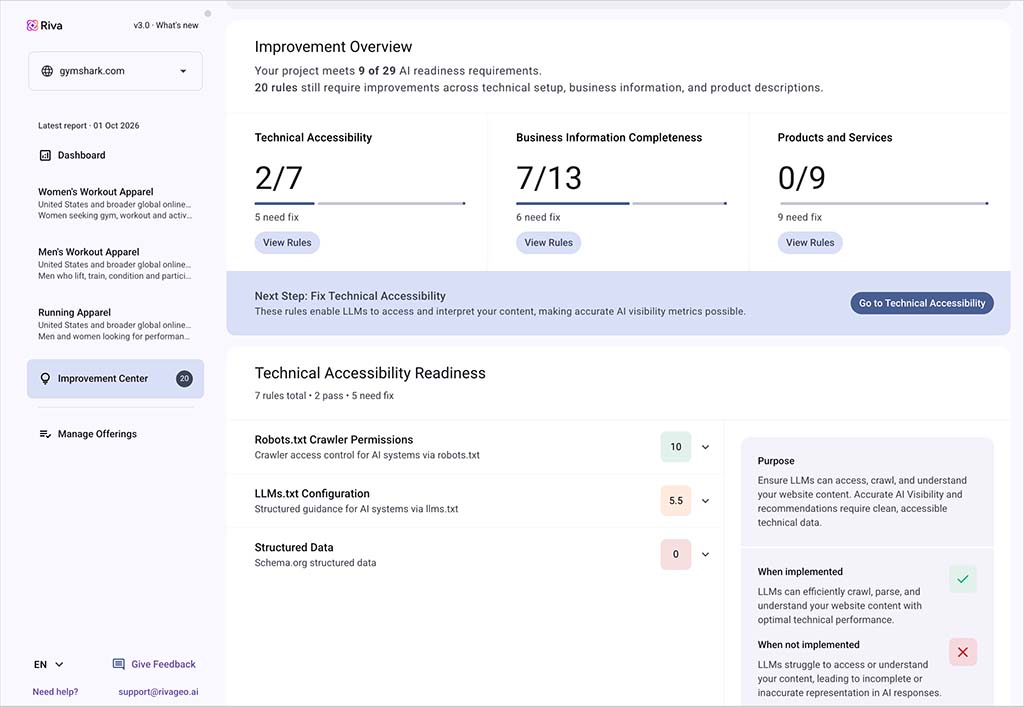
Despite the fairly technical methodology behind it, I found Riva very straightforward to use. The interface is simple, the workflow is easy to follow and there are relatively few places to get lost.
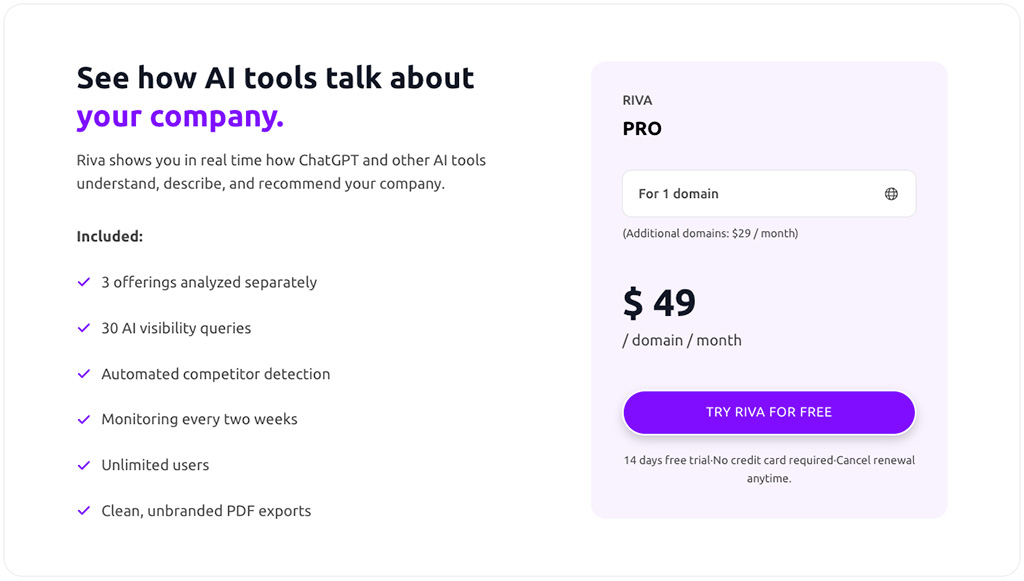
Pricing is also fairly accessible for a specialist AI visibility tool. Riva currently charges you $49 per month to track one domain, with every additional tracked domain costing $29 per month.
(I’ll revisit the value for money of this pricing approach later in the review.)
When preparing this review, I tested Riva across three very different websites: a popular content-led business site, an independent music site with ecommerce functionality, and a large international consumer brand. This gave me a useful way to see how Riva handled very different business models, site structures and levels of existing AI visibility.
How does Riva work?
Riva starts with a technical analysis of the website itself rather than immediately giving you an AI visibility score.
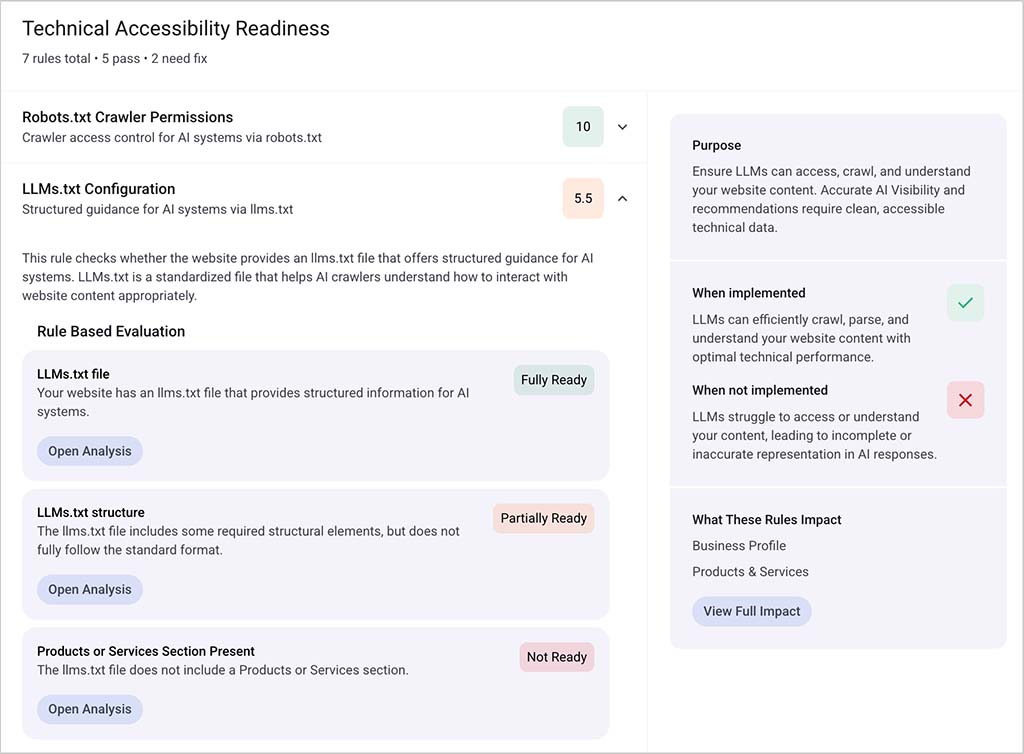
First, it assesses technical accessibility, testing components/aspects like robots.txt, AI crawler access, llms.txt, structured data quality and whether AI systems can reach and parse a site successfully.
Some of this territory is not unique to Riva — Semrush, for example, now includes an AI Search Health score and checks whether major AI crawlers can access a site — but Riva integrates these checks into a broader diagnostic workflow.
It then assesses Business Information Completeness, looking at how clearly the site communicates its company identity, address, intended audience and geographic market.
Next, Riva automatically identifies up to three active “offerings” — products, services or other things the business provides. Each has a name, description, target audience and geographic focus, and these AI-generated details can be edited.
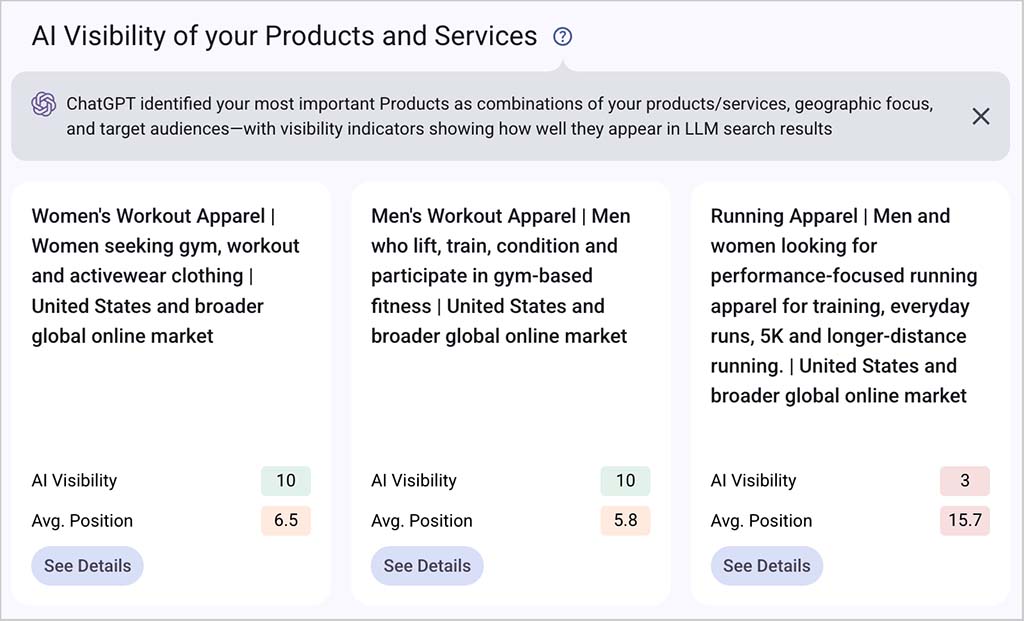
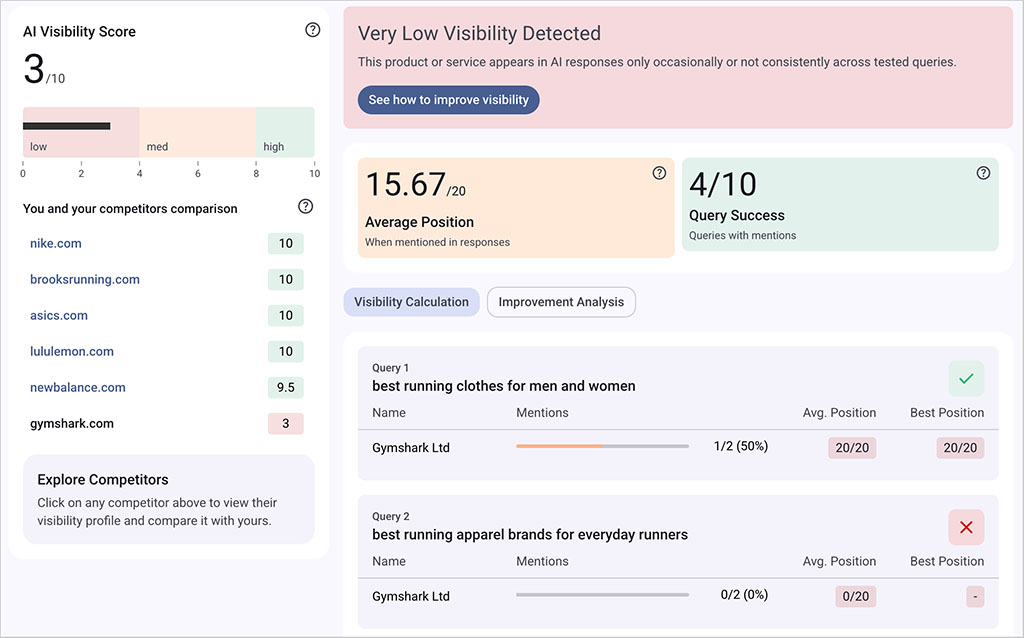
Riva then generates 10 “human-like” queries for each offering, which can also be edited. It runs these through ChatGPT and produces an AI Visibility Score from 0 to 10, supported by Query Success, showing how many queries produced a mention, and Average Position, showing where the business appeared when mentioned. It also records other businesses and entities appearing in the same answers.
Finally, failed checks feed into an Improvement Center, where Riva prioritizes actions and, in many cases, provides page-level recommendations. The same analysis is then rerun periodically, making Riva an ongoing monitoring-and-improvement system rather than just a one-off audit.
Now that we’ve looked at what Riva is and how it works, let’s take a look at the pros and cons of using it. I’ll start with its advantages, and then outline the areas that need improvement.
The pros of Riva
1. Riva takes a genuinely useful diagnostic approach to AI visibility
The thing I most like about Riva is that it treats AI visibility as the end of a chain rather than as an isolated number. Most AI visibility platforms are fairly good at answering questions such as “Where is my brand appearing?”, “Which prompts mention me?” and “Which competitors are being recommended instead?” But Riva spends much more time on the question that naturally follows: why might this be happening?
Its logic is essentially this: Can AI access the site? Can it understand the business? Does it recommend the relevant offering? And if not, what might need improving?
In other words, a disappointing “visibility score” doesn’t just sit on a dashboard. Riva connects it to things like weak audience messaging, unclear geographic information, inaccessible content or a lack of strong evidence supporting product claims — and then highlights these issues in an “Improvement Center.”
This is where it differs most obviously from products like Semrush and Profound. Those platforms can provide a substantially broader picture of visibility across large numbers of prompts, topics, citations and AI systems. Riva gives you much less raw visibility data, but works harder to connect its findings to the content and structure of your website.
As a result, I think of Riva less as a conventional AI monitoring platform and more as an AI visibility audit and improvement system.
2. Its analysis of how AI understands a business is exceptionally detailed
Riva’s Information Completeness analysis is one of the strongest aspects of the platform. At first glance, it looks fairly simple — a dashboard containing headline scores for company name, business address, target audience and geographic focus. Underneath those scores, however, is a much more detailed analysis of your website’s information. This is based on a collection of AI visibility “rules” that your website’s content is assessed against.
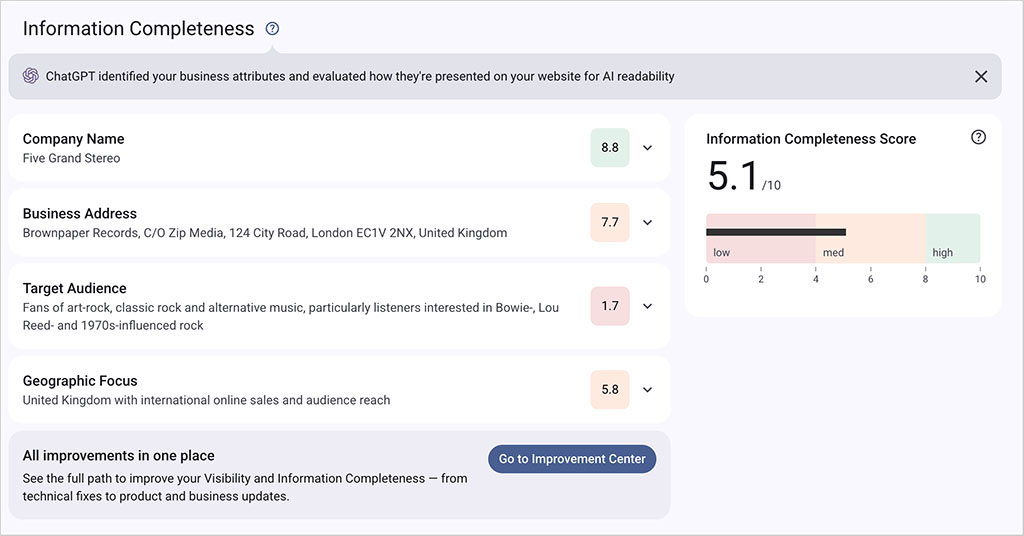
For example, company-name analysis can include entity disambiguation, contextual association and basic consistency.
Audience analysis looks at areas such as presentation quality, consistency across pages, specificity and LLM citation potential. Geographic analysis can assess service-delivery evidence, specificity and consistency too.

On my content-led test site, Riva correctly distinguished between the public-facing brand and its underlying legal company name, recommending that the relationship between the two be made clearer.
It also made a surprisingly nuanced distinction between where the business had offices and where it actually provided services.
On the independent music site, meanwhile, it correctly recognized a UK/London identity while also understanding that its ecommerce products were available to international customers.
I particularly like the evidence Riva exposes behind these conclusions. Individual rules can show the URLs analyzed, explicit statements found on the site, information Riva has inferred, what it considers to be missing and how confident it is in its assessment.
All this makes the scores considerably easier to interrogate than a generic AI visibility score.
3. Its improvement recommendations are highly actionable
The Improvement Center is probably the feature I found most useful. Plenty of SEO and AI visibility tools are good at identifying problems but leave you to work out what to do next; not so Riva.
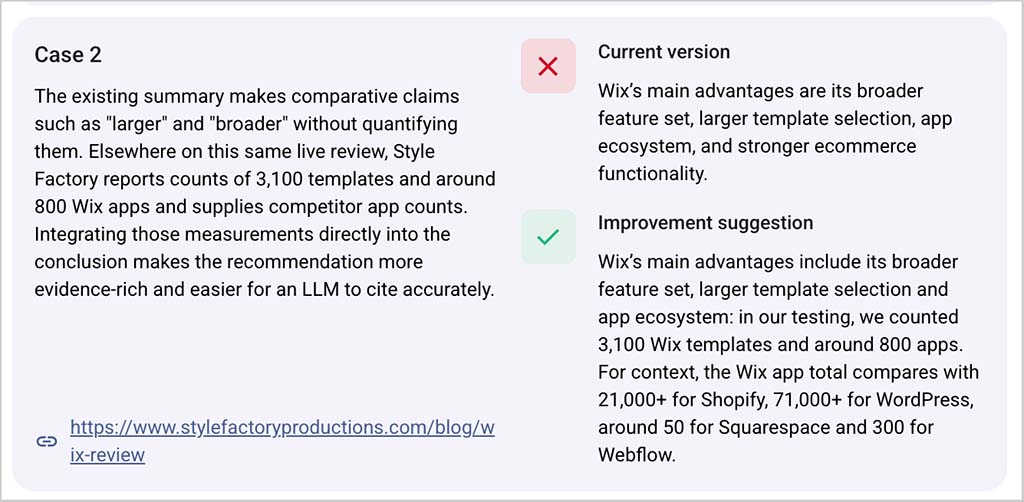
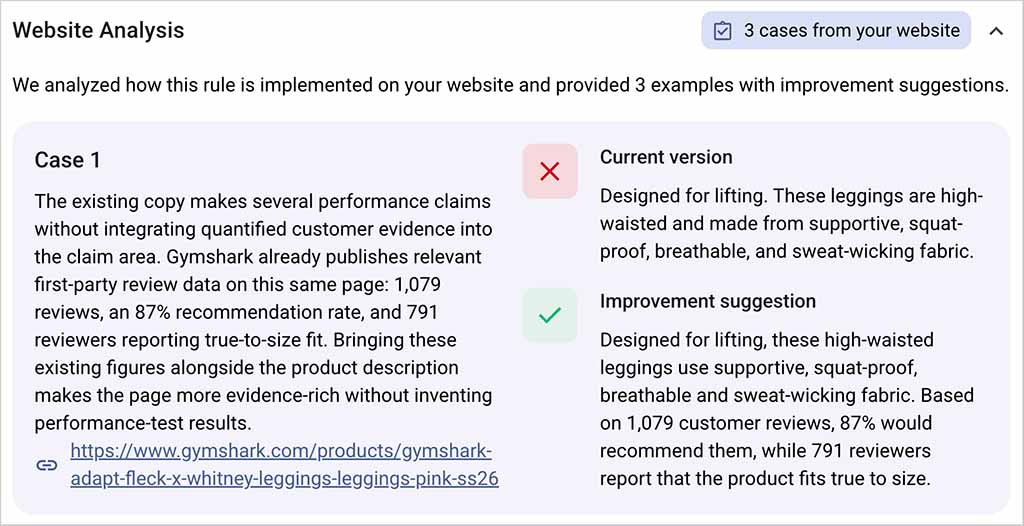
Recommendations can identify the affected URL, show relevant existing copy, explain what Riva thinks is weak or missing and suggest how it could be improved. In some cases it even supplies an alternative version of the text.
On the content-led site used for my tests, Riva identified passages where strong qualitative conclusions were being made without much supporting evidence nearby. Rather than simply telling me to “add statistics,” it found useful numbers that already existed elsewhere on the pages — such as template counts, app numbers and review data — and suggested connecting this evidence more closely to the conclusions it supported.
A similar approach appeared on the music site. When Riva encountered phrases such as “highly limited,” it pointed out that a real pressing quantity or stock figure would provide stronger evidence.
(Importantly, when that figure wasn’t available, it didn’t invent one.)
Some recommendations on the large consumer brand went deeper still, questioning broad claims around areas such as comfort, sweat management and support, and suggesting that stronger evidence might require genuine product testing, measurable performance data or verified customer evidence.
Not every recommendation is equally strong, as I’ll discuss later, but the best ones are impressively specific. Riva also leaves implementation entirely to the user, which matters.
(For me, Riva’s suggestions are best viewed as expert input rather than recommendations to follow without question.)
4. You can shape its brand visibility tests around the questions that actually matter
One of the most useful things I discovered during testing is that you can control the kinds of AI searches Riva uses to assess a brand’s visibility.
Riva starts by identifying the main products and services it finds on your website. For each one, you can change the audience and geographic market it focuses on, and edit the 10 queries it runs to see whether — and how prominently — the brand appears in AI-generated answers.
This became particularly useful with the large consumer brand website I was analyzing with Riva. It correctly identified “Running Apparel” as one of its key offerings — but defined it largely around male runners. That didn’t accurately represent the company’s broader range of clothing, so I changed the offering to cover male and female runners and rewrote all 10 queries to include areas such as general running apparel, women’s leggings and sports bras, weather-specific gear and long-distance training.
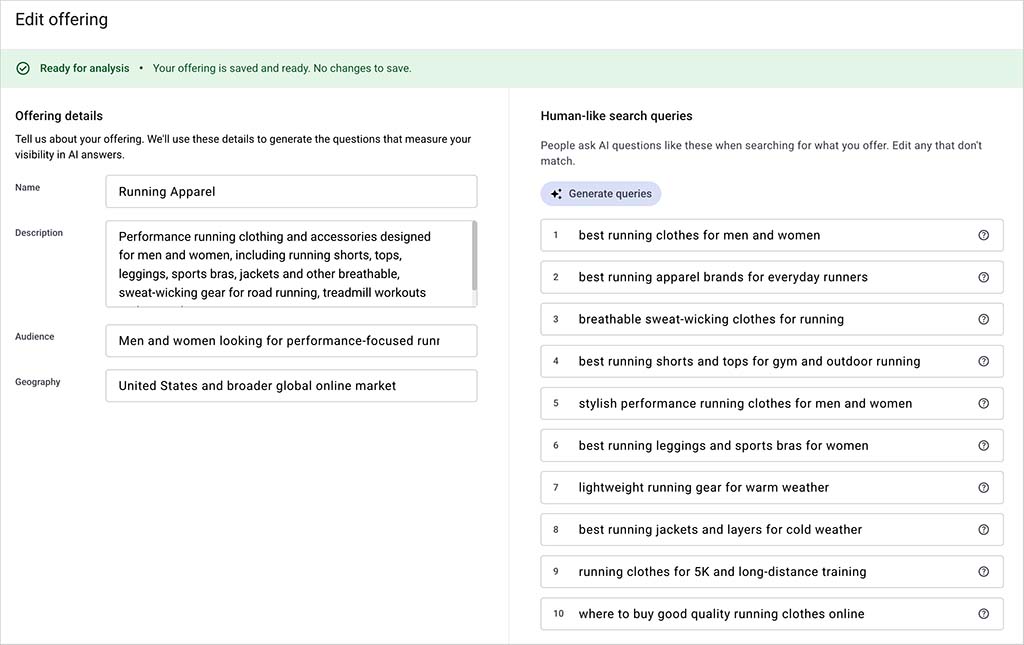
Interestingly, doing so produced weaker results across Riva’s visibility metrics:
- AI Visibility (Riva’s overall visibility score) fell from 4/10 to 3/10
- Query Success (the number of test queries in which Riva found the brand) dropped from 6/10 to 4/10
- Average Position (the brand’s average ranking when it appeared) slipped from 13.25 to 15.67.
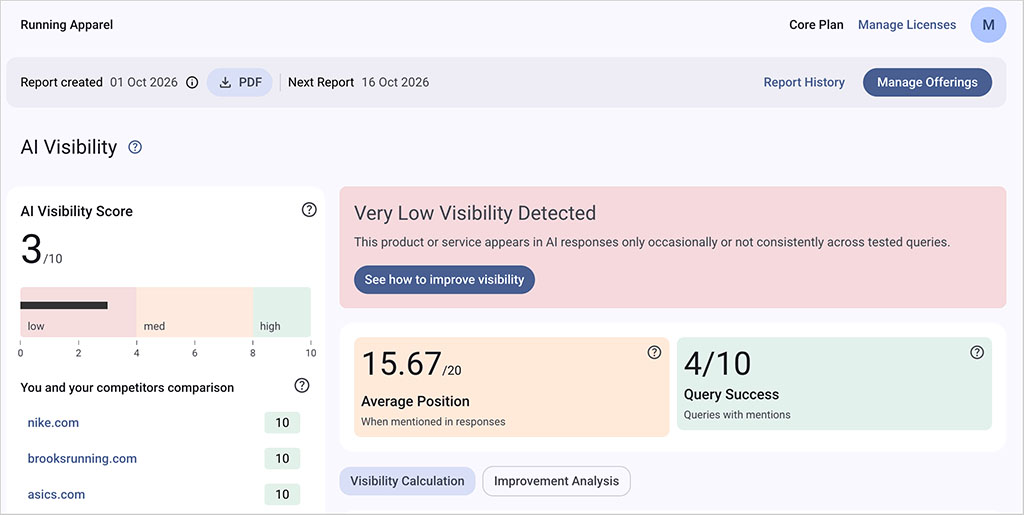
I found these changes in the metrics useful rather than problematic. My revised test showed that the brand was being surfaced for product-specific questions but not for broader queries around running brands, seasonal clothing and long-distance training. Changing the parameters had produced a more realistic — albeit less flattering — view of the site’s visibility.
That flexibility is important because it lets you align Riva’s visibility testing with the questions that actually matter to the business. Rather than having to rely on Riva’s initial AI-generated setup, you can refine the audience, market and queries being examined — and get a more meaningful picture of the brand’s actual visibility in AI-generated answers.
5. Its methodology is unusually transparent and research-backed
Another thing that impressed me is how much information Riva provides about the reasoning behind its assessment rules. AI visibility — or GEO — is still a relatively immature field, and there is no shortage of vendors touting particular tactics as established best practice.
Riva generally takes a more careful approach.
An individual rule typically includes an explanation of what is being tested, why it might matter, the pages analyzed, explicit and implied evidence, missing information, improvement advice, confidence levels and supporting references.
Most notably, Riva frequently links its rules to contemporary academic and peer-reviewed research. That gives users something external to inspect rather than requiring them to accept every recommendation on the basis that Riva says so.
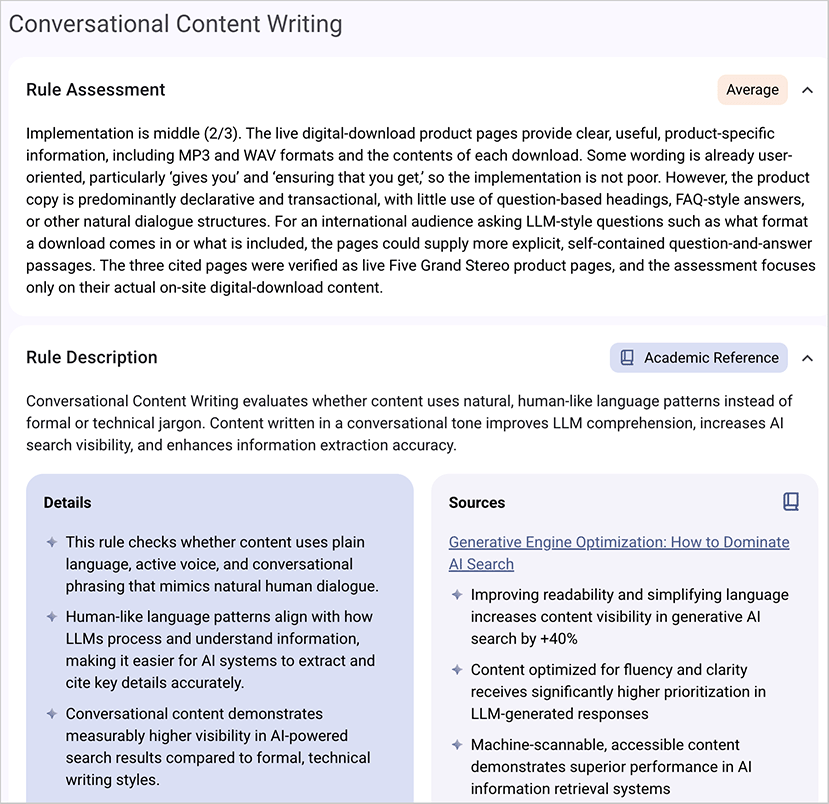
This does not mean that every rule should be treated as a proven AI ranking factor — but commendably, Riva sometimes acknowledges this itself. In one recommendation I came across, for example, it noted that research supported the idea that adding statistics to a page could make it more likely to be cited by AI systems, while stopping short of claiming that the evidence proved a direct causal relationship (see my screenshot below).
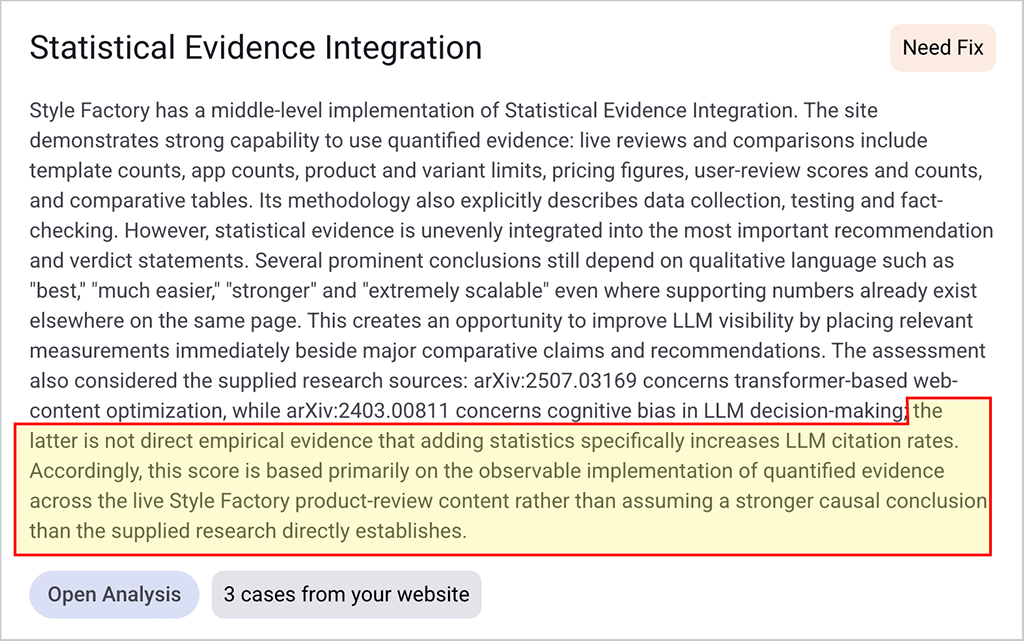
That distinction matters, particularly in a field where relatively few AI optimization principles are genuinely established.
6. It offers strong value for money, particularly for agencies and consultants
At $49 per month for one domain and $29 for each additional domain, I think Riva offers a lot of functionality for the price. For each domain tracked, you get:
- technical accessibility analysis
- business-information scoring
- three active offerings
- 30 editable visibility queries
- automated competitor discovery
- prioritized recommendations
- biweekly monitoring
- unlimited users.
The platform is also refreshingly easy to use given the complexity of some of its analysis. Its dashboards are clearly organized, setup time is minimal, and the overall workflow should feel accessible to marketers and content teams — not just users with knowledge of technical SEO.
The fact that there are no restrictions on the number of users you can add to your account is significant: other AI visibility tools like Semrush typically only let you add one user to your account — and charge a lot extra to add more seats.
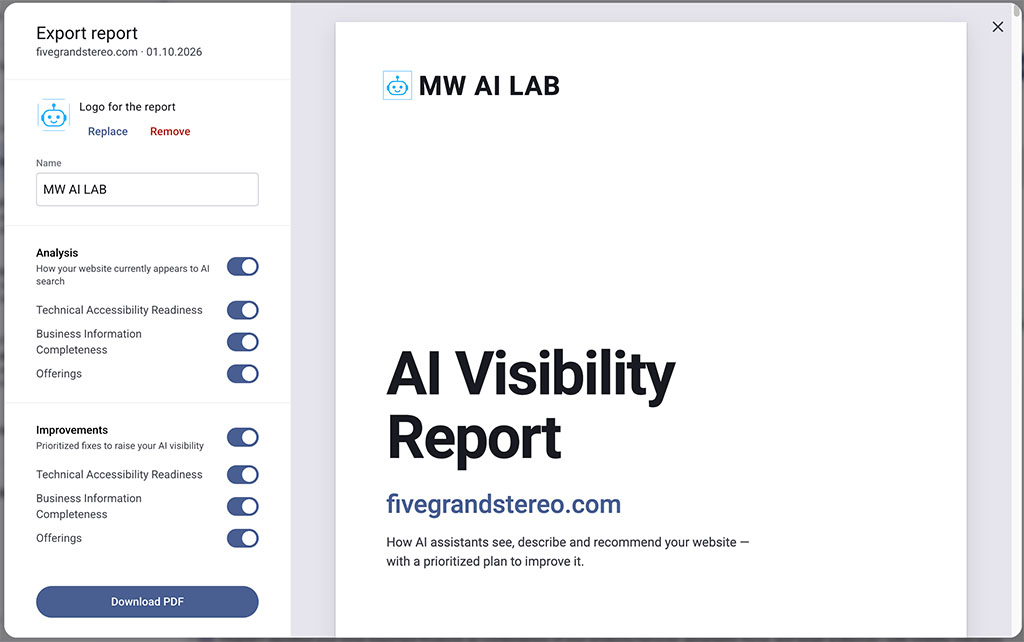
Its reporting tools add considerably to the value proposition too. The reports I generated ran to around 50 pages and contained technical findings, business analysis, visibility results and individual recommendations.
Just as importantly, Riva’s reports are easy to present as client-facing deliverables. The platform lets you customize exported PDFs with your own logos and report names — this gives agencies and consultants a simple way to produce polished, lightly white-labeled reports without a lot of extra effort.
I can see an obvious workflow here: run an audit → review the findings → create a client deliverable → implement selected improvements → rerun the analysis and show what changed.
This is also how Riva positions itself for agency use, emphasizing recurring audits and showing movement over time.
Riva is obviously much narrower in scope than enterprise-oriented AI intelligence platforms such as Profound, and it doesn’t provide the breadth of visibility data available in Semrush.
But that narrower remit is part of the appeal: if what you need is focused ChatGPT diagnosis and improvement rather than an enormous AI-search intelligence platform, the price looks competitive.
Now let’s take a look at the downsides of using Riva.
The cons of Riva
1. It currently tracks ChatGPT only
Riva’s biggest limitation is obvious: it only provides visibility data for ChatGPT. Support for Gemini, Perplexity and other LLMs is apparently coming, but a firm launch date for this has yet to be announced.
This matters because there is no single universal measure of “AI visibility.” A brand can perform differently across ChatGPT, Google AI Overviews, AI Mode, Gemini and Perplexity. Strong visibility in one environment does not necessarily translate into strong visibility elsewhere.
I saw this firsthand with the large consumer brand site I was testing with Riva. A competing AI visibility platform assigned it different visibility scores across ChatGPT, AI Overviews, AI Mode and Gemini. The differences weren’t enormous, but they were large enough to demonstrate that each AI system can produce a different picture of a brand.
Essentially, Semrush, Moz, Profound and several other competing AI visibility tools are better suited to cross-platform monitoring. They let users analyze visibility separately across ChatGPT, Google AI Mode, Gemini, Perplexity, etc.

So when Riva gives an aspect of your site a score of 7/10, it is important to understand exactly what that means: you’re dealing with a ChatGPT visibility score, not an overall measure of how visible the business is across AI search.
2. Its visibility scores are based on a relatively small sample
Even within ChatGPT, Riva’s visibility scores are based on a fairly narrow dataset. Each “offering” on your site is assessed using 10 queries, and each project is limited to a maximum of three active offerings.
That makes the results easy to understand and monitor, but it also means that a Riva score reflects performance across a maximum of 30 selected queries — a tiny fraction of the possible questions people might ask ChatGPT.
One of my test sites demonstrated this particularly clearly. Riva gave its offerings a visibility score of 0/10 across the queries it tested. But Semrush’s much broader dataset still found substantial activity from the same domain, including 79 citations across 34 cited pages (with 23 of those citations coming specifically from ChatGPT).
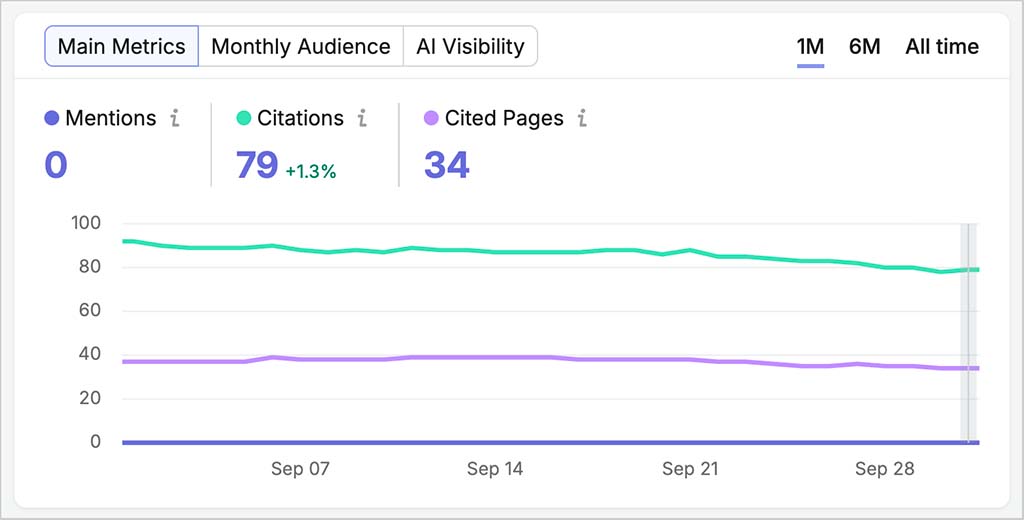
Neither result was necessarily wrong. Riva was effectively saying, “This business did not appear for these particular offering-related queries,” while Semrush had identified other prompts and search scenarios where the domain was being surfaced.
That makes the interpretation of Riva’s scores particularly important. A 0/10 score does not mean that a business never appears in ChatGPT, just as a 10/10 score does not mean that it dominates ChatGPT generally.
I therefore treat its visibility score as a focused benchmark rather than an exhaustive measure of ChatGPT visibility.
3. Its ‘competitors’ are not always competitors in the conventional sense
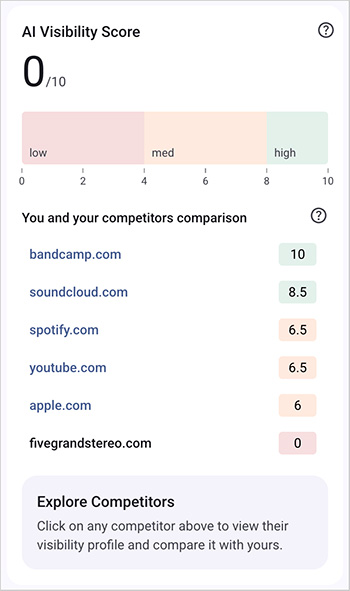
Riva automatically identifies competitors from the other brands and entities that appear alongside your business in ChatGPT answers. Sometimes this works extremely well: for the running apparel brand website I used during my tests, Riva surfaced competitors such as Nike, Adidas, Lululemon, Brooks, ASICS and New Balance.

But the results felt a bit off when my tests involved other business types. On the content-led site, Riva identified businesses such as Shopify, WooCommerce, Wix and Adobe as competitors — companies the site was more likely to write about than directly compete with. For the independent music site, it identified Spotify and Bandcamp as key rivals, rather than other bands.
That didn’t make the information useless. In fact, it revealed something quite interesting: the entities that occupy the same AI answer space as your business. But that is not necessarily the same thing as identifying competitors in the conventional commercial sense.
I’d like to see Riva distinguish between AI-answer competitors and manually selected commercial competitors, ideally allowing both sets to be tracked. That would preserve the useful automatic discovery while making conventional competitor benchmarking much stronger.
4. Some recommendations can feel too formulaic or prescriptive
Riva’s recommendations are one of its biggest strengths, but which ones to follow will require editorial judgment.
It frequently suggested turning declarative copy into question-and-answer structures, for example. That can work well for FAQs and comparison content, but applied too broadly it risks making editorial, product, and brand copy feel repetitive and formulaic.
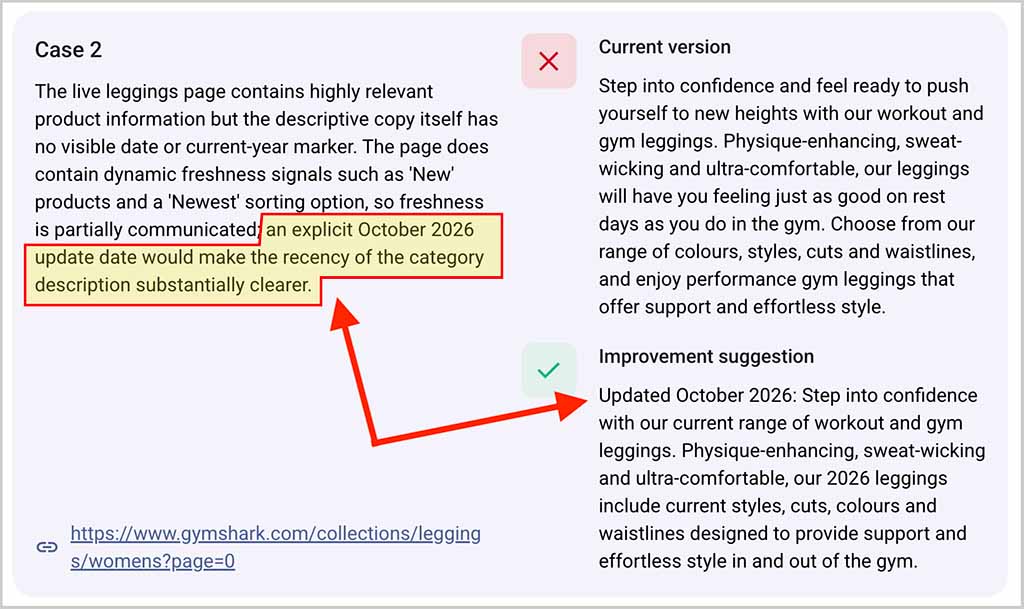
Another recurring instruction from Riva was to add “updated on” dates to content. Now, adding an updated date to a genuinely rewritten software review is sensible; adding conspicuous “Updated October 2026” messaging to continuously maintained ecommerce collection pages is less obviously beneficial.
The target-audience suggestions were occasionally a bit suspect too. Recommendations to add detailed demographic or psychographic information make sense for commercial business websites, but I raised an eyebrow when Riva suggested adding them to the independent band website I was testing.
(I also ignored its suggestion to add office hours and directions to the band site!)
Ultimately, it’s best to treat Riva as an expert second opinion rather than an instruction sheet.
5. Its readiness framework is not a proven formula for AI visibility
Riva evaluates sites against 29 rules across three layers: seven covering technical accessibility, 13 covering business information and nine covering products and services. This framework is useful, but my tests showed very clearly that passing more Riva checks does not automatically translate into stronger ChatGPT visibility.
The large consumer brand website proved the point most clearly. Riva reported that it passed only 9 of the 29 checks, leaving 20 suggested fixes to be made. Yet the same site achieved 10/10 visibility for two major product categories.
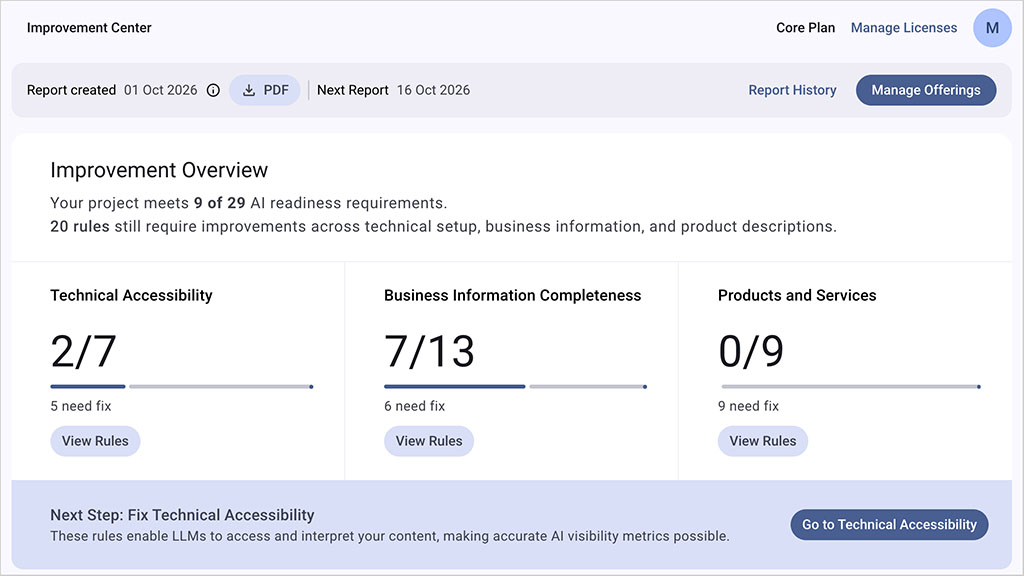
In other words, a business can fail a large number of Riva’s readiness checks while still performing extremely well in ChatGPT. Conversely, there is no reason to assume that achieving a perfect readiness score will automatically cause ChatGPT to start recommending a business.
(I also encountered one technical discrepancy when testing Riva. On one site, Riva was unable to retrieve the robots.txt file and marked the check as “Not Ready,” while another AI visibility tool successfully tested multiple AI crawlers on the same site and found that none were blocked.)

Ultimately, Riva’s checks are useful for identifying potential weaknesses, but they should not be considered as a 29-step recipe for appearing in ChatGPT.
Riva review — verdict
Riva is a slightly unusual product in the growing AI visibility market, and I think that is largely a strength.
Now, it isn’t the tool I would choose if my main priority were to monitor the broadest possible range of AI platforms, prompts, citations and sources — platforms such as Semrush, Ahrefs Brand Radar, Moz, and Profound are generally better for accessing that type of large-scale visibility intelligence.
However, Riva is considerably more interesting when viewed as an AI visibility diagnostic and improvement tool. Its strongest features are the depth of its business-information analysis, its highly specific page-level recommendations, the way it lets you customize offerings and queries, and the transparency with which it explains many of its rules.
I particularly like its use of contemporary academic research to support its methodology. And for agencies and consultants, the combination of an accessible interface, detailed reporting and a relatively modest price makes for an attractive package.
There are meaningful limitations to be aware of, however. Riva currently monitors ChatGPT only, its visibility scores are based on relatively small query sets, three active offerings may be restrictive for some larger businesses, and its initial AI-generated setup needs human oversight.
Most importantly, its readiness scores should be interpreted as diagnostic indicators rather than a formula for success.
Used on those terms, however, Riva does something genuinely useful. It may not tell you everything happening to your brand across the AI-search landscape, but it does a particularly good job of helping answer the question that comes next: why might my business be performing this way — and what can I actually change on my website to improve matters?
If you’d like to try Riva out for yourself, you can access its 14-day free trial here.
Now over to you: if you’ve got any questions about Riva — or observations of your own — please do leave them in the comments.
Alternatives to Riva
Riva is quite distinctive in the way it combines AI visibility testing with detailed website analysis and improvement recommendations. But if your priority is broader AI visibility monitoring — particularly across multiple AI platforms — there are several alternatives worth considering, including Ahrefs, Semrush, Moz, SE Ranking and Profound. Our video guide to AI visibility tools below walks you through the pros and cons of several of these.
Riva review — FAQ
What is Riva?
Riva is an AI visibility and optimization tool from XOVI. It analyzes how well AI systems can access and understand a business, tests whether its products or services appear for relevant ChatGPT queries, and provides recommendations for improving its AI visibility.
How much does Riva cost?
Riva currently costs $49 per month for one domain. Additional domains cost $29 per month each. No separate XOVI subscription is required.
Does Riva have a free plan?
No. Riva does not currently offer a permanent free plan, but it provides a 14-day free trial with no credit card required.
Which AI platforms does Riva track?
Riva currently measures visibility in ChatGPT. XOVI says support for additional AI platforms, including Gemini and Perplexity, is planned.
How many products or services can I track with Riva?
Riva lets you monitor up to three offerings per domain. Each offering is tested using 10 AI visibility queries, giving you up to 30 tracked queries in total.
How often does Riva update its reports?
Riva reruns its visibility analysis automatically approximately every two weeks, letting you track changes over time rather than relying on a single snapshot.
Is Riva an SEO tool?
Not in the conventional sense. Traditional SEO tools focus primarily on search-engine rankings, backlinks and technical SEO. Riva focuses on whether AI systems can access and understand a business, whether it appears in relevant AI-generated answers and what might be improved to increase its visibility there.

No comments