


In this post I explain the different types of AI visibility you can achieve for your brand, and give you practical tips on how to ensure your content is performing as well as it can in AI search experiences.
In recent years, there has been a massive shift in how people discover information, research products, and make purchasing decisions online.
Instead of browsing multiple websites to find answers, an increasing number of users are now relying on AI-powered tools like ChatGPT, Gemini, Perplexity, and Google’s AI Overviews for advice — receiving immediate (and detailed) answers to their queries rather than a long list of websites to visit.
This means that appearing in AI-generated answers is becoming an increasingly important way for businesses to reach customers. If an AI tool recommends your product, mentions your brand, or cites your publication, you can gain:
- the opportunity to influence a decision
- improved brand awareness
- more credibility for your publication.
Conversely, if your brand is consistently absent from these answers — or is misrepresented in them — you stand to miss out on these opportunities.
So, how do you make sure your content gets noticed?
Well, in this guide, I’ll show you how to check whether your website is appearing in AI-generated answers, explore key ways to improve its visibility in AI search experiences, and look at how to measure the results.
But first, a look at the different types of AI search visibility.
Understanding the different types of AI search visibility
Broadly speaking, AI search visibility refers to how often your website, content, or brand appears in AI-generated answers.
But there are actually quite a few different types of visibility to consider. These are:
- Source citations: where an AI-generated answer references a page on your website, often accompanying this with a clickable link.
- Brand mentions: where an AI system names your business, product, or service in its response.
- Recommendations: where an AI system actively recommends your business or product to someone seeking advice.
- Indirect influence: where an AI answer draws on information originating from your content — but without visibly acknowledging your website.
Each can benefit your business in different ways.
Source citations can generate traffic and build credibility (but don’t expect large numbers of clicks from them).
For example, if ChatGPT cites an independent review of an iPhone when explaining the benefits of the device, users might click through to the original article to learn more. This can lead to advertising revenue or affiliate commissions.
However, research suggests that clickthroughs from AI-generated answers are relatively rare. A 2025 Pew Research Center study found that users clicked a source link within Google’s AI Overviews in just 1% of searches where an AI Overview appeared.
Citations can still be useful, however: they can introduce publications and brands to new audiences and potentially strengthen their credibility — but publishers shouldn’t assume that being referenced by AI systems will translate into significant increases in website traffic. If anything, the reverse is true, particularly where Google searches are concerned.
Brand mentions are arguably more useful, because they can significantly increase awareness of your business. For example, if someone asks Gemini about email marketing platforms, it might mention Omnisend alongside several competitors. Even if Omnisend isn’t explicitly recommended, the mention introduces the brand to someone researching email marketing software. That person might subsequently investigate Omnisend further — or include it in a shortlist of products to consider.
Recommendations can influence purchasing decisions. For example, someone might ask Perplexity to recommend an email marketing platform for a small Shopify store. If Perplexity recommends Omnisend and explains why it’s a good fit, this could encourage the user to sign up for a trial or purchase a subscription.
(Recommendations can be particularly valuable when they appear in answers to questions from users who are close to making a purchase.)
Indirect influence can shape purchasing decisions, but its commercial benefits to content creators are less clear. For example, an AI tool might produce a software comparison that incorporates findings originally published by an independent review website, without citing or mentioning that website. The comparison could influence which product a user buys, but the publication supplying the information won’t get any traffic — or even any brand awareness — as a result.
(It’s also difficult to establish whether an AI system has actually relied on a particular source when that source isn’t acknowledged!)
The weird economics of AI visibility: who are citations actually valuable to?
One of the most interesting (or perhaps frustrating) things about AI search is that the businesses benefiting from an AI-generated answer aren’t necessarily the ones supplying the information used to create that benefit.
Take an independent software review website (like ours!) whose comparisons are regularly cited by ChatGPT or Google’s AI Overviews.
Its research and content might be helping thousands of users decide which products to buy. But if those users get all the information they need from the AI-generated answer, they may never access the content powering it — they’re more likely to go straight to the brand website and make a purchase, depriving the publication of any revenue-generating opportunities.
For the software companies being recommended, however, these answers can be incredibly valuable — a positive recommendation can lead to multiple purchases, even if no measurable referral traffic is generated.
This creates a potential disconnect between the value that a publisher’s content provides to AI search systems and the revenue that the publisher receives from it.
But AI visibility can still have benefits beyond generating immediate clicks. It can build brand awareness, establish authority, or lead to other types of business opportunities.
Now that we’ve discussed the different types of AI visibility, let’s establish how to measure them.
How to check whether your content appears in AI-generated answers
There are several ways to check whether AI systems are referencing your content, ranging from simple manual searches to using dedicated AI visibility monitoring tools.
Let’s look at these.
1. Check visibility manually using AI search tools
The simplest way to determine the extent of your AI visibility is to ask AI tools questions related to your website.
For example, if you sell or review camping equipment, you could try entering prompts like these:
- “What are the best tents for family camping?”
- “Is a down sleeping bag better than a synthetic one for winter camping?”
- “What are the main disadvantages of inflatable camping mattresses?”
- “Which websites publish reliable independent reviews of camping equipment?”
In the responses you get, look for citations of your articles, mentions of your brand, and references to competing websites.
The problem here is that AI-generated answers aren’t consistent. Results can vary based on location, previous interactions, the AI model being used, and other factors.
For this reason, I wouldn’t draw too many conclusions from a single test. You’ll need to run multiple queries across multiple systems to get a proper sense of your brand’s visibility in AI-generated answers. This can be done manually, but realistically, you’re better off using a dedicated tool to establish the AI visibility of your brand.
And this brings me to…
2. Use an AI visibility tracking tool
For a more systematic approach to monitoring your content’s performance in AI search, I’d recommend using a dedicated AI visibility tracking tool. There is an increasing number of these available, but at Style Factory, we use Semrush — this combines conventional SEO functionality with tools specifically designed to measure visibility in AI-generated answers.
Its AI Visibility Toolkit lets you investigate how often your brand is mentioned, which pages on your website are being cited, and how your visibility compares with that of competitors.
A good place to start is its Visibility Overview report.
To access this, open Semrush, select AI Visibility → Visibility Overview, and enter your website’s domain.
You’ll then be shown an AI Visibility Score, along with information about your brand mentions, citations and cited pages (see screenshot below)
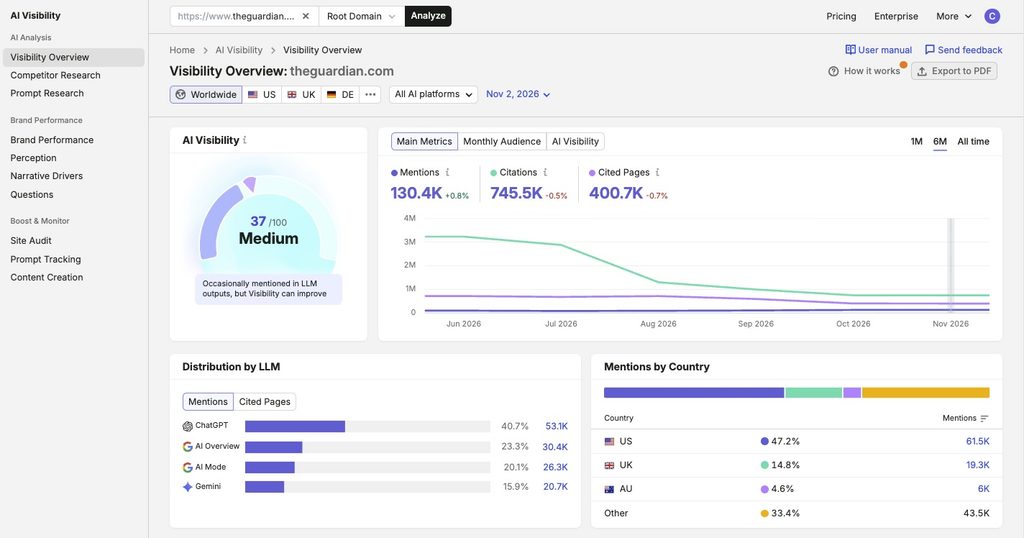
This gives you an idea of which parts of your website are already gaining traction in AI search. For example, if you run a website that reviews ecommerce software, you might discover that your Shopify content receives citations regularly, while your articles about email marketing don’t.
You can also use Semrush’s Competitor Research report to identify topics where other businesses are appearing but yours isn’t.
And its Prompt Tracking tool lets you monitor specific questions over time.
It’s important to note, however, that Semrush doesn’t have access to every conversation taking place in ChatGPT, Gemini, or other AI platforms. Its reports are based on its own datasets of AI prompts and responses, while its prompt tracking features monitor a defined collection of questions.
So, if Semrush reports that your website isn’t being cited much, that doesn’t necessarily mean it’s absent from AI search altogether. Treat the data as a useful indicator of visibility rather than a complete record of every AI-generated answer.
3. Check Google Search Console and Bing Webmaster Tools
You can also obtain useful AI visibility information directly from Google and Bing.
Google Search Console provides a dedicated Generative AI performance report, which shows impressions associated with AI Overviews and AI Mode. This lets you investigate which pages are appearing in Google’s AI-powered search features, and how their visibility changes over time.
⚠️ Note: the generative AI performance report only provides you with data if your site receives a meaningful number of impressions in Google’s generative AI search features.
Meanwhile, Bing Webmaster Tools provides an AI Performance report covering supported Microsoft AI experiences, including Copilot.
This shows which pages on your website are being cited, how citation activity is changing, and which phrases are associated with the retrieval of your content.
(These phrases are called grounding queries. They’re not necessarily the exact questions users typed into an AI tool.)
Both Google and Bing’s tools are worth making use of, mainly because they provide first-party information rather than relying entirely on third-party estimates.
4. Check your AI referral traffic
Finally, take a look at your website analytics. These should let you identify some traffic arriving from services like ChatGPT and Perplexity.
In Google Analytics 4, you can find this information under Reports → Acquisition → Traffic acquisition, by selecting the AI Assistant channel.
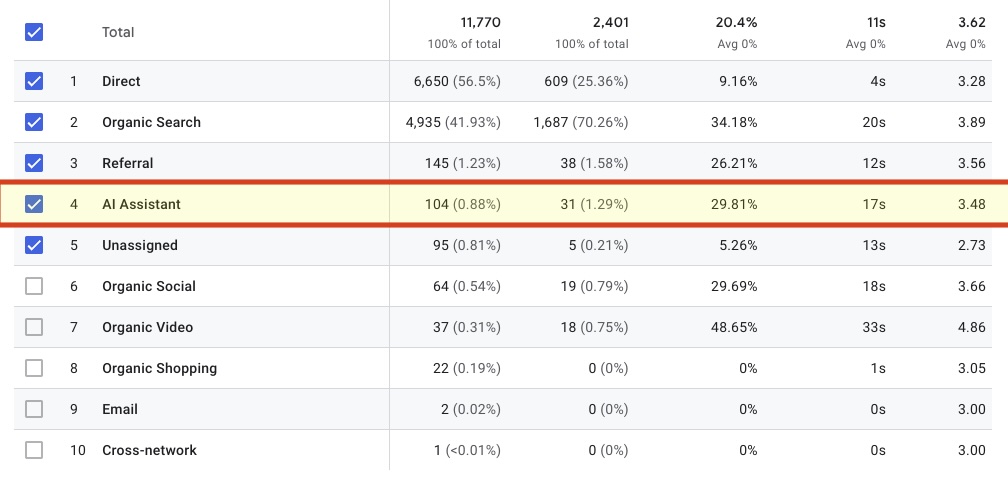
Bear in mind, however, that not all AI-generated traffic is identifiable. Some visits may be recorded as direct traffic, while clicks from Google’s AI Overviews and AI Mode are typically grouped with conventional Google organic search traffic.
But in general, your web analytics let you get a sense of whether AI search is generating actual visits — and, importantly, whether those visits are leading to inquiries, purchases, or other conversions.
Now that we’ve covered how to check your visibility, let’s look at how to improve it.
The six key ways to improve your visibility in AI search
1. Get the fundamentals of SEO right
If you want your content to appear in AI-generated answers, the first thing to do is ensure your conventional SEO is in good shape. This is because many AI-powered search experiences rely on systems that discover, index, and retrieve conventional web pages.
Google is particularly clear about the importance of this. In its official guidance on optimizing for generative AI search, it recommends following established SEO practices rather than trying to deploy special “AI optimization” tricks.
So, make sure that you:
- are using descriptive title tags, headings, and URLs on your pages
- are including relevant keywords naturally in your content
- have ensured important pages can be crawled and indexed
- create useful internal links between related articles
- build a fast, mobile-friendly website
- use appropriate structured data where relevant
- are creating trustworthy content (fact-checked, proof-read articles — not AI slop!).
It’s also important to publish the right sort of content. For example, if your website focuses on personal finance, publishing a well-connected collection of guides to budgeting, saving, investing, and managing debt is more desirable than hosting a bunch of unrelated articles on your site.
Essentially, you want to become a “topical authority” on your subject; doing this can bring SEO rewards, and by extension, better AI visibility.
(For a comprehensive guide to improving SEO, I’d suggest watching our video on how to make your site more visible in search results.)
Important: check that AI crawlers can access your website
It’s really important to ensure that AI search bots can actually access your content — without that, you can forget about AI visibility entirely!
Different AI companies use different crawlers, and some distinguish between bots used for search and those used for training AI models.
For example, OpenAI uses OAI-SearchBot to discover content for ChatGPT search. It also operates GPTBot, which collects information that may be used to train its models.
These serve different purposes. You can allow OAI-SearchBot while blocking GPTBot, for example. OpenAI’s crawler documentation explains how to manage access.
To ensure your content is eligible for inclusion in Google’s AI results, make sure that the “Search generative AI” setting in Google Search Console is enabled.
Also, try to make sure your important content is accessible in HTML without requiring visitors to log in or perform complicated interactions.
And don’t get too distracted by supposedly essential AI-specific technical fixes.
For example, there’s been plenty of discussion about adding llms.txt files to websites. But Google explicitly says it doesn’t use these files for Search, including its AI features. It also confirms that no special structured data is needed to appear in AI Overviews or AI Mode.
2. Publish original, experience-led content
This is probably the recommendation I’d place the most emphasis on.
AI systems are already very good at summarizing information that’s widely available online. So, if your article simply repeats what dozens of other websites are saying, what reason is there for an AI search system to reference it over the alternatives?
One way to make your content more valuable is to include information that can’t easily be obtained elsewhere.
Google makes a similar point in its AI search guidance, specifically encouraging publishers to focus on original, “non-commodity” content when trying to achieve more visibility in AI search.
Let’s look at an example.
Say you’re writing a comparison of Shopify, Wix, and Squarespace. You could produce an article explaining that Shopify is particularly strong for ecommerce, Wix provides considerable design flexibility, and Squarespace offers attractive templates.
All fair points — but they’re also things that an AI tool could explain without much difficulty.
Now consider a comparison that includes:
- results from building a test store on each platform
- screenshots showing how key features work
- details of problems encountered during setup
- a breakdown of the actual costs involved in running each store
- specific examples of where one platform performed better than another
- recommendations based on different business requirements.
This second article is much more interesting. It introduces evidence and observations that aren’t necessarily available in other publications, giving readers a reason to consult it rather than relying entirely on an AI-generated summary.
And it gives AI systems original information that they may find useful to reference.
Does content freshness affect AI visibility?
Research suggests that keeping your content up to date may improve its chances of being cited in AI-generated answers.
For example, a 2026 study by Seer Interactive found that 75% of the dated pages cited by ChatGPT, Gemini, and Perplexity had been updated within the previous year. Similarly, research by Ahrefs found that AI assistants tended to cite newer content than conventional Google search results.
These findings suggest a relationship between content freshness and AI visibility, although they don’t prove that updating a page will automatically result in more citations.
My advice? Keep your content accurate and current, particularly where information changes regularly.
And don’t confuse changing a publication date with genuinely updating an article!
3. Make your content easy to understand
Another way to improve your AI search visibility is to make your content easy for AI systems to understand and extract information from.
One way to do this is by structuring articles around the questions your audience is asking — and providing clear, direct answers to those questions.
For example, instead of simply searching for “best electric bikes,” someone might ask ChatGPT or Google AI Mode, “What’s the best electric bike for a 10-mile commute involving steep hills, with a budget of $1,500?”
Your content needs to factor in this new way of searching for things — and provide the sort of information that could realistically inform answers to these more specific questions.
Other useful techniques for helping AI systems understand your content more easily include:
- Using descriptive headings — making it obvious what each section of your content covers.
- Providing direct answers — avoiding lengthy introductions that delay answering the question at hand.
- Including comparison tables — presenting key differences between products or services in a format that’s easy to scan.
- Adding FAQ sections — addressing common questions that your main content doesn’t already answer.
- Keeping paragraphs focused — trying to cover one main point at a time, making individual passages easier to understand.
These approaches can help AI retrieval systems identify relevant information in your content more easily – and potentially use it when generating answers.
However, I wouldn’t get too carried away with formatting everything specifically for AI. Google explicitly advises against unnecessary “content chunking” as a generative AI optimization tactic, and there’s no evidence that turning every heading into a question will automatically increase citations.
(It might put human readers off your content too, if done too aggressively.)
Ultimately, the goal is to make your content clear, well-organized and genuinely useful to readers. If you’re doing that already, you’re giving AI search systems a good foundation to work with too.
Understanding query fan-out
To maximize the potential visibility of your content, it’s worth understanding how AI search systems handle more complex questions from users. Google, for example, uses a technique called query fan-out, which involves breaking a question into several related searches and drawing information from multiple sources to construct the answer to it.
This means that even if your content doesn’t rank particularly well for a broad search term (for example, “camping”), it may still be relevant to one of the more specific searches performed in an AI environment (e.g., “can you recommend a cheap campsite near Paris?”).
And this gives you another good reason to cover your subject thoroughly and comprehensively address the particular questions your audience has.
4. Publish YouTube videos
If you’re trying to improve your visibility in AI search, I’d strongly recommend using YouTube as part of your content strategy.
This has been one of the most effective tactics we’ve used to raise the visibility of Style Factory content. In the screenshot below, you’ll see that our Moz vs Semrush video comparison is featured prominently (twice!) in Google’s AI answer to a “Moz vs Semrush” query. This video appeared in that AI answer within a few hours of being published.
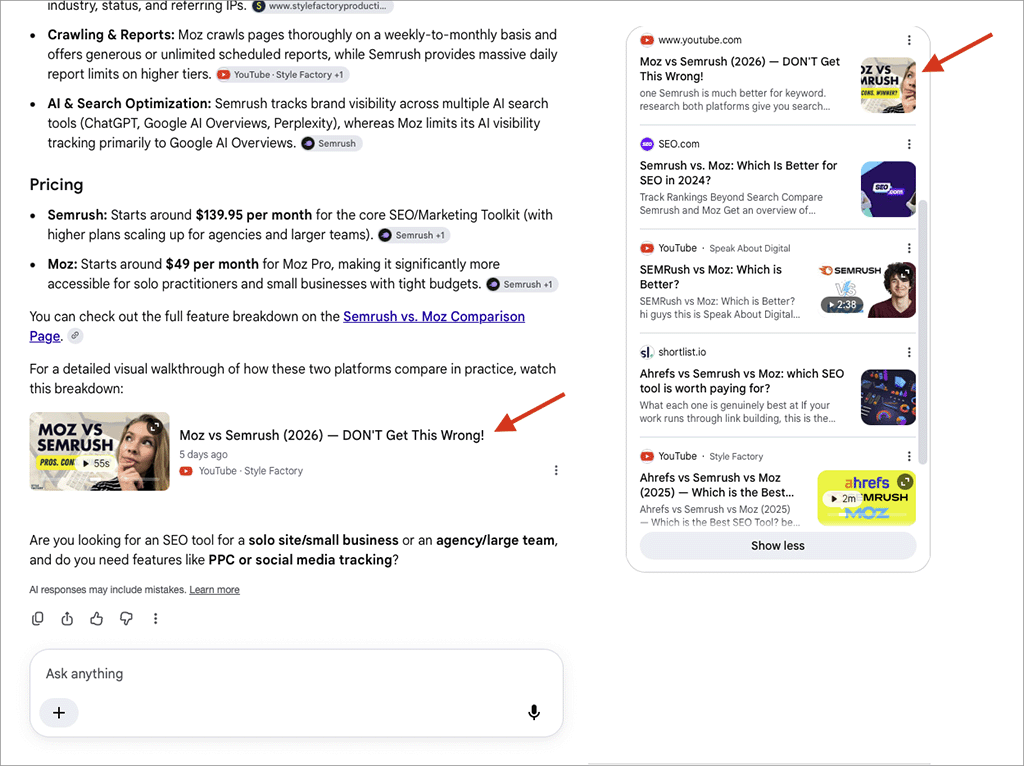
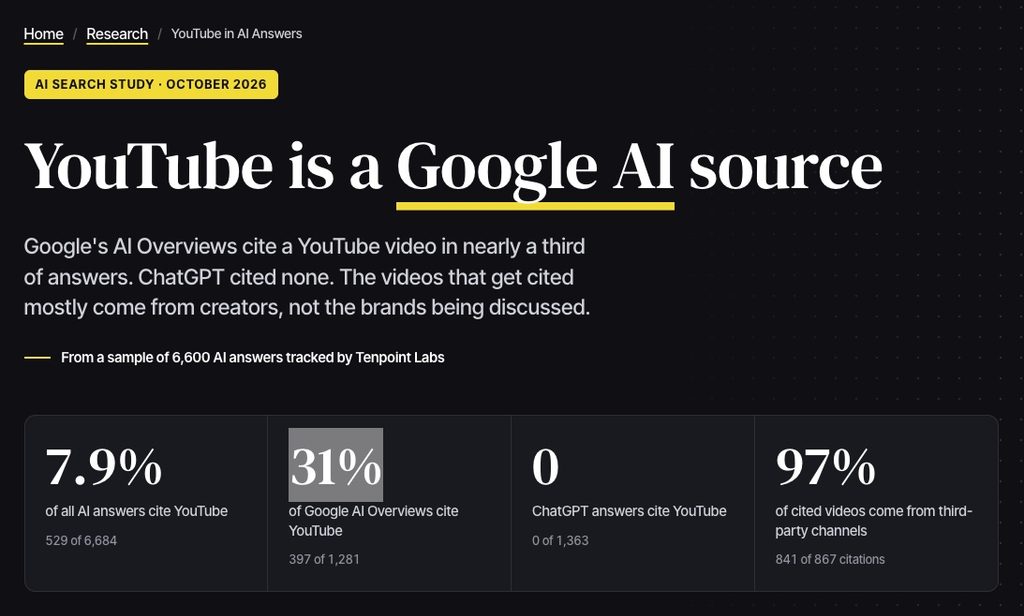
This is unsurprising — if you’ve Googled anything recently, you’ve probably noticed that YouTube videos are increasingly appearing as sources in Google’s AI Overviews and AI Mode. A 2026 study by Tenpoint Labs found that 31% of the Google AI Overviews it analyzed contained at least one YouTube citation; research by Semrush has identified YouTube as one of the most frequently cited sources in Google’s AI Mode too.
You don’t necessarily need to create completely different content for YouTube — you can turn existing blog posts into videos, using them to better demonstrate products, explain complicated processes, or add first-hand observations.

When publishing videos, I’d recommend:
- Using descriptive titles and descriptions that make it clear what questions your video answers.
- Adding accurate captions — this makes your spoken information available as text, and easier for LLMs to access.
- Including chapters and timestamps — these help AI systems identify the main subjects covered.
- Providing original demonstrations (screen recordings, product demos etc.) rather than simply reading out information from an existing article.
- Embedding relevant videos in your written content — based on our experience, this can help videos get surfaced more frequently in Google AI Overviews (this is particularly the case if you have an authoritative domain).
Google’s video SEO guidance confirms that YouTube timestamps can help it identify important moments within videos, while YouTube recommends descriptive titles, descriptions and captions to improve discoverability.
Of course, publishing videos doesn’t guarantee that they’ll appear in AI-generated answers. And some AI platforms cite YouTube videos much more frequently than others.
Nonetheless, it is increasingly clear that YouTube provides an excellent opportunity for your expertise to reach potential customers via AI search.
📚 Related resource: Key reasons to make YouTube a key part of your SEO strategy
5. Get your brand mentioned on relevant third-party websites
Another way to potentially improve your AI visibility is to get your brand mentioned on relevant third-party websites. There’s some interesting research suggesting that these sorts of mentions may be particularly important for AI search.
For example, a 2025 study by Ahrefs involving 75,000 brands found that mentions across the web correlated much more strongly with brand visibility in ChatGPT, Google AI Mode, and AI Overviews than traditional backlink metrics did.
This study showed that:
- brand mentions across the web had a correlation of 0.66–0.71 with AI visibility.
- traditional backlink metrics showed much weaker correlations.
These findings suggest that getting your brand discussed across the web — even without necessarily receiving a backlink — could be particularly useful for improving its visibility in AI-generated answers.
Now, there’s an important caveat here: correlation doesn’t necessarily mean causation. The Ahrefs study doesn’t prove that securing additional brand mentions will automatically increase your visibility in AI search. Well-known brands may simply attract more mentions both across the web and in AI-generated answers.
Nevertheless, the findings provide a good reason to make genuine brand recognition part of your AI search strategy.
As ever, though, quality counts: avoid manufacturing brand mentions via low-quality sponsored articles, artificial forum discussions, or other schemes designed purely to influence AI-generated answers. And remember that the research discussed above primarily concerns brand mentions in AI answers, rather than citations of a website’s individual articles.
How to build your presence on third-party websites
You can increase the number of mentions of your brand on other websites through:
- Digital PR: publish original research, useful statistics, or interesting studies that industry publications may want to reference — and pitch these to relevant journalists.
- Expert contributions: share your expertise through interviews, guest articles, podcasts, and industry roundups.
- Independent reviews: encourage genuine customer reviews and make sure relevant third-party publications have accurate information about your products or services.
- Community participation: contribute useful advice to relevant forums, Reddit communities, and professional discussion groups, without turning every contribution into a sales pitch.
6. Make sure AI systems have accurate information about your products and business
If you sell products or services, make sure AI search systems have access to accurate information about what you offer.
This is because AI tools don’t just rely on blog posts and other editorial content when making recommendations. They can also use structured product data, merchant feeds and business listings to identify relevant products and services.
For example, Google recommends keeping your Merchant Center and Google Business Profile information up to date to support visibility in its AI search experiences.
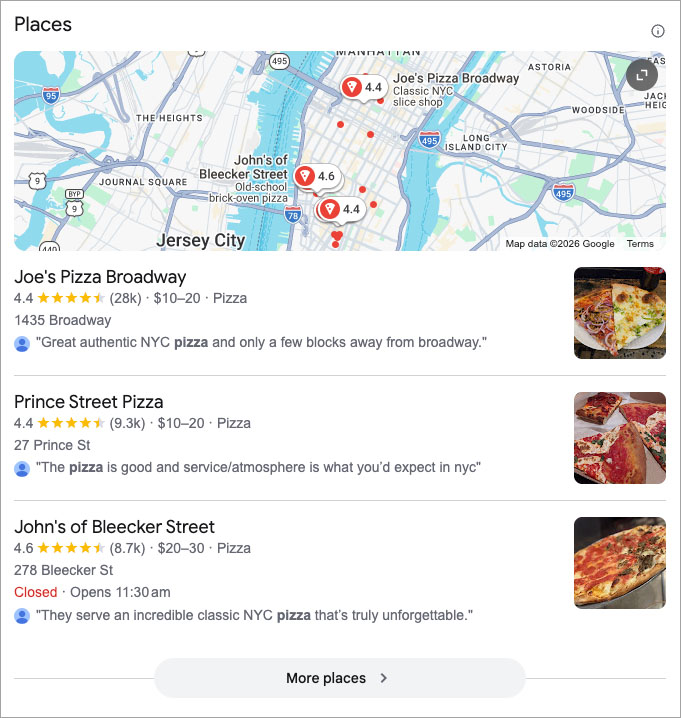
And OpenAI confirms that ChatGPT uses product data supplied by merchants and third-party providers when generating shopping results.
So, I’d recommend:
- Keeping your product information accurate: make sure descriptions, specifications, prices, and availability are correct and regularly updated.
- Using Google Merchant Center: submit an accurate product feed if you sell physical products online.
- Adding appropriate structured data: use Product and Offer schema markup where relevant.
- Updating your Google Business Profile: make sure your business details, opening hours, and services are accurate.
It’s also worth looking into whether your store building tool supports AI shopping integrations; some ecommerce platforms support sharing product information directly with AI systems.
For example, Shopify’s agentic storefronts let eligible merchants make their products available through AI shopping platforms, including ChatGPT. OpenAI also supports direct product feeds from approved merchants.
Monitor your AI visibility — and act on what you find
The six recommendations above should give you a good starting point for improving your visibility in AI search. But it’s important to check whether your efforts are yielding results — and that’s where monitoring AI visibility comes in.
As mentioned earlier, we use Semrush at Style Factory for this kind of thing.
You can use its AI Visibility Toolkit to:
- Establish a baseline: use the Visibility Overview report to record your current AI Visibility Score, brand mentions, citations, and most frequently cited pages.
- Track important questions: use Semrush’s prompt tracking features to monitor a consistent set of questions relevant to your business. Focus particularly on those associated with purchasing decisions or other commercially valuable actions.
- Keep an eye on competitors: use the Competitor Research and Sources reports to see which competing websites are appearing in AI-generated answers when yours isn’t.
- Check how your brand is being presented: don’t just count mentions. Look at whether AI tools are recommending your products, describing them accurately, or favoring competitors.
- Measure the impact of content updates: record when you make significant changes to your articles, then monitor whether their citation visibility improves over the following weeks.
And don’t forget to compare your AI visibility with actual business outcomes. An increase in citations is encouraging, but an increase in relevant traffic, inquiries, or sales is ultimately more valuable.
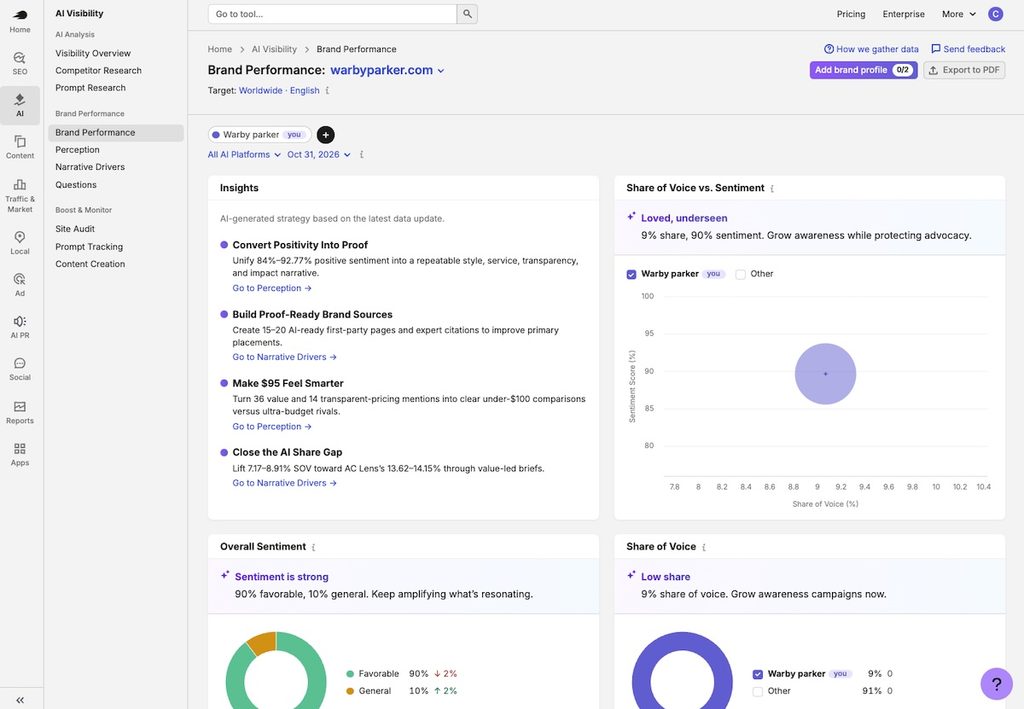
Ultimately, your goal shouldn’t simply be to appear in as many AI-generated answers as possible. It should be to identify — and take advantage of — the opportunities that matter most to your business.
Frequently asked questions about AI search visibility
What is AI search visibility?
AI search visibility refers to how often your website, content, products, or brand appear in AI-generated answers from services like ChatGPT, Google AI Overviews, Gemini, and Perplexity. This can take several forms, including citations of your website, mentions of your brand, and recommendations of your products or services. Each type of visibility can have different benefits for your business.
How can I improve my website’s visibility in AI search?
To improve your visibility in AI search, start by following established SEO best practices and ensuring that search engines and relevant AI crawlers can access your content. Then focus on publishing original, up-to-date information that answers your audience’s questions clearly. Creating useful YouTube videos, building genuine brand recognition, and keeping your business information accurate can also help.
Is AI search optimization different from traditional SEO?
AI search optimization, often called generative engine optimization (GEO), has a lot in common with traditional SEO. Both benefit from accessible websites, high-quality content, clear page structures, and a strong online reputation. However, GEO also involves monitoring how AI systems cite, describe and recommend your content or brand — something that conventional search ranking reports don’t fully capture. In most cases, it’s best to treat GEO as an extension of SEO rather than a replacement for it.
Do you need an llms.txt file to appear in AI-generated answers?
No. An llms.txt file is not a requirement for appearing in AI-generated answers. Google has explicitly confirmed that it doesn’t use llms.txt files for Search, including AI Overviews and AI Mode. There’s also insufficient evidence that adding one will materially improve your visibility across other AI platforms. It’s best to prioritize crawlability, original content, and established SEO practices instead.
Does structured data help with AI search visibility?
Structured data can help search engines understand information about your website, products, and business. For example, Product and Offer schema markup can describe product specifications, prices and availability. However, Google has stated that no special structured data is required to appear in AI Overviews or AI Mode. Use relevant, accurate schema markup where appropriate, but don’t expect it to guarantee AI citations.
How can I get my products recommended by ChatGPT?
Start by making sure accurate information about your products is available online, including descriptions, specifications, prices, and availability. If you use an ecommerce platform that supports AI shopping integrations, investigate whether your products can be made available through them. For example, Shopify supports product discovery through AI shopping platforms, while OpenAI provides product feed integrations for approved merchants. These steps can make your products easier to discover and evaluate.
How can I track my website’s visibility in ChatGPT and other AI tools?
You can check your AI visibility manually by asking relevant questions in ChatGPT, Gemini, Perplexity, and other AI tools, then looking for mentions of your brand and citations of your content. For more systematic monitoring, tools like Semrush let you track AI visibility, monitor important prompts, and compare your performance with competitors. You should also check your website analytics for traffic and conversions originating from AI services.
Does appearing in AI-generated answers increase website traffic?
Not necessarily. AI-generated answers often provide users with enough information to answer their questions without visiting the original sources. A 2025 Pew Research Center study found that users clicked source links within Google’s AI Overviews in just 1% of searches where an AI Overview appeared. However, AI visibility can still generate brand awareness, influence purchasing decisions, and lead to commercial opportunities. For this reason, it’s important to measure more than citations alone.

No comments