

Ahrefs vs Profound: which tool is better for tracking AI visibility? In this comparison, I explore the key differences to help you choose the right platform for your needs.
Quick verdict
Profound is a good option if your main goal is to monitor how your brand appears for a very defined set of AI prompts over time. Its prompt-monitoring model makes it easy to track visibility, sentiment and citation share across multiple AI systems, and it also includes some interesting specialist features that you won’t find in Ahrefs — such as prompt demand estimates and AI shopping analysis.
However, for most businesses, Ahrefs is probably the more logical investment. AI visibility still depends heavily on many of the same signals that influence traditional SEO — including backlinks, content authority and technical site quality — and Ahrefs gives you a huge range of tools to ensure your SEO is good. It doesn’t just show you where your brand appears in AI responses; it also helps you analyze and improve the underlying signals that influence that visibility in the first place.
| Key reasons to use Ahrefs | Key reasons to use Profound |
| Analyzes a much larger dataset of AI prompts and responses | Better for tracking prompt performance over time |
| Makes it easier to explore how brands appear across entire industries and topics | Includes AI brand sentiment analysis features |
| Reveals which websites and publishers influence AI-generated answers | Estimates demand for prompts being asked inside AI engines |
| Tracks brand discovery across platforms like YouTube, TikTok and Reddit | Monitors a wider range of AI platforms |
| Gives you access to a huge range of SEO tools that help ensure AI visibility in the first place. | Includes specialized analysis for AI shopping and product discovery |
The rise of AI visibility tracking tools
As AI tools like ChatGPT, Gemini and Perplexity become more widely used, the way people discover information online is starting to change. Instead of scrolling through lists of links in traditional search engines, users are increasingly receiving direct answers from generative AI systems.
For businesses, this raises a new question: how visible is my brand in AI answers?
To help marketers get a handle on this, a new category of AI visibility tracking tools has emerged. These analyze how brands, websites, and products appear in AI-generated responses, and help organizations optimize their content to increase visibility in them. You’ll often see this optimization process described using terms like AEO (Answer Engine Optimization) or GEO (Generative Engine Optimization).
Two of the more prominent platforms in this emerging area are Ahrefs’ Brand Radar and Profound. Both tools are designed to help organizations understand their presence in AI responses — but they approach the challenge from different directions.
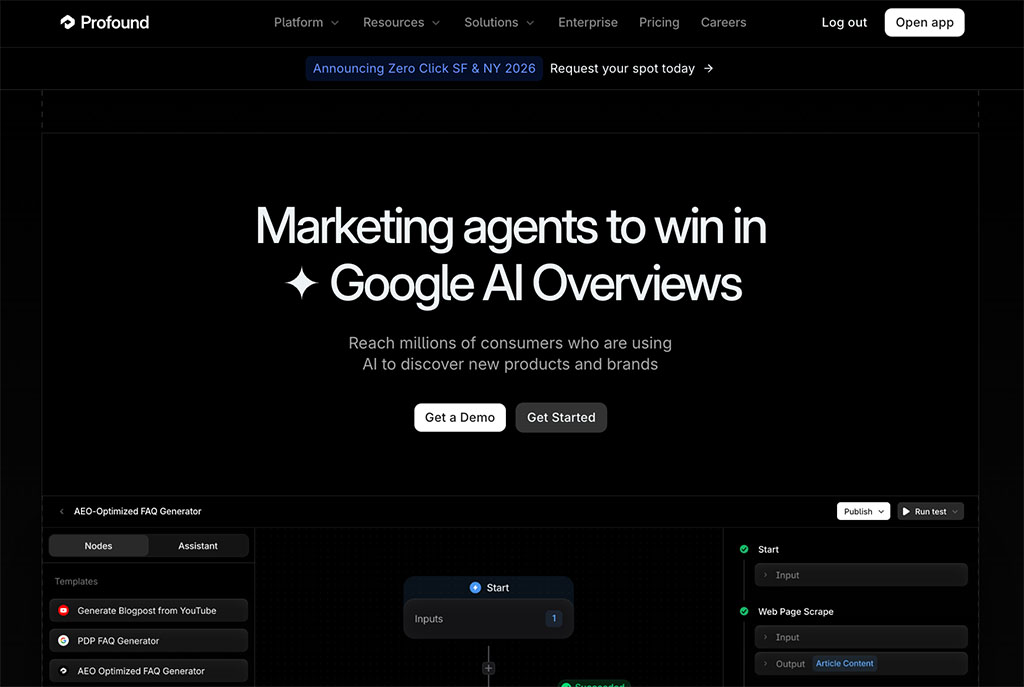
Profound is primarily built around prompt monitoring. It allows teams to track how their brand appears for specific queries across multiple AI platforms, and provides metrics like visibility scores, sentiment signals and citation share.
Ahrefs’ Brand Radar, meanwhile, puts more emphasis on analyzing large datasets of AI answers. Instead of focusing exclusively on a predefined list of prompts, it allows users to explore how brands, websites and sources appear across a much broader set of AI conversations.
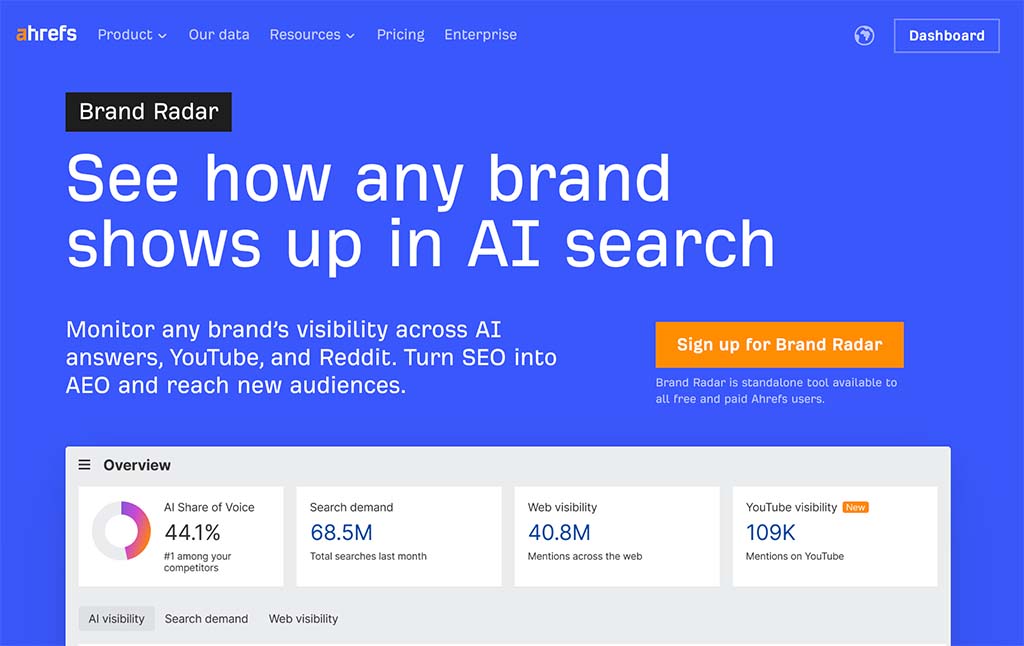
That said, the distinction isn’t completely black and white. Profound also includes tools for prompt research and brand narrative analysis, while Brand Radar now provides extensive custom prompt monitoring capabilities too.
In practice, however, the platforms still tend to emphasize different workflows. Profound is organized more exclusively around structured prompt monitoring and longitudinal tracking, while Ahrefs combines prompt monitoring with broader exploratory analysis across its indexed dataset.
In what follows, I’ll take a closer look at how these two approaches differ — and in which situations each platform may have the edge.
I’ll start with the key advantages that Ahrefs has over Profound, and then move on to the areas where Profound might be the better solution.
Reasons to use Ahrefs over Profound
1. Ahrefs analyzes a far larger dataset of AI prompts
One of the biggest differences between Ahrefs’ Brand Radar and Profound comes down to how the tools collect and use data.
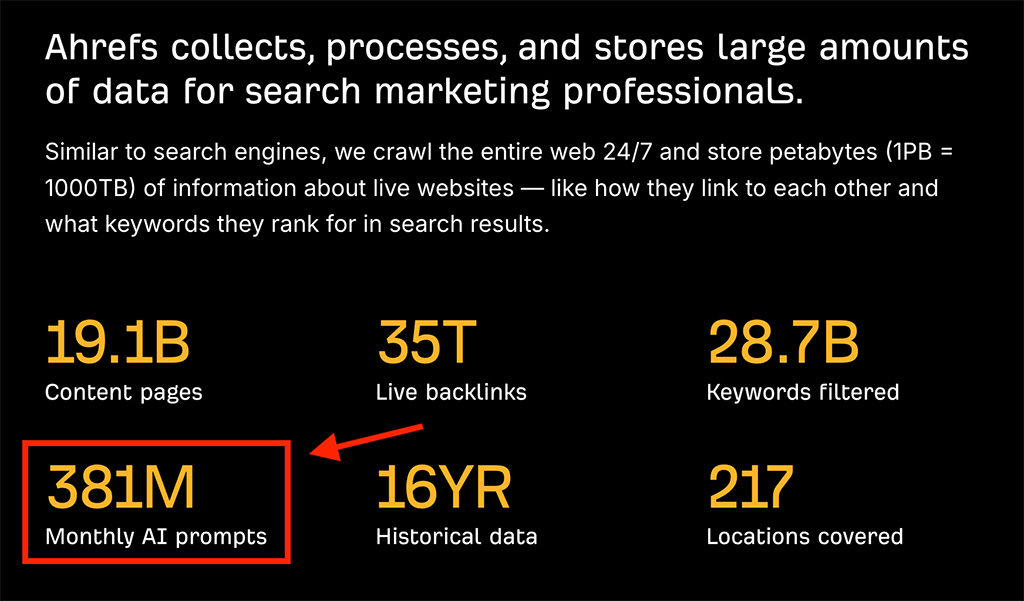
Ahrefs’ Brand Radar is built on a very large, pre-collected dataset of AI prompts and responses (380+ million prompts per month are covered by the tool). In simple terms, this means it already has information about how AI tools respond to a huge number of questions.
Because of this, you can explore a wide range of topics straight away. For example, instead of just tracking a few prompts you’re interested in, you can look at an entire category — like “email marketing tools” — and see which brands AI tools mention most often.
Profound works differently. Instead of giving you a big dataset to explore, it focuses on tracking specific prompts that you choose.
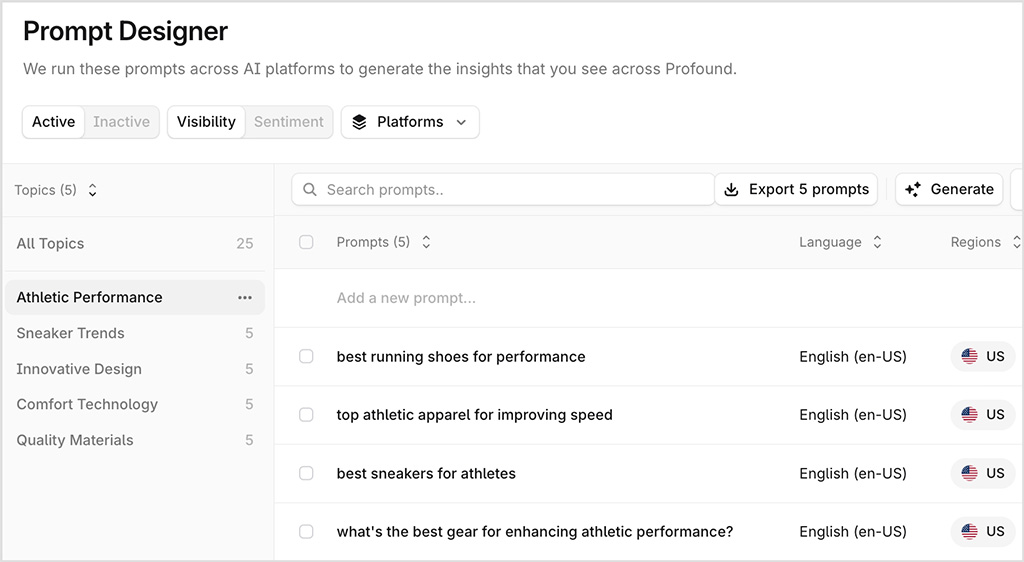
So, you might enter a list of important queries — for example, “best ecommerce platform” or “Shopify alternatives” — and then monitor how your brand appears in AI answers for those queries over time.
Ahrefs now supports custom prompt monitoring too, including AI-generated prompt suggestions, thematic prompt grouping and prompt tagging. However, custom monitoring still feels more like an extension of Brand Radar’s broader exploratory dataset, whereas Profound’s platform is fundamentally organized around prompt monitoring workflows from the outset.
In short:
- Ahrefs helps users discover how brands appear across a very large universe of AI conversations, while also supporting custom prompt monitoring where needed.
- Profound is designed more specifically for monitoring how brands perform over time for carefully defined sets of prompts.
So, Profound’s model works well for structured monitoring. However, it also means the scope of analysis is typically limited to the particular prompts being tracked (and on Profound’s non-enterprise plans, monitoring is capped at just 50–100 prompts).
By contrast, Brand Radar’s indexed dataset allows users to explore visibility across a far larger prompt universe — without relying primarily on predefined prompt sets.
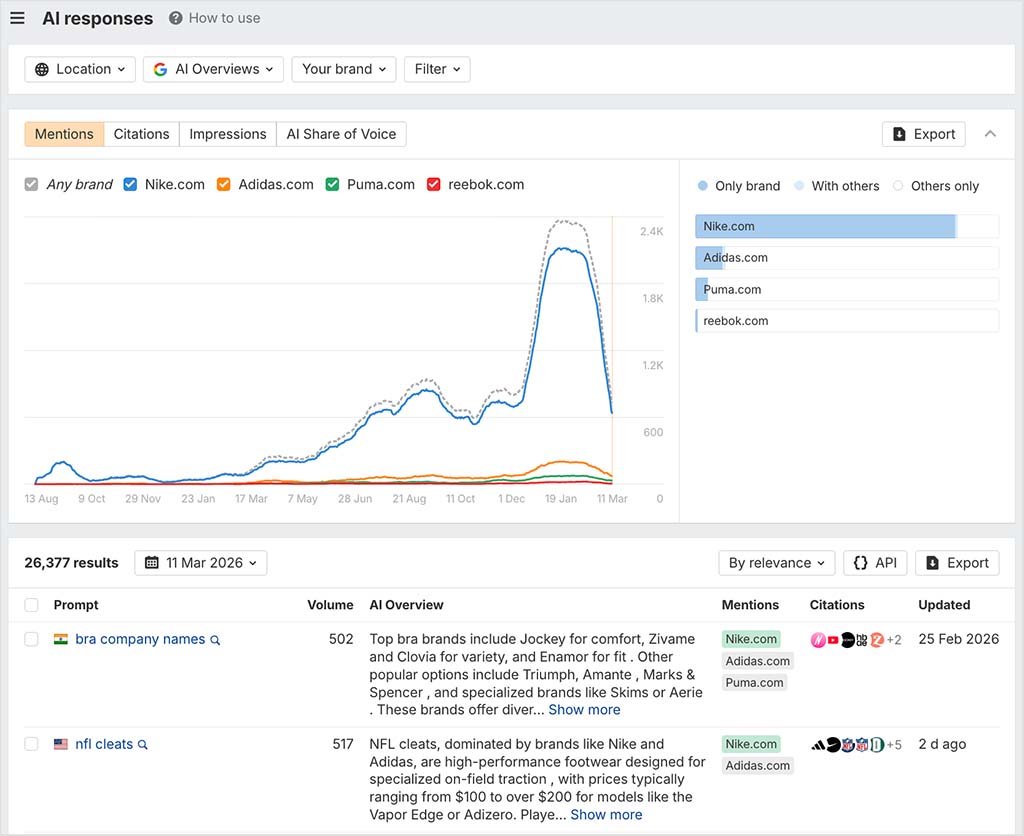
This architecture also ties into Ahrefs’ broader data infrastructure. The company has spent more than a decade building some of the biggest SEO datasets on the web, including:
- a 28.7 billion keyword database
- more than 35 trillion backlink records
- 16 years of historical data
- 19.1 billion indexed web pages.
Because Brand Radar sits on top of this broader data infrastructure, it functions less like a simple monitoring dashboard — it’s more like a research engine for understanding how brands appear across AI-generated answers.
2. Ahrefs reveals where AI recommendations actually occur
Another advantage of Brand Radar’s large prompt dataset is that it helps marketers understand where AI platforms actually introduce products and brands within conversations.
Many companies begin their AI visibility strategy by monitoring obvious commercial prompts such as:
- “best CRM software”
- “best running shoes”
- “top email marketing platforms.”
These queries are certainly important. However, they represent only a small portion of the situations where AI platforms mention brands.
In practice, AI systems often introduce products within problem-focused or informational prompts, such as:
- “how to organize remote teams”
- “how to prevent knee pain when running”
- “tools for managing multiple projects.”
In these cases, the user may not be asking for a product recommendation. But AI engines often introduce tools or brands to consider when trying to help them solve their problem.
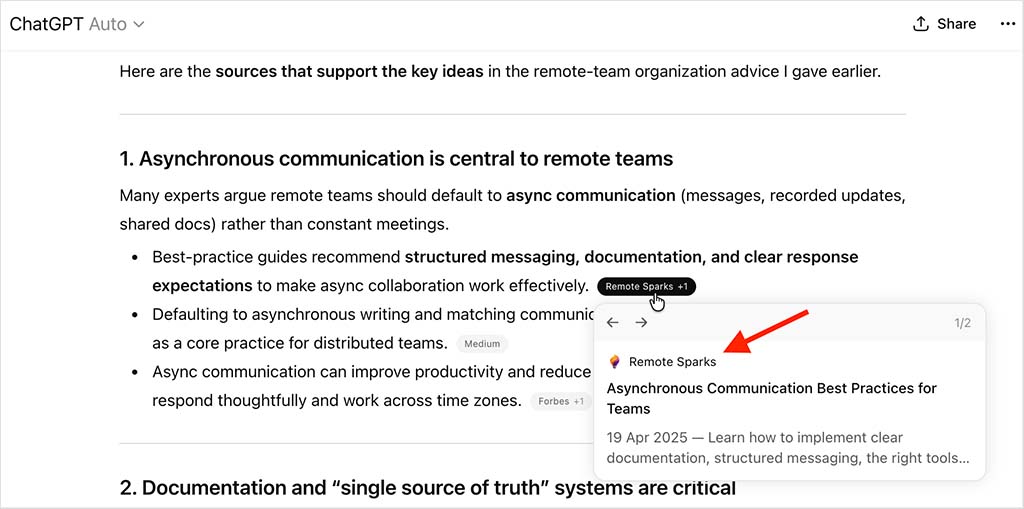
Because Brand Radar analyzes a very large dataset of prompts and AI responses, marketers can explore these sorts of contexts, and identify the types of conversations where their brand surfaces.
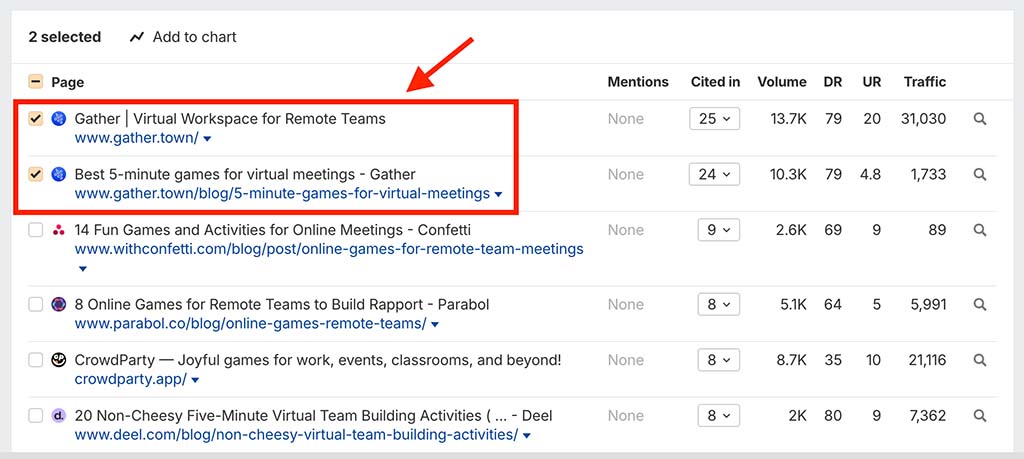
In my testing, this made it easier to uncover the informational and problem-solving queries where brands naturally surface in AI answers — contexts that might otherwise go unnoticed.
For example, a company might discover that its product rarely appears in “best product” prompts but frequently surfaces in how-to queries, industry explanations or problem-solving discussions.
Prompt monitoring platforms like Profound can also track visibility for individual queries — including informational or “how-to” prompts. However, because monitoring usually begins with prompts defined by the user, uncovering these broader recommendation contexts often requires more manual prompt research and experimentation.
3. Ahrefs makes competitor research in AI search much easier
Another advantage of Brand Radar’s indexed dataset is that it makes it easy to compare how competing brands appear across AI-generated answers.
Rather than beginning primarily with predefined prompt sets, users can enter a brand and add competitors to quickly see how often different companies are mentioned across key AI platforms.
For example, you could use Brand Radar to compare how sports brands like Nike, Adidas and Puma appear across ChatGPT, or analyze how ecommerce platforms like Shopify, WooCommerce and BigCommerce are surfaced within Google’s AI Overviews.
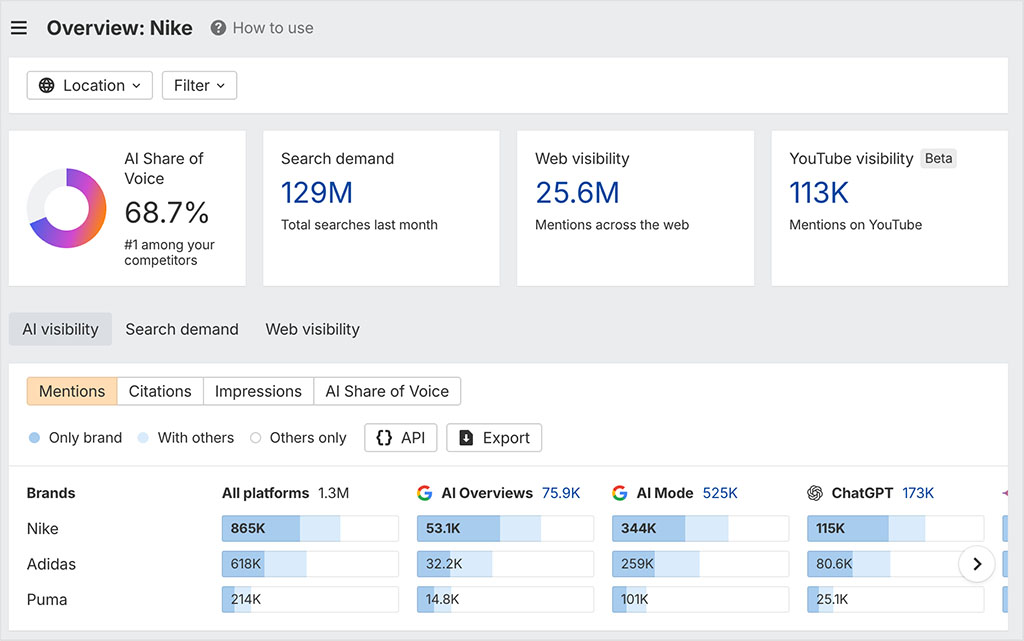
Because Brand Radar’s dataset is indexed in advance, these comparisons can be explored immediately across a broad universe of existing AI responses. And this makes it easier to understand which brands AI systems most frequently associate with a particular topic or industry.
Now, Profound can also be used for competitive research. However, because it typically relies on running predefined prompts and collecting results over time, building a comparable competitor-level view often requires defining a larger set of prompts and waiting for monitoring data to accumulate.
4. Ahrefs makes it easier to identify the publishers shaping AI answers
When AI platforms respond to questions, they typically synthesize information from multiple sources across the web — and understanding which domains appear most frequently in these responses can provide valuable insight into how AI systems construct their answers.
Brand Radar makes it easy to see the websites and publishers that are cited most often in AI-generated responses. Using the tool, marketers can investigate:
- which domains AI systems cite most frequently for a particular topic
- which publishers dominate AI answers within a specific industry
- how often certain websites appear as sources across different prompts.
In many industries, a relatively small number of websites tend to supply a large share of the content that AI engines draw upon — and Brand Radar lets you spot these easily.
Ahrefs has also expanded its “cited-pages” reports considerably. Users can now see page-level authority metrics such as DR and UR alongside traffic data and page-type classification, making it easier to understand not just which pages influence AI answers, but why AI systems may be relying on them.
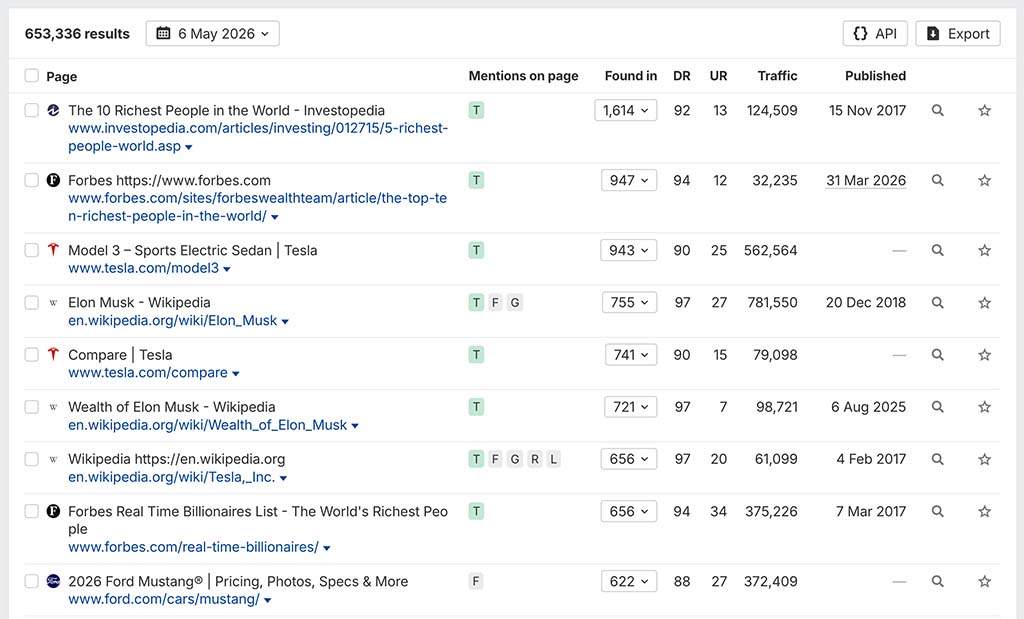
In practice, the pages cited most often in AI-generated answers frequently share characteristics associated with strong SEO performance — such as authoritative domains, strong backlink profiles and well-structured informational content.
In other words, many of the same signals that influence traditional search visibility still appear to shape AI citations.
Understanding these signals can be extremely useful when developing a strategy for AI visibility. If you know which websites AI engines consistently reference in response to queries relating to your niche, you can analyze the content they contain — and create your own material that covers similar topics and uses similar keywords.
(Note however that you really will have to focus on quality and depth of coverage here — it’s not enough just to create a few articles that are similar to those of your competitors.)
Profound also provides visibility into citation sources within monitored prompts, allowing users to see which domains and pages are referenced in specific AI responses. However, because this analysis is tied to the prompts you’ve defined, identifying broader publisher influence typically requires expanding the monitored prompt set (something that can involve a bit of guesswork).
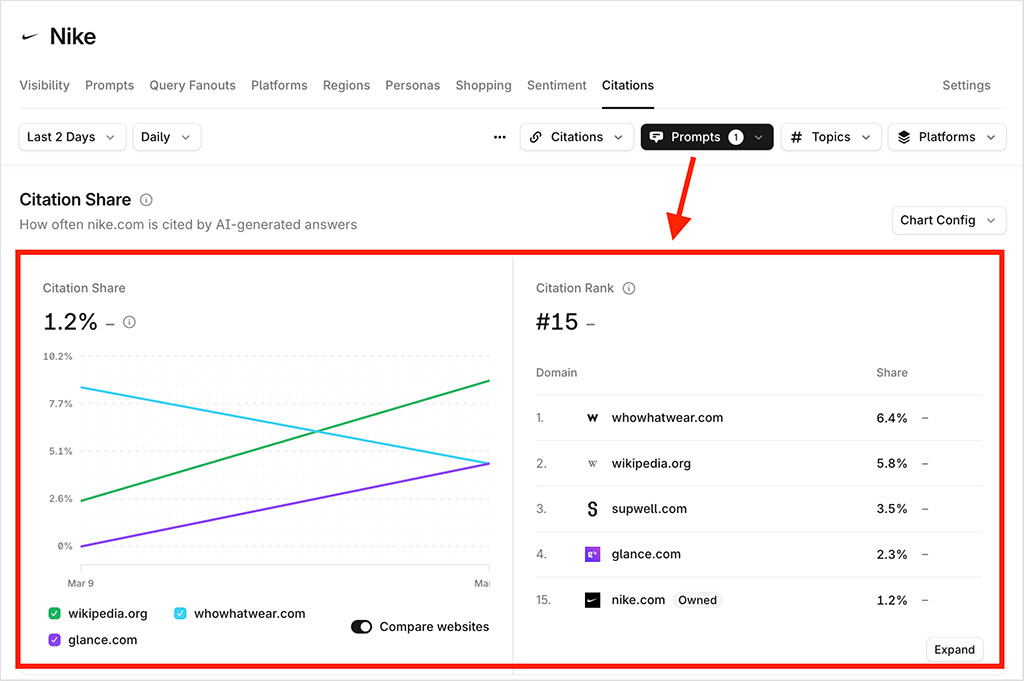
By revealing which websites shape AI responses, Brand Radar helps marketers understand not just whether their brand appears in AI answers, but which sources — and which authority signals — influence those answers in the first place.
5. Ahrefs tracks brand discovery across creator and community platforms
Another distinctive capability of Brand Radar is its ability to track brand visibility across creator and community platforms (specifically YouTube, TikTok, and Reddit).
These platforms generate enormous volumes of user-generated product reviews and brand comparisons. As a result, they often play an important role in shaping online discovery — both within AI tools and, thanks to Google’s insistence on placing Reddit threads at the top of organic results, within traditional search.
Brand Radar now includes dedicated indexes that track brand mentions across:
- YouTube and TikTok videos
- Reddit discussions that appear in Google Search results
For video platforms, Brand Radar scans video titles, descriptions and transcripts for brand mentions. Rather than indexing entire videos, the system surfaces short snippets around those mentions, allowing teams to quickly identify which creator content references their brand, and to understand the context in which it appears.
Ahrefs has recently expanded this functionality to show how often YouTube videos are cited within AI-generated responses, with citation data broken down by chatbot. This makes the feature considerably more strategic: marketers can use it to identify not just which creators mention a brand, but which videos are influencing AI-generated answers themselves.
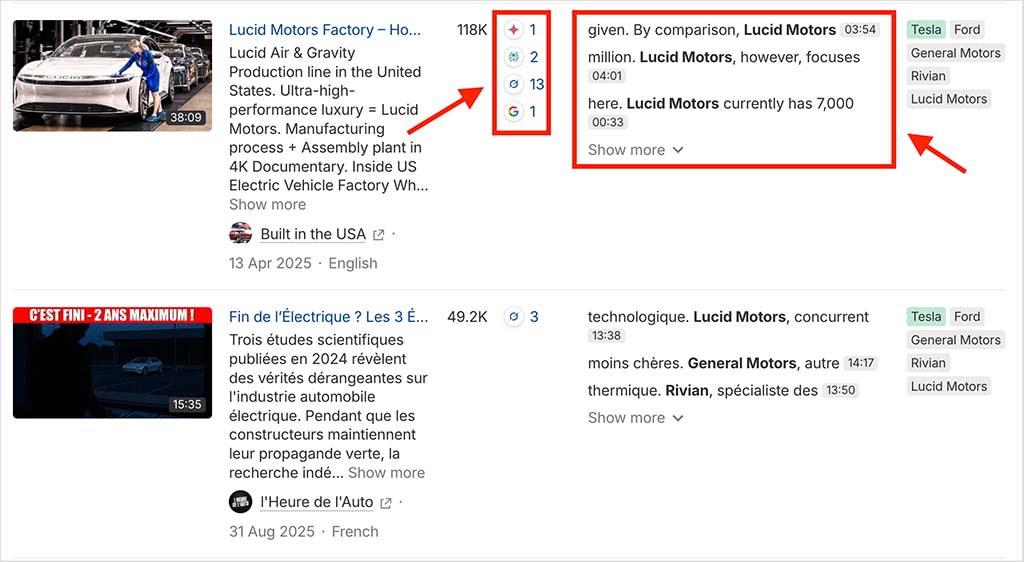
In practice, this can help organizations understand:
- which creator formats AI systems appear to favor
- which publishers are shaping AI recommendations
- which types of video content are most likely to surface in conversational search environments.
The platform also tracks Reddit threads that surface in Google search results, highlighting discussions where users recommend, compare or criticize products. These conversations often influence both search visibility and brand perception.
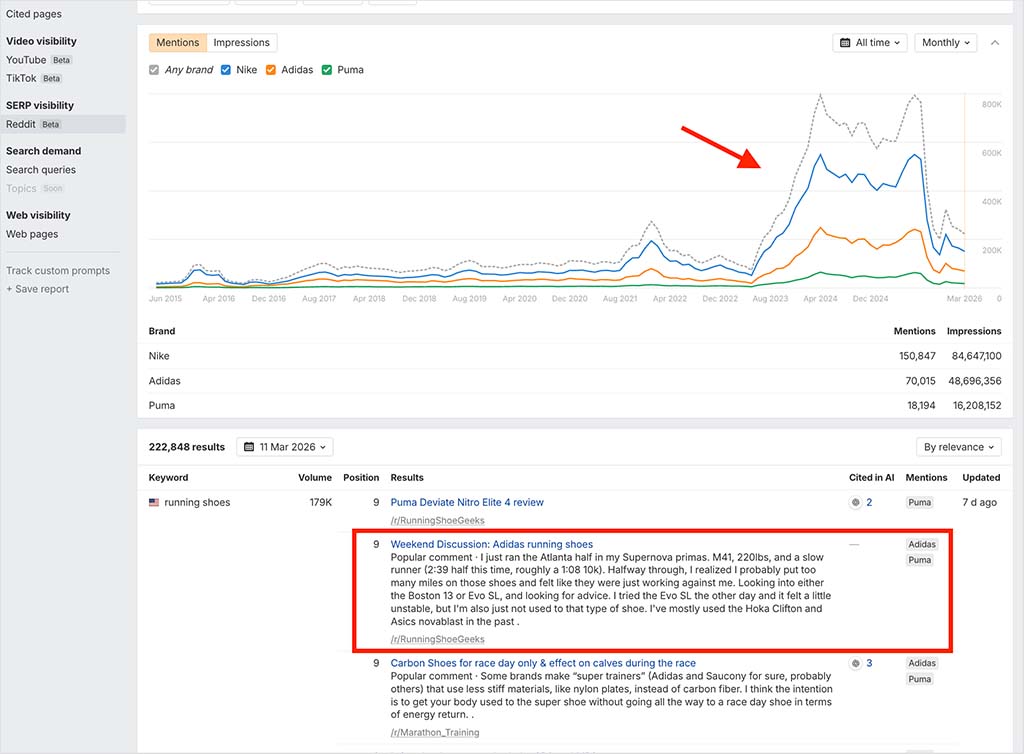
By tracking brand mentions across these ecosystems, Brand Radar helps marketers monitor the conversations that shape brand discovery across the wider web — and, where necessary, to contribute to them.
By contrast, Profound focuses more directly on tracking how brands appear within AI-generated responses themselves. While this provides useful visibility data, it gives you less insight into the origins of these answers.
6. Ahrefs doesn’t just give you AI visibility insights — it provides SEO data too
A key advantage of Brand Radar over Profound is that it sits inside the broader Ahrefs SEO platform, rather than operating as a standalone AI visibility tool (note: it can be purchased separately, but many users will access it through the main Ahrefs tool).
Founded in 2010, Ahrefs has spent over fifteen years building one of the largest SEO data infrastructures on the web. Its platform includes tools for:
- keyword research
- backlink analysis
- technical SEO audits
- competitor analysis
- rank tracking.
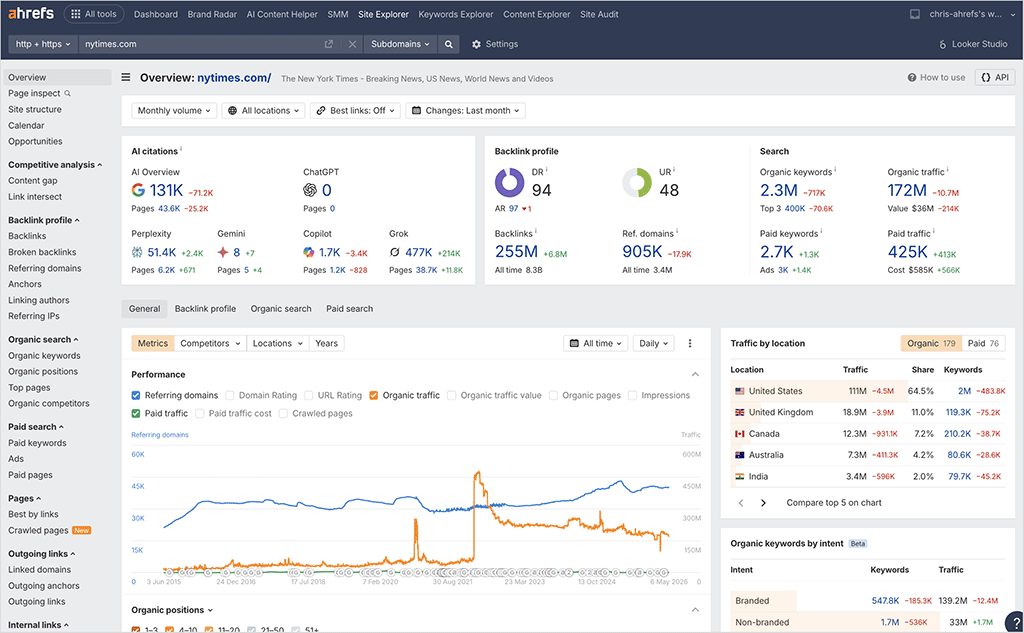
Because Brand Radar is integrated into this ecosystem, users can move directly from AI visibility insights to practical optimization work.
For example, if Brand Radar reveals that a competitor frequently appears in AI answers for a particular topic, a marketer can immediately investigate:
- which web pages AI systems cite as sources
- which keywords those pages target
- what backlinks support those pages
- whether technical SEO factors influence their visibility.
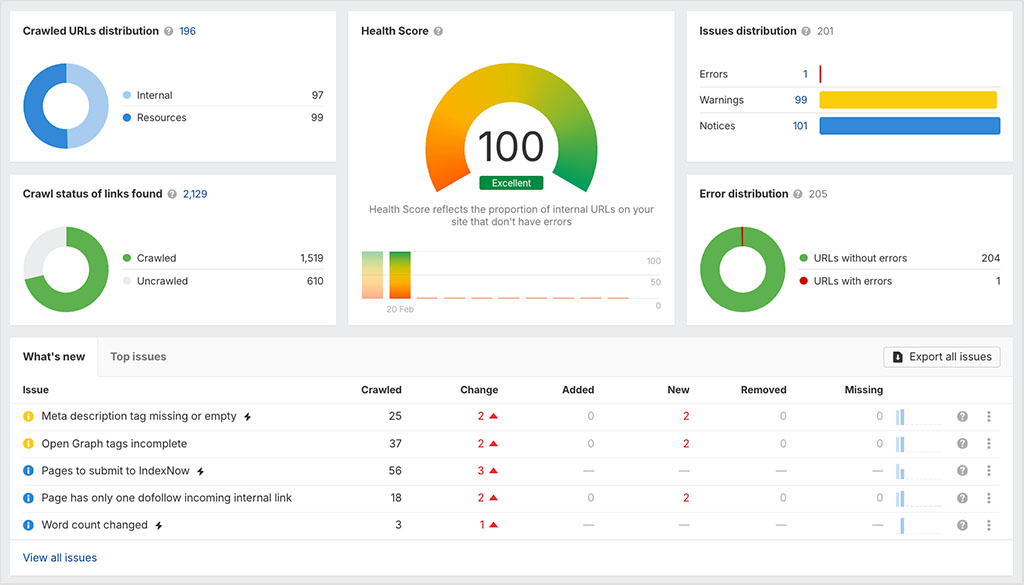
This ability to move quickly from insight to execution is particularly important, because AI visibility is still very much dependent on web content in general. As a result, improving AI visibility often still involves strengthening the same signals that influence traditional search rankings.
And although AI platforms are growing rapidly, traditional search engines remain the dominant source of website traffic. Traditional search still drives a large share of global web referrals, while AI engines such as ChatGPT currently generate only a small fraction of visits.
Ultimately, because Ahrefs combines AI visibility research with a full SEO toolkit, teams can investigate opportunities and implement improvements within a single platform.
A standalone AI visibility tool like Profound can show whether a brand appears in AI responses. However, turning those insights into actionable improvements typically requires additional tools for keyword research, technical SEO and competitor analysis.
7. Ahrefs offers more flexible scaling for AI prompt monitoring
Both Ahrefs and Profound allow users to track how their brand appears in AI responses for particular queries. However, the two platforms approach this type of monitoring in different ways. Profound uses a fixed prompt limit model tied to pricing tiers. For example:
- Starter ($99/month) — up to 50 prompts
- Growth ($399/month) — up to 100 prompts
- Enterprise (custom pricing) — tailored prompt tracking plan
These prompts are then executed across supported AI engines to generate visibility reports.
Brand Radar takes a different approach. Instead of allocating a fixed number of prompts, it measures monitoring activity through a system of “checks.”
Each check represents a prompt being executed on a particular AI platform and location. Users can also control how frequently prompts are run — for example daily, weekly or monthly — allowing teams to manage how quickly checks are consumed.
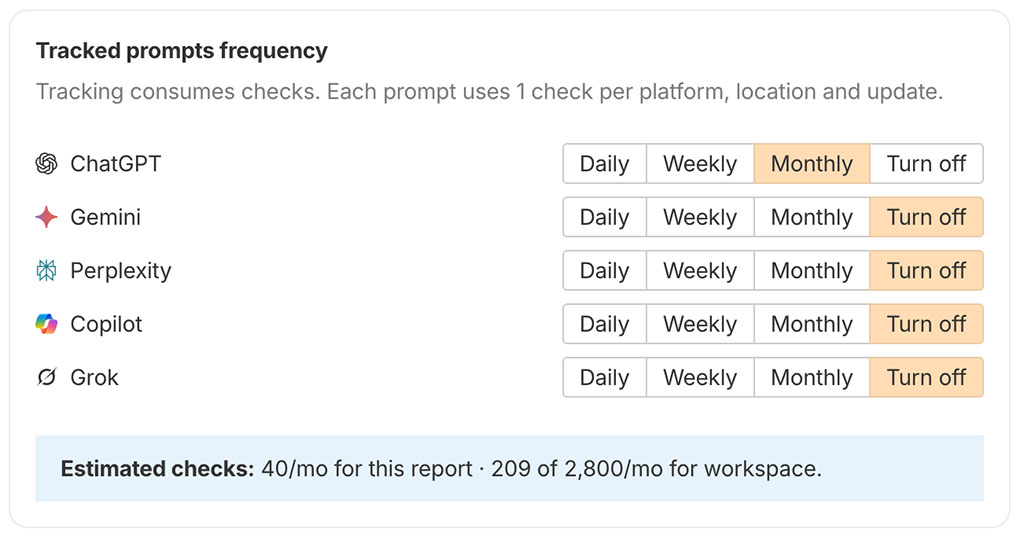
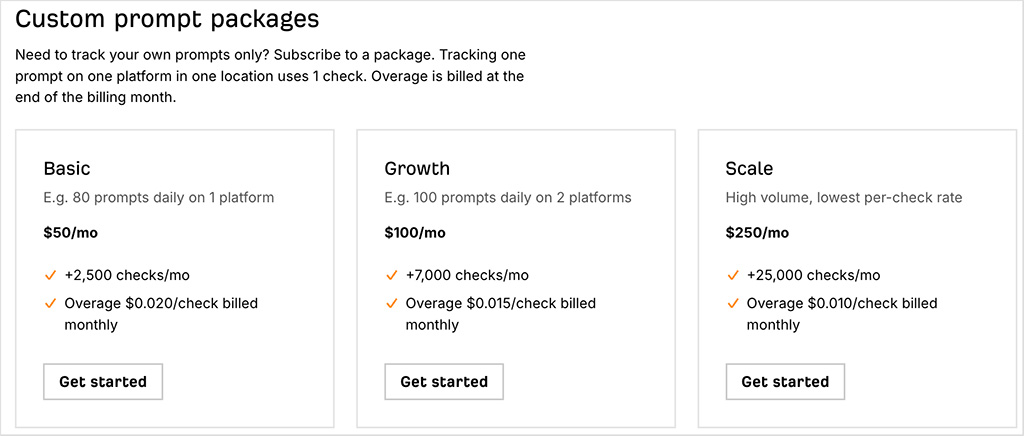
Additional monitoring capacity can be added through transparently priced packages, for example:
- $50 per month — 2,500 checks
- $100 per month — 7,000 checks
- $250 per month — 25,000 checks.
This usage-based model allows organizations to scale monitoring gradually rather than upgrading to entirely new plan tiers every time they want to track more prompts.
Brand Radar also supports prompt checks across around 180 countries, while Profound supports 60 markets.
Reasons to use Profound over Ahrefs
1. Profound estimates demand for AI prompts
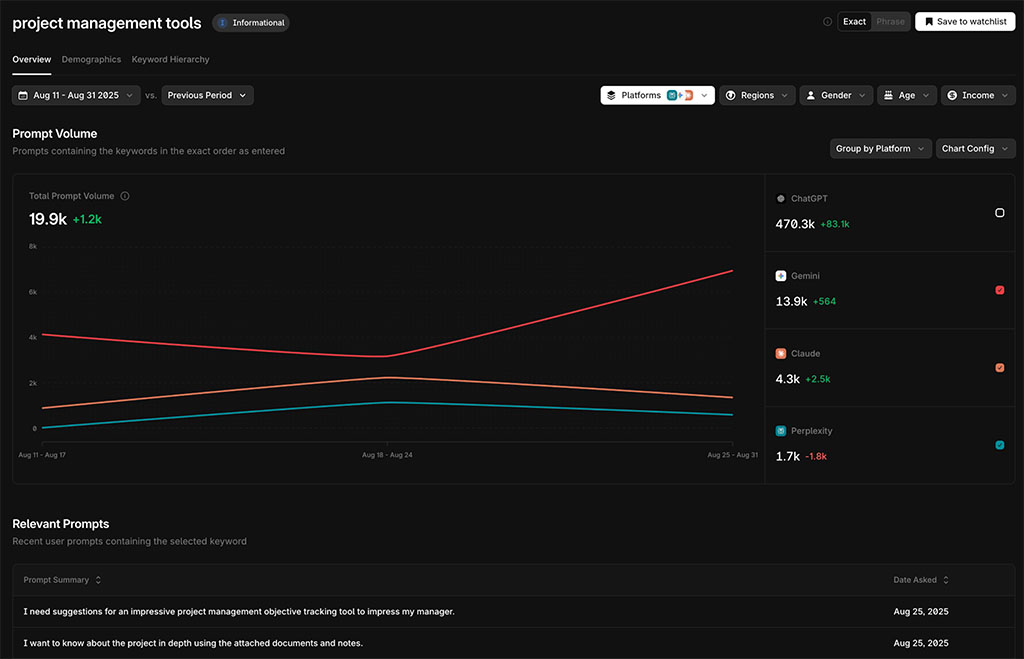
A distinctive capability of Profound is its Prompt Volumes dataset, which attempts to estimate how frequently particular prompts are used inside AI answer engines.
To build this dataset, Profound licenses anonymized prompt data from large panels of AI platform users. These prompts are aggregated using probabilistic statistical modeling to estimate how often similar questions occur across the wider population of AI users.
This allows Profound to estimate demand for AI prompts (in a similar way to how SEO tools provide keyword search volume).
Within the interface, users can explore:
- estimated prompt volumes for different topics
- related prompts and conversational variants
- trend data over time
- segmentation by AI platform, region or demographic group.
In practice, this helps teams identify which questions appear to attract meaningful demand within AI tools, not just which prompts mention their brand.
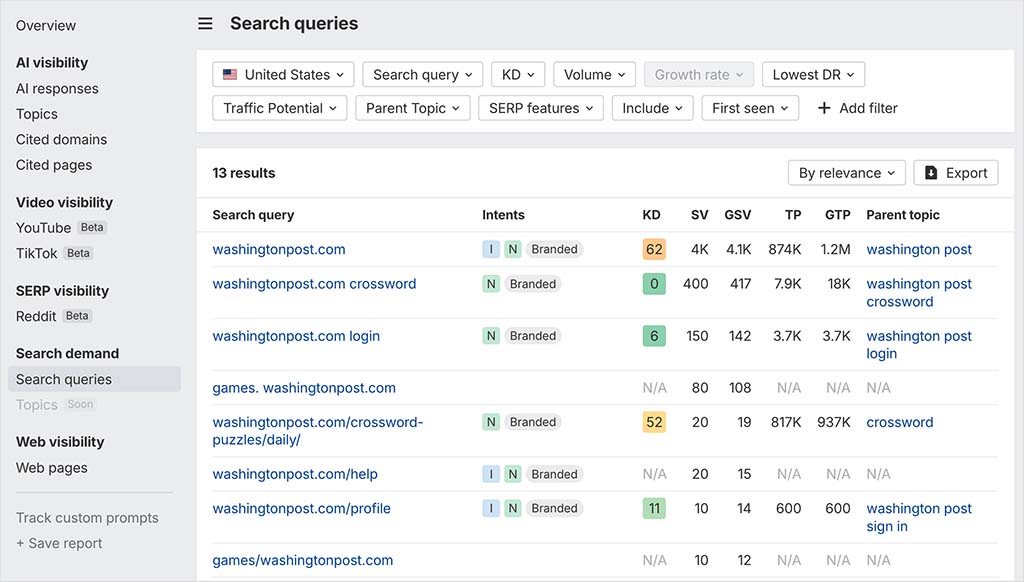
Brand Radar approaches demand signals differently. Instead of estimating prompt frequency from AI conversations, it analyzes prompts derived primarily from Google search queries and related questions. The platform also includes a ‘Search demand’ section that surfaces relevant search queries connected to monitored topics.
However, these signals are based on traditional search demand, rather than estimates of how often prompts are asked inside AI platforms.
(Ahrefs has argued that accurately estimating “true” AI prompt demand remains difficult because major AI platforms do not publish comprehensive query-level usage data. The company says that because of this, it prefers to anchor Brand Radar around more established search-demand datasets rather than relying heavily on third-party AI prompt-volume estimates.)
As a result, Ahrefs and Profound use noticeably different approaches to estimating AI demand patterns.
- Ahrefs combines roughly 50% AI-generated modeling and 50% traditional search data — blending estimated AI conversations with the kinds of topics and queries people already search for on Google.
- Profound focuses more heavily on simulated AI conversations and prompt datasets — attempting to model the kinds of questions and follow-up interactions people may encounter inside AI tools themselves.
In practice, Profound’s approach may provide useful directional insight into emerging conversational behavior inside AI systems — particularly for teams that want to identify potential AI-native demand patterns earlier.
2. Profound lets you monitor a wider range of AI platforms
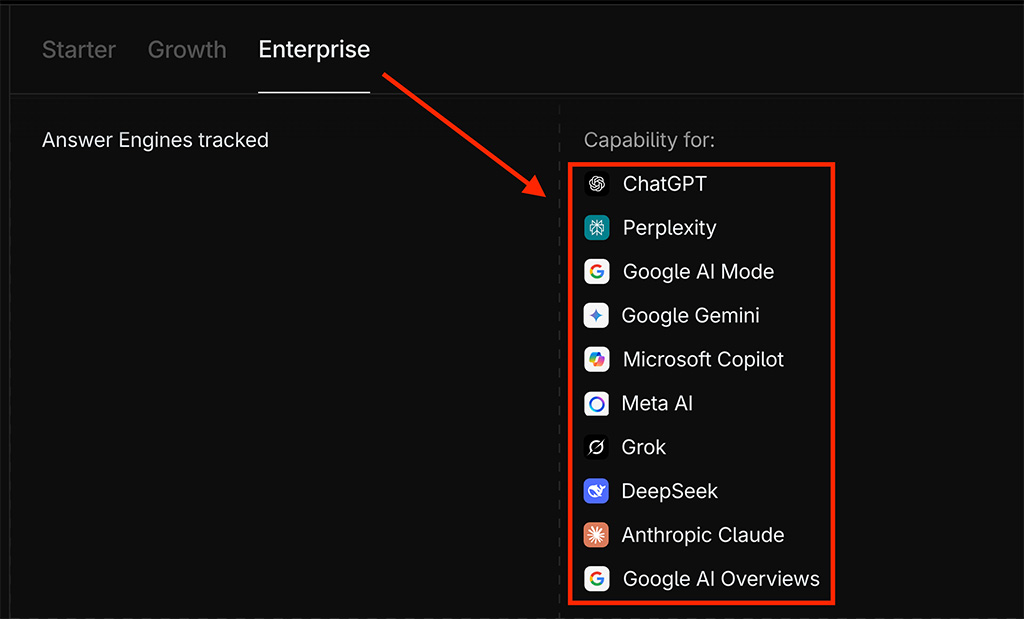
Another advantage of Profound is its ability to track brand visibility across a broad set of AI answer engines. On the highest tier, the platform can show you how brands appear across 10 leading AI engines:
- ChatGPT
- Perplexity
- Google AI Mode
- Google Gemini
- Microsoft Copilot
- Meta AI
- Grok
- DeepSeek
- Anthropic Claude
- Google AI Overviews.
By comparison, Ahrefs’ Brand Radar currently focuses on a smaller group of 7 AI systems: ChatGPT, Google AI Overviews, Google AI Mode, Gemini, Copilot, Perplexity and Grok.
This means that Ahrefs now covers most of the major mainstream AI discovery environments. However, Profound still offers broader platform coverage overall — particularly for organizations that want visibility into emerging or more specialized AI systems such as Claude, DeepSeek and Meta AI.
3. Profound analyzes AI-driven shopping results
Profound includes a shopping analysis module that tracks how products appear and are ranked within AI-generated shopping responses.
When users ask product-related questions inside AI tools — for example “best running shoes for marathon training” or “top high-performance sportswear brands” — AI systems increasingly generate structured product recommendations. Profound analyzes these responses to identify which products appear most frequently, and how their visibility compares with competing items.
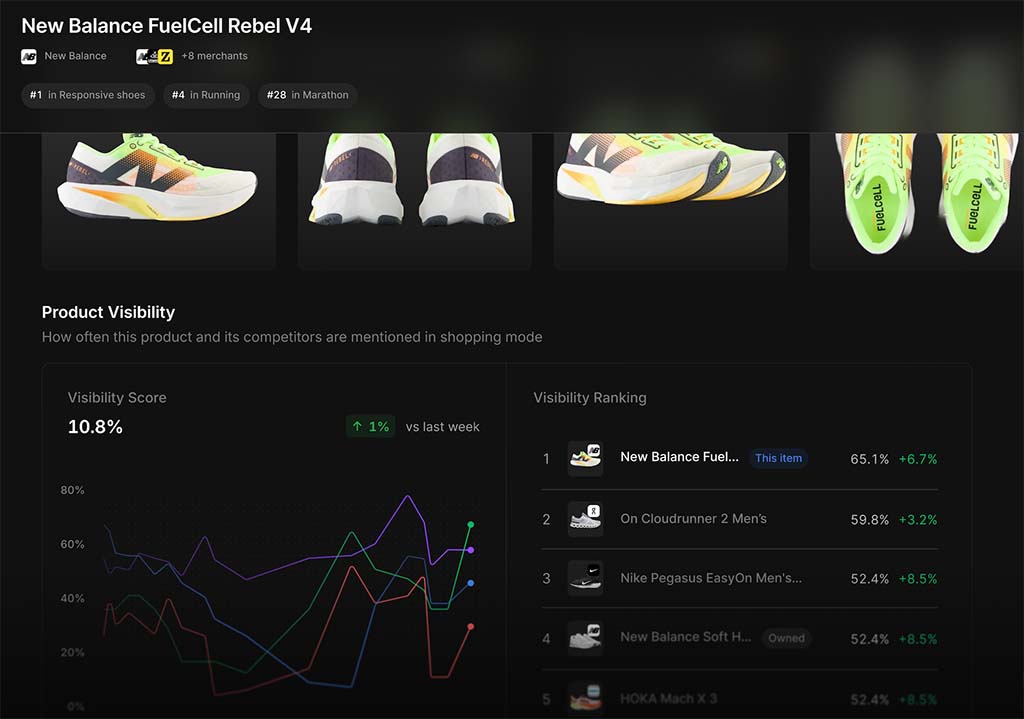
Within the shopping interface, users can explore:
- product visibility scores
- rankings of competing items
- changes in visibility over time
- the merchants associated with recommended products.
In addition to overall product visibility, Profound also analyzes which product attributes appear most prominently in AI shopping recommendations. These attributes can include factors such as comfort, breathability, price range or performance characteristics.
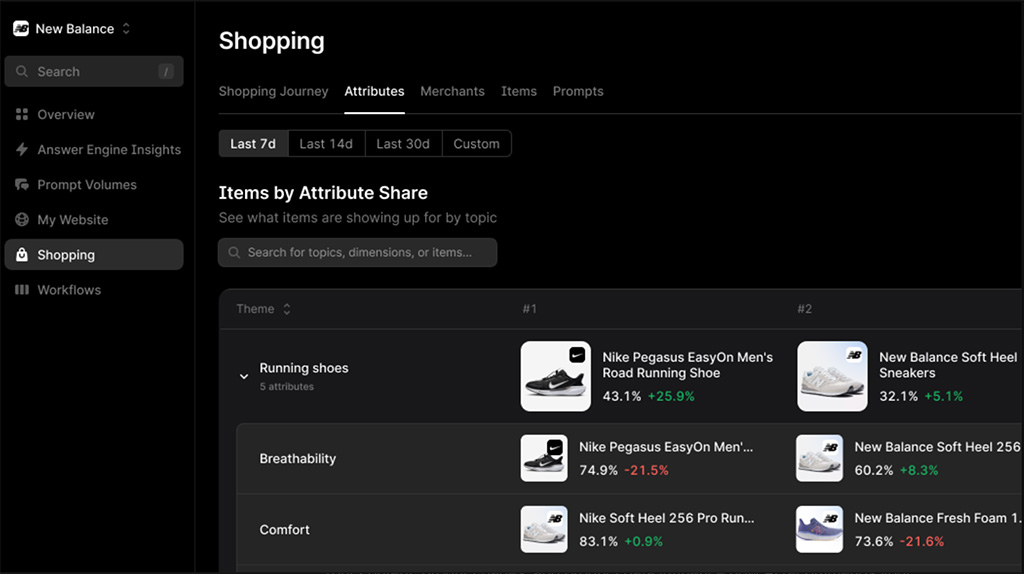
The platform also provides placement tracking metrics, competitive benchmarking data, and retailer mapping tools designed to help ecommerce teams understand how AI platforms recommend products.
Profound also offers ‘Agent Analytics for Shopify,’ which monitors when AI answer engines access a Shopify store, and which product pages they visit during product research.
This feature is powered through an integration with Nostra, a platform that detects visits from AI agents and answer engines. Once connected to a Shopify store, it can reveal which product pages AI systems are reviewing as part of their research and recommendation processes.
These capabilities are likely to be particularly useful for ecommerce brands and marketplace sellers operating in competitive product niches — and there’s not really an equivalent feature set provided by Ahrefs yet.
4. Profound connects AI crawler activity more directly to AI referral insights
Many AI systems use specialized bots and retrieval agents to access website content that may later appear in AI-generated answers. Examples include crawlers such as GPTBot, ClaudeBot and PerplexityBot.
Profound’s “Agent Analytics” feature is designed to help organizations understand how these AI systems interact with their websites.
Like Ahrefs’ own Bot Analytics feature, it can identify which AI crawlers are visiting a site, which pages they access most frequently, and how AI bots interact with website content over time.
For example, marketers may notice that certain page types — such as comparison articles, glossary pages or buying guides — are repeatedly accessed by AI crawlers, potentially indicating that these pages play an important role in AI-generated answers.
However, Profound goes slightly further by attempting to connect this activity to broader AI visibility and referral insights.
The platform can help teams analyze how AI-driven discovery may translate into indexing, citations or AI-originated referral traffic — providing a more direct link between crawler activity and AI-search visibility outcomes.
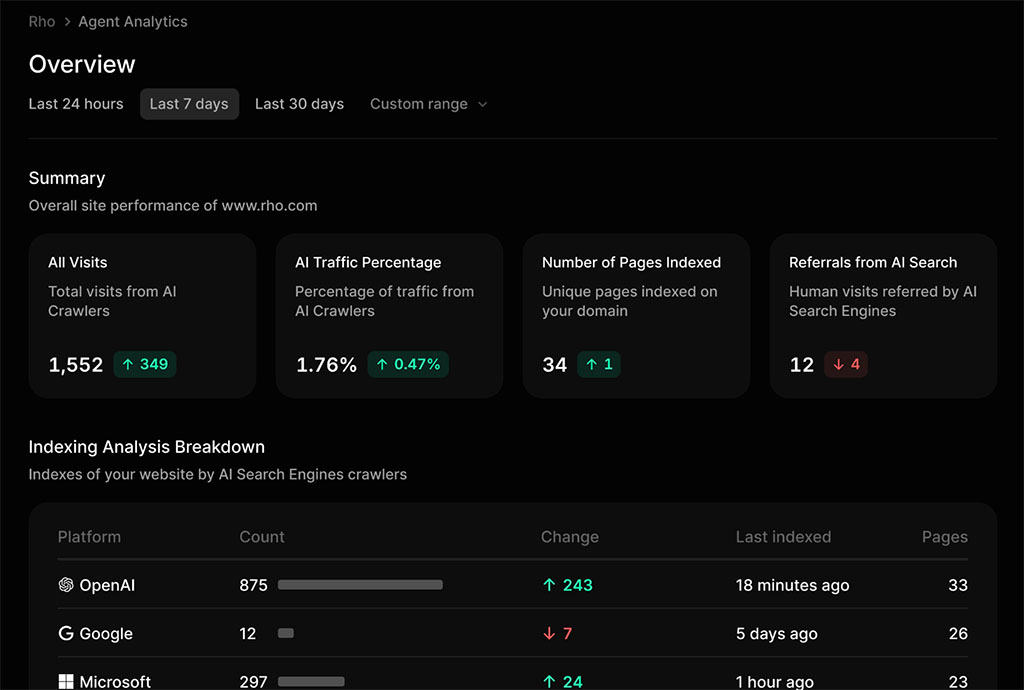
Ahrefs approaches this area through two separate features.
Its Web Analytics tool includes AI traffic filters that allow users to identify visits originating from AI systems and answer engines. This provides visibility into referral traffic from AI platforms themselves.
Additionally, Ahrefs’ newer Bot Analytics feature provides detailed server-side analysis of crawler activity across websites. This includes AI crawlers, search-engine bots, SEO crawlers and other automated traffic sources.
In practice, Profound presents these analytics more directly within its AI visibility monitoring workflow, whereas Ahrefs distributes similar functionality across its broader analytics and SEO toolset.
5. Profound is more tightly focused on prompt monitoring over time
Profound is designed specifically as a prompt monitoring platform, allowing organizations to track how their brand appears for specific AI queries over time.
Users typically create projects that monitor prompts related to their brand, competitors or product categories. These prompts are then executed regularly across supported AI systems, allowing teams to track how AI-generated responses evolve.
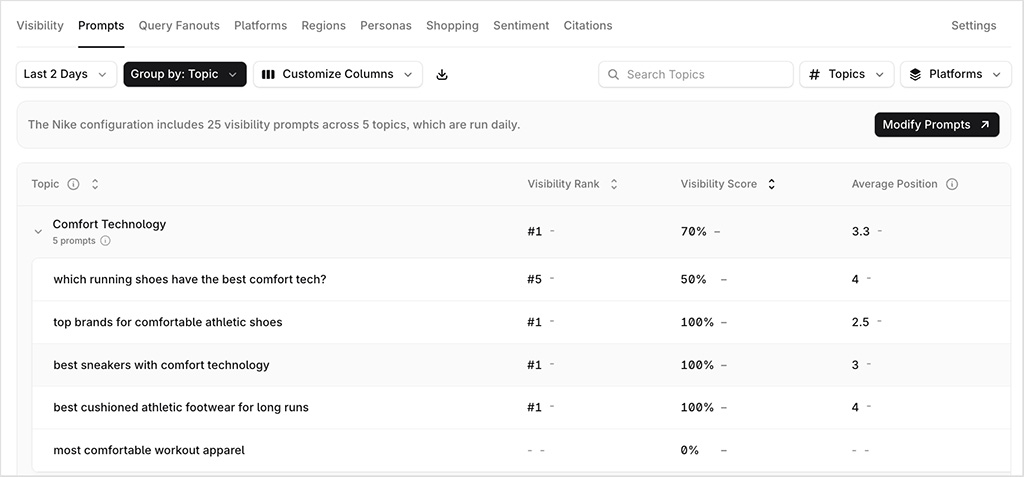
Because the same prompts are repeatedly tracked, organizations can monitor metrics easily over time. These include:
- visibility score — how often a brand appears in responses
- visibility rank relative to competitors
- average position within AI-generated answers
- citation share across referenced sources
- execution counts showing how frequently prompts have been run.
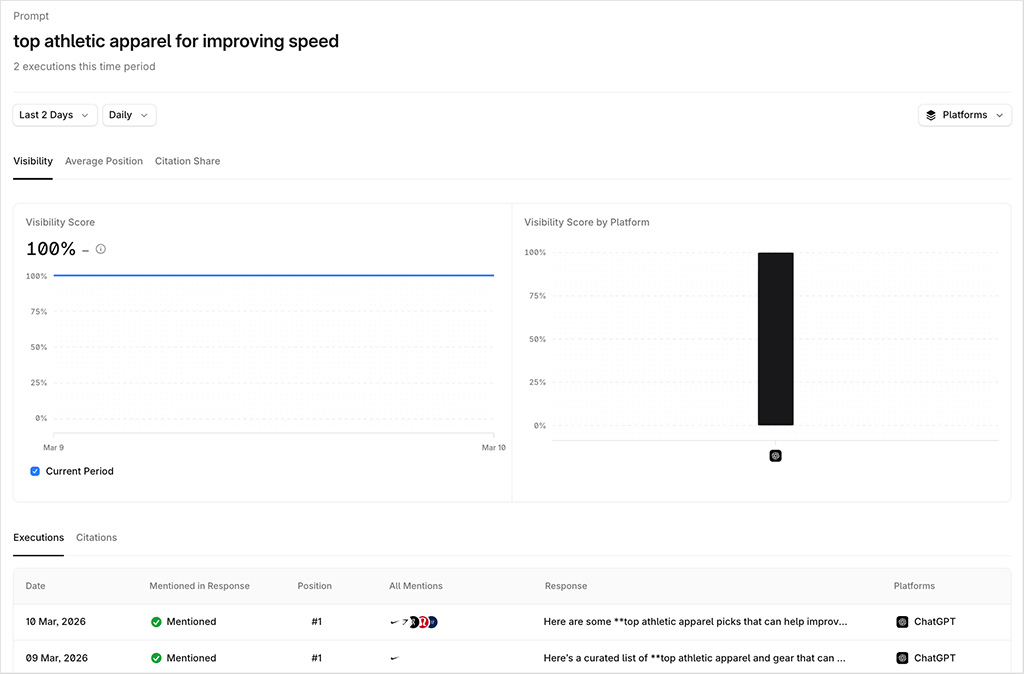
Prompts can also be grouped into broader themes — for example product attributes, brand perception or industry topics — allowing teams to monitor performance across entire categories of AI queries rather than individual prompts alone.
Ahrefs’ Brand Radar also provides prompt tracking capabilities, allowing users to create custom prompts and analyze the responses generated by AI platforms. Prompt monitoring allowances are included on standard Ahrefs plans, with daily limits varying by tier (for example, 5 daily prompt runs on Lite plans, 10 on Standard and 20 on Advanced).
However, prompt tracking works rather differently in Ahrefs. Brand Radar remains more heavily oriented toward exploratory analysis of AI responses, citations and visibility patterns across its broader indexed dataset, whereas Profound is designed more explicitly around repeated monitoring and longitudinal visibility tracking for predefined prompt sets.
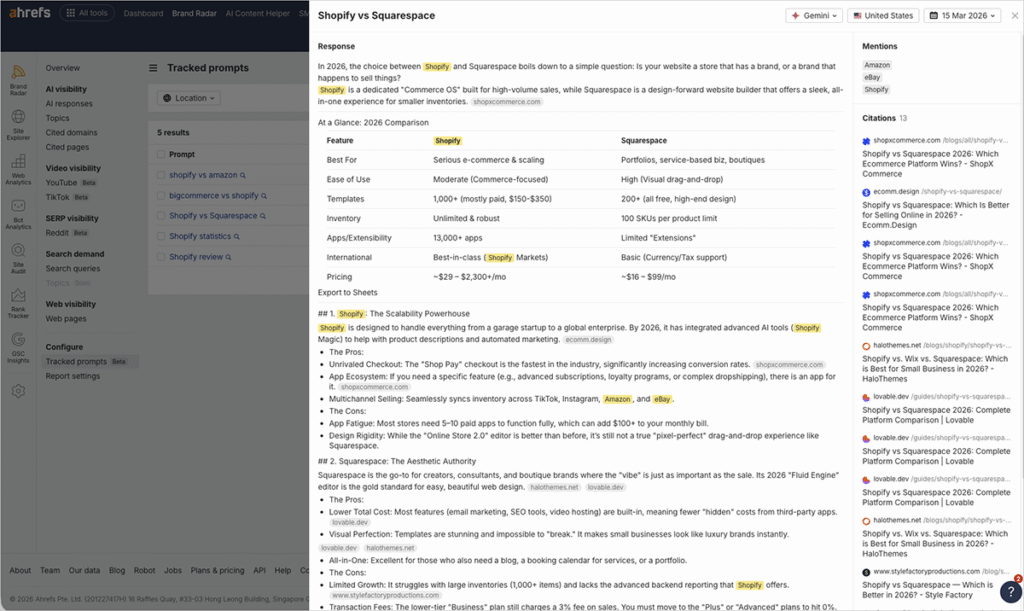
While Ahrefs now includes custom prompt monitoring on standard subscriptions, the relatively modest built-in daily allowances also mean that many teams will quickly require additional prompt-check add-ons.
As a result, organizations that want to build structured monitoring around a defined set of queries may find Profound’s prompt-centric architecture better suited to that task.
6. Profound analyzes brand narratives and sentiment in AI answers
Profound provides tools designed to analyze how AI systems describe and evaluate brands, helping organizations understand not just where AI tools are mentioning brands, but how those brands are being described and framed.
Themes relating to product quality, innovation, pricing, or durability can all be identified by Profound, and classified as positive or negative sentiment signals.
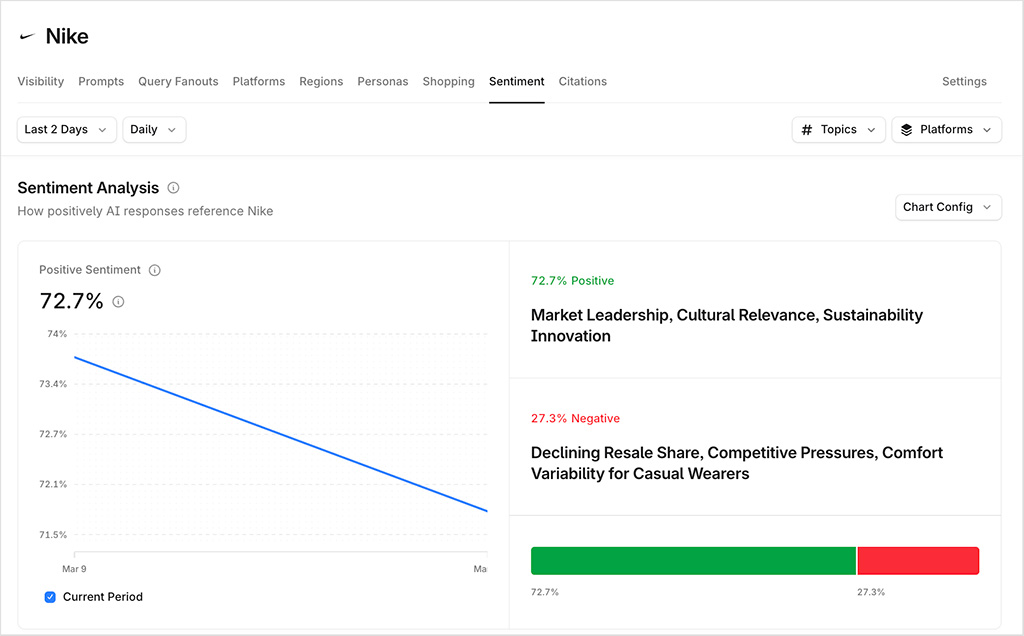
These themes are displayed alongside example AI responses (see my screenshot below for an example).
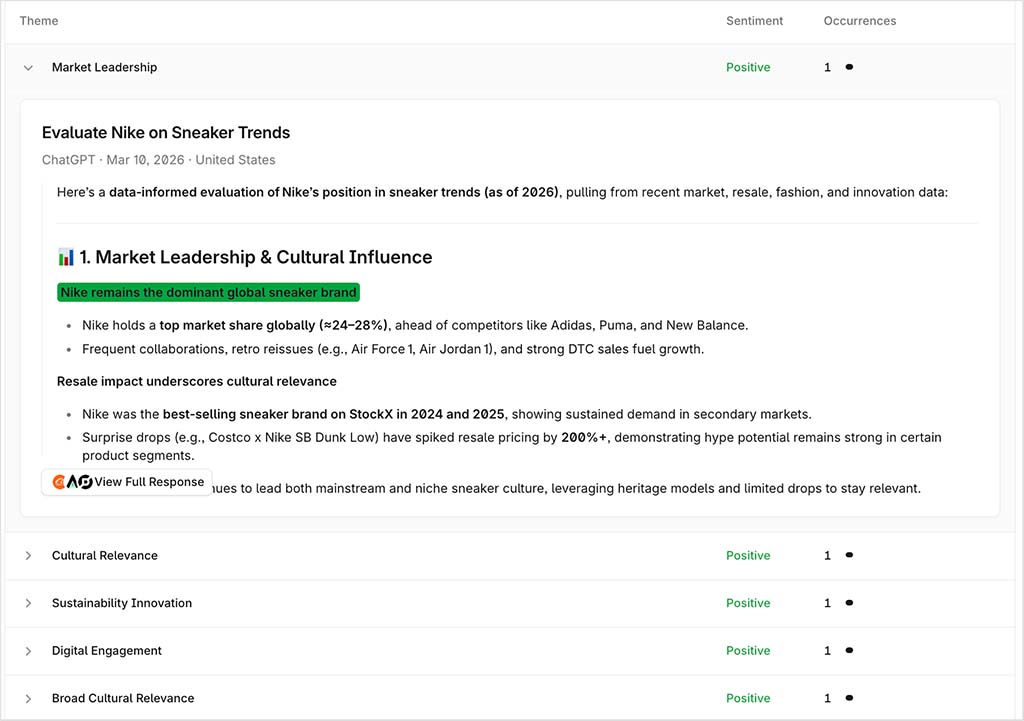
For companies concerned with brand reputation within AI answers, this type of analysis can provide useful insight.
Brand Radar primarily measures visibility and citation patterns; this lets you see how often brands appear and which sources AI systems cite — but doesn’t give insights into how your brand is being perceived and presented by these systems.
Ahrefs vs Profound: pricing
Pricing for Ahrefs and Profound is structured quite differently, reflecting the different roles the tools are designed to play.
Profound operates as a dedicated AI visibility monitoring platform, while Ahrefs provides AI monitoring through its Brand Radar feature (a tool that can be used within, or outside of, the general Ahrefs SEO platform).
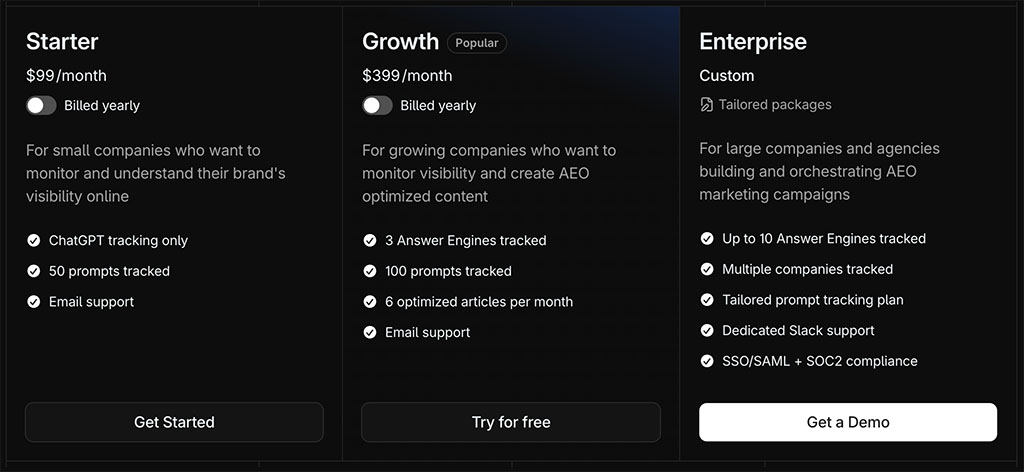
Profound currently offers three main plans.
Its Starter plan costs $99 per month and allows monitoring in ChatGPT only. It facilitates tracking for 50 prompts and up to 1,500 AI responses per month.
Its Growth plan, priced at $399 per month, expands coverage to three AI platforms — ChatGPT, Perplexity and Google AI Overviews — and increases monitoring limits to 100 prompts and 9,000 monthly responses.
For access to the platform’s full capabilities, however — including monitoring across a wider range of AI systems and tracking larger prompt sets — users need to move to Enterprise plans, which come with custom, negotiated pricing.
Ahrefs’ Brand Radar can be accessed in two ways.
First, it can be used as an add-on to a standard Ahrefs subscription (starting at $129 per month), giving users access to Brand Radar alongside Ahrefs’ wider SEO toolkit.
Importantly, Ahrefs subscriptions also include some built-in custom prompt monitoring allowances. Depending on plan tier, you can run between 5 and 20 prompt checks per day for free.
Alternatively, Brand Radar can be purchased as a standalone product.
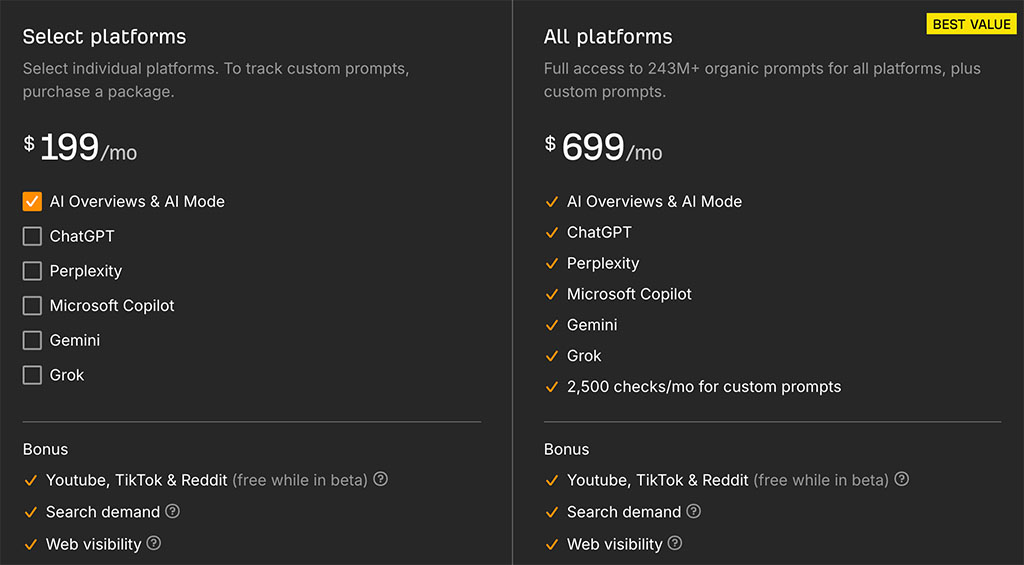
Standalone Brand Radar pricing starts at $199 per month per AI platform, or $699 per month for access across all supported platforms. This full plan includes 2,500 prompt checks per month.
Each time a prompt is executed on a specific AI platform, it counts as one check.
If additional monitoring capacity is required, Ahrefs offers extra prompt-check packages starting at:
- $50 per month — 2,500 checks
- $100 per month — 7,000 checks
- $250 per month — 25,000 checks.
Profound’s pricing is based primarily on fixed limits around prompt monitoring, response volume and platform coverage, with the lower tiers supporting relatively small monitoring limits.
Ahrefs’ model is somewhat more modular. While there are core subscription tiers, the check-based system allows teams to increase or decrease monitoring volume more flexibly depending on how intensively they want to track prompts.
For some organizations — particularly agencies or teams running multiple campaigns — that flexibility may make it easier to scale monitoring activity up or down over time.
User reviews
So far you’ve heard my thoughts on Ahrefs and Profound. But what do their user bases make of them?
To get a sense of this, I checked customer feedback on the popular user review site G2.com.
Ahrefs currently holds a score of 4.5 out of 5 from around 688 G2 reviews, reflecting its long-standing use across SEO teams, agencies and digital marketing departments.
Profound has a slightly higher rating of 4.6 out of 5 from roughly 323 reviews. However, the platform is significantly newer, having launched in 2024, and therefore has a smaller review base.
Overall, both tools are well regarded by users — although Ahrefs’ larger number of reviews makes its ratings more reliable.
Ahrefs vs Profound: the verdict
Both Ahrefs and Profound bring valuable capabilities to the emerging category of AI visibility tools.
Profound stands out in situations where structured prompt monitoring is the main priority: it does a better job of this than Ahrefs. Unlike Brand Radar, its prompt-tracking model makes it straightforward to track specific queries over time, and features such as prompt demand estimates, AI shopping analysis and brand narrative analysis also give it several specialist capabilities that Ahrefs does not yet fully cater for.
Profound also currently offers broader monitoring coverage across AI platforms, along with more developed tools for understanding how brands are framed and described within AI-generated answers themselves.
The key reason to use Ahrefs probably boils down to the fact that it doesn’t just give you AI visibility data — it is a long-established SEO platform that gives you a host of data and tools that help you optimize your site for search results too. And because SEO remains at the heart of AI visibility — authoritative, well-linked sites crop up far more often in AI-generated responses — these SEO features are incredibly important.
So in other words, it’s best to consider Ahrefs as a ‘best of both worlds’ option: it gives you the data you need to get a good sense of how you’re performing in AI tools, and the features you need to get your content performing in the first place. It also gives you access to more data — its prompt library is considerably bigger than Profound’s, and it facilitates tracking in more countries too.
Profound has a much more narrow focus — prompt tracking over time — and it’s currently better at that than Ahrefs.
If you have any questions about Ahrefs or Profound — or you’d like to share your own thoughts on either platform — feel free to leave a comment below.
Ahrefs vs Profound FAQs
Is Ahrefs or Profound better for AI visibility tracking?
It depends on the type of AI visibility data you need. Ahrefs is better for “broad” AI visibility research, because its Brand Radar tool analyzes a much larger pre-collected dataset of prompts and responses. Profound is better for structured prompt monitoring, because it lets you track how your brand appears for a defined set of AI prompts over time.
What does Profound do better than Ahrefs?
Profound is the better choice for teams focusing heavily on prompt tracking. It offers more mature monitoring for specific prompts over time, along with prompt demand estimates.
Profound also wins when it comes to brand sentiment analysis and AI shopping analysis. These give brands detailed insights into how they are presented inside AI tools.
What does Ahrefs do better than Profound?
Ahrefs is better for discovering where and why brands appear in AI-generated answers. Its larger indexed dataset makes it easier to research competitor visibility, uncover the publishers influencing AI responses, and explore the broader conversations in which brands are mentioned. And, because its AI visibility tools sit within one of the most fully-featured SEO platforms on the market, it gives you all the key tools you need to ensure that your website is discoverable by AI systems in the first place.
Should I choose Ahrefs or Profound for long-term marketing strategy?
For most businesses, Ahrefs is likely the more logical long-term investment, because it combines AI visibility research with a full suite of SEO tools for keyword research, backlink analysis, site audits and competitor research (good SEO results in better AI visibility). Profound is a strong option if your main priority is monitoring a fixed set of prompts across multiple AI platforms and measuring brand visibility, sentiment and citation share over time.
Alternatives to Ahrefs and Profound
If neither Ahrefs nor Profound feels like the right fit for your needs, there are several other platforms beginning to offer tools for monitoring AI visibility and conversational search performance. Three notable options are Semrush, SE Ranking and Similarweb.
Semrush
Semrush has also begun expanding into AI visibility analysis through its Semrush One platform. This product combines traditional SEO datasets with tools designed to monitor how brands appear in AI-generated answers.
Because Semrush sits on top of a large SEO data infrastructure — including keyword research, backlink analysis, rank tracking and site auditing tools — it offers a similar “AI visibility plus SEO toolkit” model to Ahrefs.
You can learn much more about Semrush in our full Semrush review, our Ahrefs vs Semrush comparison, and our Semrush pricing guide.
SE Ranking
SE Ranking recently introduced an AI Visibility Tracker designed to monitor how brands appear in AI-powered search environments. The tool tracks visibility across AI-generated answers and Google’s AI Overviews, helping teams understand how their content surfaces in conversational search results.
Compared with enterprise-focused platforms like Profound, SE Ranking is generally positioned as a more affordable option for smaller SEO teams and agencies.
You can learn more about SE Ranking in our ‘SE Ranking vs Semrush’ and ‘SE Ranking vs Moz’ comparisons.
Similarweb
Similarweb has also begun expanding its analytics platform to include insights into AI-driven traffic sources. Its tools can identify visits originating from AI platforms and help organizations understand how generative search environments contribute to website traffic.
While Similarweb focuses primarily on digital market intelligence rather than prompt monitoring, its data can still provide useful insight into how AI platforms influence online discovery and referral patterns.
You can learn more about Similarweb in our full Similarweb review and our Similarweb vs Semrush comparison.
Update details
This article was updated on May 6, 2026. The following key updates were made:
- The comparison was revised to reflect recent updates to Ahrefs’ Brand Radar features.
- Product screenshots throughout the article were updated.
- Hrefs’ prompt database statistics were updated.
- User review ratings and pricing information were refreshed.
- Several sections were updated to reflect the latest AI visibility monitoring features in both Ahrefs and Profound.
- The verdict section was revised.

No comments