

We have an honest review policy, but this page contains affiliate links. If you buy through these, we may earn a commission. This helps fund our research at no cost to you.
Which is best for keeping track of your brand’s visibility in Google and AI search results — Ahrefs, Semrush, or Ubersuggest? In this post, I compare their SEO and AI visibility tracking features, database sizes, reporting limits, pricing, and more to help you decide which platform is the best fit for your business.
Quick verdict
If you want the most comprehensive combination of SEO and AI visibility tracking tools, choose Semrush. Its ‘Semrush One’ plans bring both types of functionality together, with generous reporting limits, excellent keyword research tools, and detailed AI visibility analysis. It’s also the strongest choice for PPC research, site auditing, and access to a wider range of digital marketing features.
If keeping costs down is your top priority, choose Ubersuggest. It provides all the essential SEO tools, along with basic AI visibility tracking, at a fraction of the cost of its rivals. Its affordable monthly subscriptions, lifetime pricing options, and generous user account allowances make it particularly appealing to beginners and small businesses.
If you need to manage SEO and AI visibility campaigns across lots of websites, choose Ahrefs. Its unlimited verified projects, generous reporting allowances on higher-tier plans, and excellent backlink research tools make it particularly attractive to agencies. It also boasts the largest AI visibility research database of the three, although accessing its full capabilities involves significant additional fees.
I’ll start the full comparison with a look at how these three visibility tools compare when it comes to AI visibility tracking features.
1. AI visibility data
All three platforms provide tools and data for measuring your brand’s visibility in AI-generated answers.
These let you:
- see how frequently AI systems mention your brand
- compare its visibility against competitors
- monitor relevant AI prompts.
However, there are considerable differences between the three tools in terms of the amount of AI platform data provided, the number of platforms covered, and how frequently databases are updated.
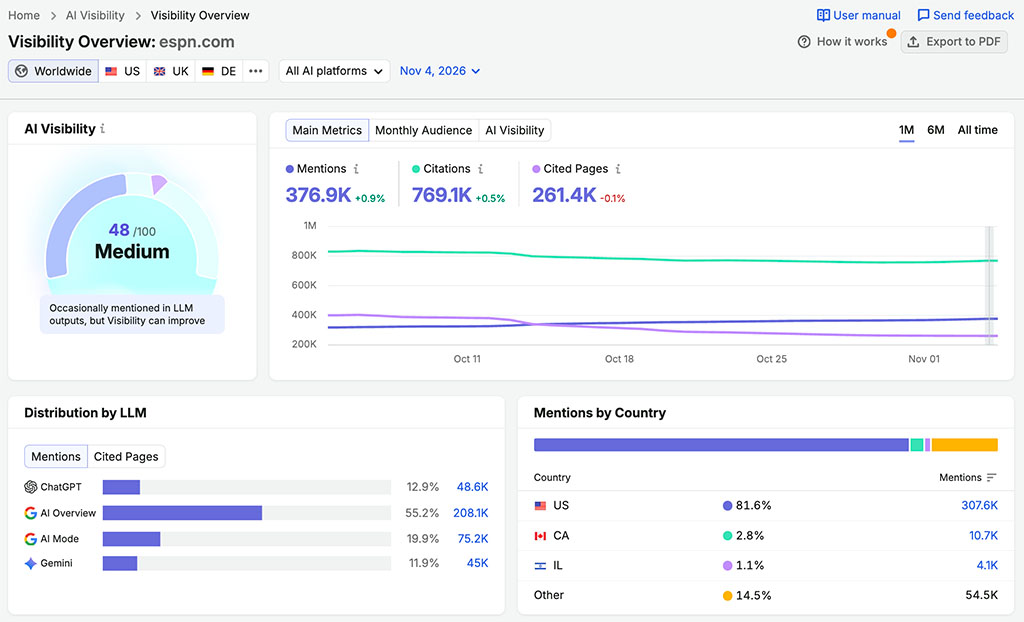
Semrush arguably offers the best all-around option here — its “Semrush One” plans combine a very wide range of SEO tools with AI visibility research features, and start at $199 per month. Its AI research database contains over 317 million prompts and responses from ChatGPT, Google AI Overviews, Google AI Mode, and Gemini.
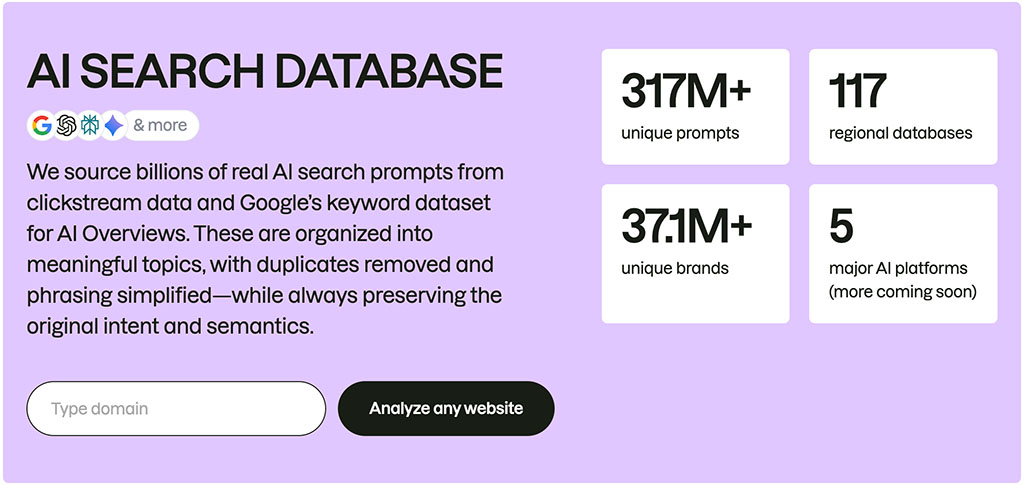
(Its brand monitoring features also cover Perplexity.)
Semrush lets you monitor 50 custom prompts daily on its Starter plan and 100 on Pro+. It also provides tools for researching AI search topics, analyzing competitors’ visibility, identifying citation opportunities, and getting recommendations for improving your brand’s presence in AI-generated answers.
Ahrefs has the largest advertised AI visibility database of the three. Its Brand Radar tool draws on over 565 million prompts, covering ChatGPT, Gemini, Perplexity, Microsoft Copilot, Google AI Overviews, and Google AI Mode. It provides extensive information on brand mentions, citations, and competitor performance, and lets you monitor custom prompts across these platforms.
(Claude is also supported for prompt monitoring.)
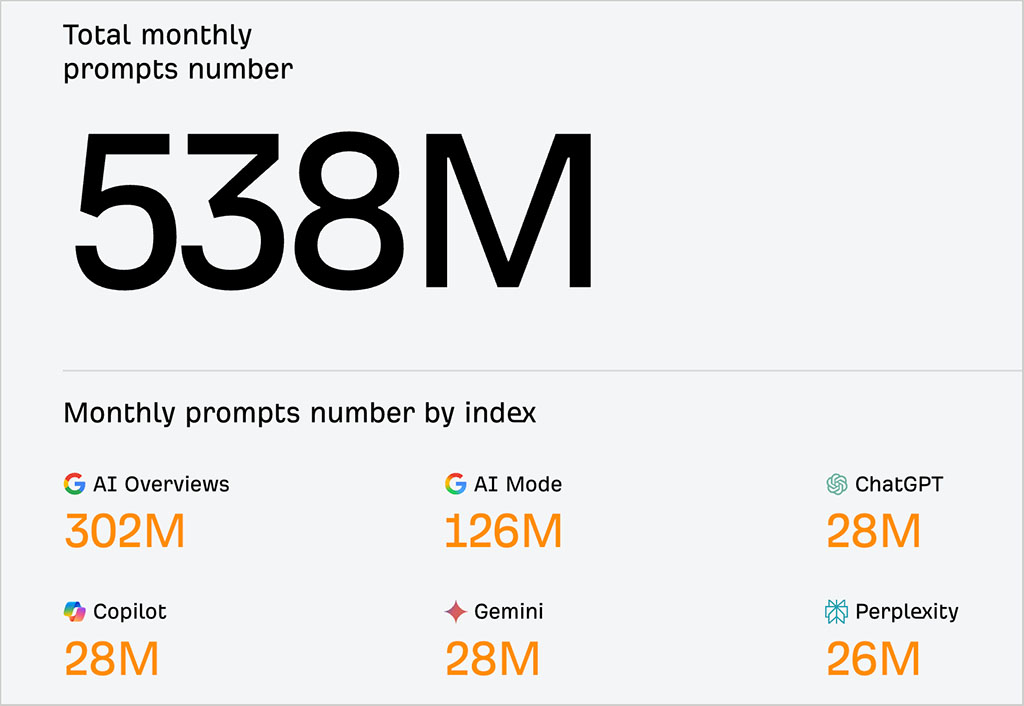
Now, Ahrefs’ regular SEO plans, which start at $129 per month, include daily monitoring for 5–20 custom prompts, depending on the plan.
But accessing its full AI visibility research database requires a separate purchase: you’ll have to pay for the ‘Brand Radar’ add-on to do so. This costs $199 per month if you want access to data for one AI platform, and $699 per month to access data from all of them.
Brand Radar lets you enter your brand name and see which AI-generated answers mention it, which websites and pages are cited, and how your visibility compares with competing brands. It also gives you access to larger prompt tracking allowances (for example, around 80 prompts per day can be tracked on the $699/mo version of Brand Radar).
As for Ubersuggest, its AI visibility features are available at a lower price point than either Ahrefs or Semrush (its entry-level plan costs just $29 per month) but the number of platforms it works with and the number of prompts you can track with it are lower.
Its AI Search Visibility tool provides visibility scores, competitor comparisons, brand sentiment analysis, and citation information — but only covers ChatGPT, Gemini, and Google AI Overviews (i.e., platforms like Perplexity, Microsoft Copilot, and Claude are not catered for).

And its prompt monitoring allowances are much smaller than those of its rivals — you can only track 15 to 20 prompts on its standard plans. Paid add-ons let you add another 25 to that limit, but for higher-volume prompt tracking (i.e., at the scale possible with Ahrefs or Semrush) you may need to discuss a custom plan with Ubersuggest.
It’s worth noting that all three platforms differ when it comes to how often they update their AI visibility data. Semrush refreshes its main AI visibility research database on a rolling daily basis. Ahrefs, by contrast, generally refreshes its AI chatbot research data monthly (although its Google AI Overviews and AI Mode data is updated more frequently). Ubersuggest updates its AI reports on a weekly, biweekly, or monthly basis, depending on the plan.
2. Search engine support
When it comes to the search engines covered by Ahrefs, Semrush, and Ubersuggest, all three tools under discussion focus mainly on Google — unsurprising really, given that it handles around 91% of global searches (source: Statcounter).
Semrush offers a bit more support for other search engines, however: it also lets you track rankings on Bing and Baidu. And this extra coverage is useful: Baidu accounts for around 49% of searches in China, while Bing is particularly popular with older users.
(According to UK research by Ofcom, 43% of internet users aged 65+ have made use of Bing, compared to just 36% of 25–34-year-olds.)
Ultimately, thanks to its broader coverage of non-Google search experiences, it’s probably a win for Semrush here.
Best for tracking rankings across multiple search engines: Semrush
3. Keyword database size
The larger an SEO tool’s keyword database, the more opportunities it can potentially uncover for attracting search traffic.
Semrush currently has the largest database of the three: it contains 29.2 billion keywords. This puts it narrowly ahead of Ahrefs, which counts 29 billion queries in its keyword database.
Ubersuggest doesn’t publish a comparable database size. Instead, it relies on third-party keyword data, mainly that of Moz, which has a keyword database containing around 1.25 billion phrases.
There are some interesting differences in country-specific keyword coverage, too. Semrush’s database contains more US keywords than those of its rivals — it covers 4 billion US keywords, while Ahrefs’ database features 2.7 billion. It’s a similar story in the UK (1.9 billion vs. 1.6 billion), Brazil (2.9 billion vs. 1.6 billion), and France (1.9 billion vs. 1.1 billion).
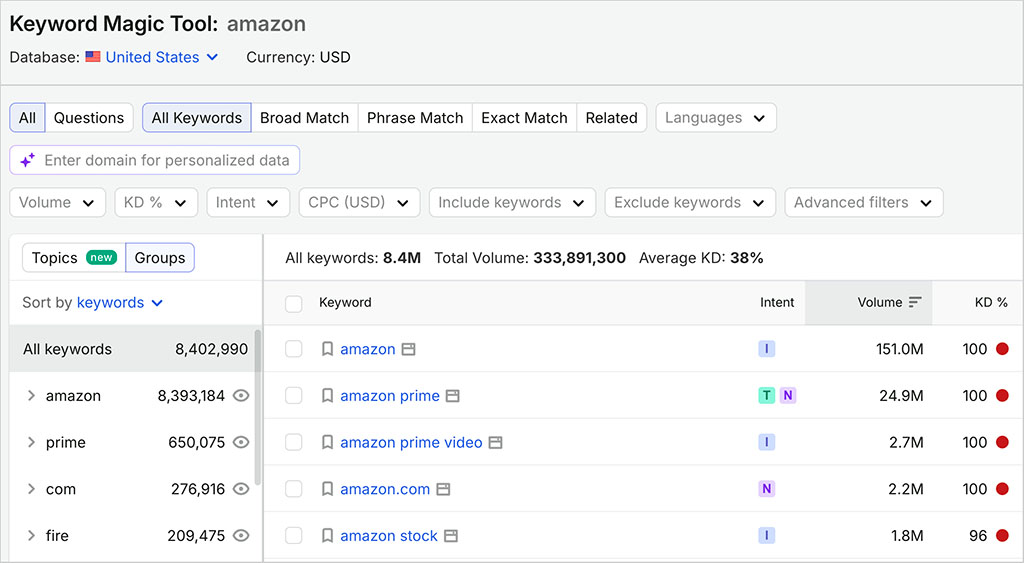
To see how these differences translated into actual keyword suggestions, I entered a selection of popular search terms into all three tools. You can see the number of suggestions surfaced by each platform in the table below.
| Keyword | Semrush suggestions | Ahrefs suggestions | Ubersuggest suggestions |
|---|---|---|---|
| Amazon | 8.4 million | 3.9 million | 1.3 million |
| Canva | 1.1 million | 246,000 | 138,000 |
| Shopify | 424,000 | 223,000 | 165,000 |
| Etsy | 500,000 | 203,000 | 130,000 |
| eBay | 2.7 million | 567,000 | 200,000 |
| Temu | 54,000 | 93,000 | 40,000 |
| Printful | 5,400 | 4,100 | 2,100 |
As you can see, Semrush returned the most suggestions for six of the seven keywords tested, often by a considerable margin. Ahrefs came out on top for ‘Temu,’ however, showing that a larger overall database doesn’t necessarily translate into more suggestions for every search.
Of course, more suggestions don’t automatically mean better ones. But having access to a larger pool of keywords can be particularly useful when researching the popularity of niche topics or less obvious phrases.
Overall, Semrush takes the win here, thanks to its slightly larger global database, stronger country-specific coverage, and the results it delivered in my keyword suggestion tests.
Largest keyword database and most keyword suggestions found in testing: Semrush
4. Project limits
All three tools let you create ‘projects’ to monitor individual domains, with each project letting you keep tabs on keyword rankings, broken links, AI visibility, technical SEO issues and more.
However, the number of projects you can create varies considerably by platform and by plan:
| Entry-level plan | Mid-tier plan | Top-tier plan | |
|---|---|---|---|
| Semrush | 5 | 15 | 40 |
| Ahrefs | 5 | 20 | 50 |
| Ubersuggest | 1 | 7 | 15 |
Ahrefs offers the most generous project allowances overall, while Ubersuggest is considerably more restrictive than either of its competitors.
And Ahrefs has another significant advantage over Semrush and Ubersuggest: it lets you work with an unlimited number of verified domains (websites you can prove you own or have administrative access to). You can verify ownership via Google Search Console, by adding a DNS record to your domain, or inserting some HTML code on your site.

This approach makes Ahrefs particularly attractive for agencies managing multiple client websites or businesses operating several domains.
Most generous project allowances: Ahrefs
5. Reporting limits and exports
When it comes to how many SEO reports you can pull, on first inspection Ahrefs looks like the clear winner, because its Standard and higher-tier plans let you run unlimited reports.
However, Ahrefs’ most affordable plan — “Lite” — lets you pull just 1,000 reports per month. This compares rather poorly with the reporting limits of Semrush’s entry-level plan, which lets you access 3,000 reports per day (you can pull 5,000 and 10,000 reports per day on Semrush’s more expensive plans, which for most users will probably feel like unlimited reporting).
Ubersuggest gives you allowances of 150, 300, and 900 reports per day across its three plans.
As for exports, all three platforms let you download SEO data, but Semrush is the most flexible option for creating branded, client-facing reports. Ahrefs provides extensive data exports too, while Ubersuggest supports CSV, PDF, and image exports but not white-label reporting.
6. Rank tracking
Rank tracking lets you monitor how your website ranks for a set of target keywords over time.
Of the three tools under discussion, Ahrefs offers the most generous keyword allowances, letting you track 750 keywords on its entry-level ‘Lite’ plan, and 2,000 to 5,000 on its more expensive plans.

Semrush is slightly less generous here, providing position tracking allowances of 500, 1,500, and 5,000 keywords across its three plans. However, unlike Ahrefs, it provides daily ranking updates by default — Ahrefs only updates its ranking reports on a weekly basis.
(You can pay extra to access daily rank tracking reports in Ahrefs, but the fees involved are high.)
Ubersuggest takes a different approach to its rivals, limiting keyword tracking per project: you can track 125 keywords on its “Individual” plan, 150 on “Business,” and 300 on “Enterprise”. This means, for example, you can track up to 4,500 keywords across 15 projects on Ubersuggest’s top-tier plan, but only 300 in any individual project.
Like Ahrefs, Ubersuggest updates rankings weekly.
Significantly, Semrush also helps you decide what to do with your ranking data. Its “Potential Growth” feature highlights keywords where content improvements could generate meaningful extra traffic.
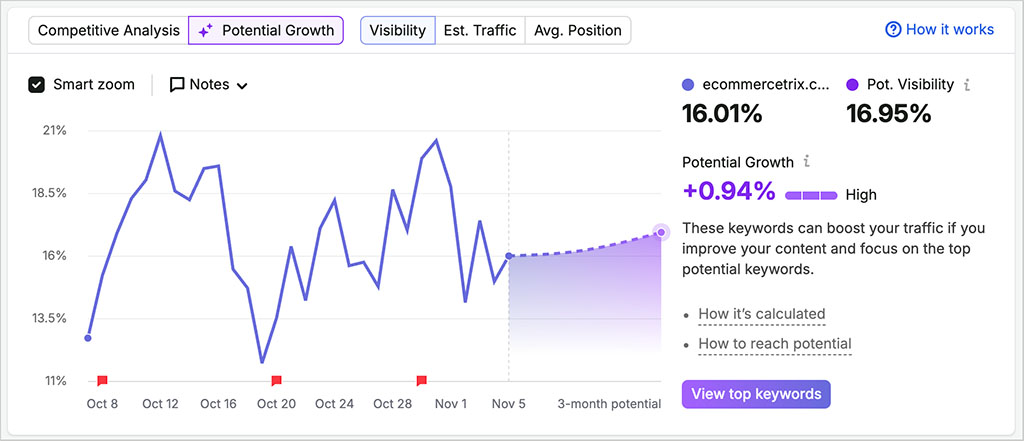
That combination of daily updates, flexible keyword allowances, and useful optimization suggestions makes Semrush my preferred rank tracking tool.
7. Page crawl limits
All three platforms let you crawl websites to identify technical SEO problems. These include broken links, missing metadata, and pages that search engines struggle to access.
However, there are significant differences in their crawl allowances.
Ahrefs is the most generous of the three, letting you crawl between 100,000 and 1.5 million pages per month, depending on your plan. Semrush isn’t far behind, with monthly allowances ranging from 100,000 to 1 million pages. Ubersuggest is considerably more restrictive, limiting you to between 1,000 and 10,000 pages per audit.
It’s worth noting that these aren’t quite like-for-like limits; Ahrefs and Semrush also apply caps to the number of pages you can examine in a single audit, as the table below shows.
| Platform / plan | Monthly crawl allowance | Maximum pages per audit |
|---|---|---|
| Ahrefs Lite | 100,000 | 25,000 |
| Ahrefs Standard | 500,000 | 50,000 |
| Ahrefs Advanced | 1,500,000 | 250,000 |
| Semrush Starter | 100,000 | 20,000 |
| Semrush Pro+ | 300,000 | 20,000 |
| Semrush Advanced | 1,000,000 | 100,000 |
| Ubersuggest Individual | Weekly audits | 1,000 |
| Ubersuggest Business | Weekly audits | 5,000 |
| Ubersuggest Enterprise | Weekly audits | 10,000 |
In practice, both Ahrefs and Semrush are well suited to auditing larger websites, while Ubersuggest’s lower limits make it a better fit for smaller ones.
Ahrefs does have an additional advantage, however: it provides 5,000 extra monthly crawl credits for every verified project— this makes it particularly useful if you need to audit multiple websites.
Most generous page crawl limits: Ahrefs
8. User accounts
If you need to provide several people with access to your SEO/AI Visibility software, Ubersuggest is the most generous of the three platforms.
Its “Individual” plan includes one user account, “Business” includes two, and “Enterprise” includes five. And you can add extra seats for just $5 per month each.

By contrast, Semrush and Ahrefs include only one user account on each of their three main plans.
Additional Semrush users cost $45–$100 per month, depending on your subscription. Ahrefs charges $40–$80 per additional user, with limits on how many you can add.
There’s a catch with Ubersuggest’s approach, however: additional users have fewer administrative privileges and share the account owner’s reporting limits. They can’t create or edit projects or connect Ubersuggest to Google Analytics and Search Console accounts.
Even so, Ubersuggest’s included seats and inexpensive additional users make it particularly attractive for small teams.
Best for teams on a budget: Ubersuggest
9. Backlink database size
Getting backlinks — links from other websites to yours — is a key way to improve your site’s visibility in search results. And the larger and fresher an SEO tool’s backlink database, the more useful it can be for analyzing competitors and finding link-building opportunities.
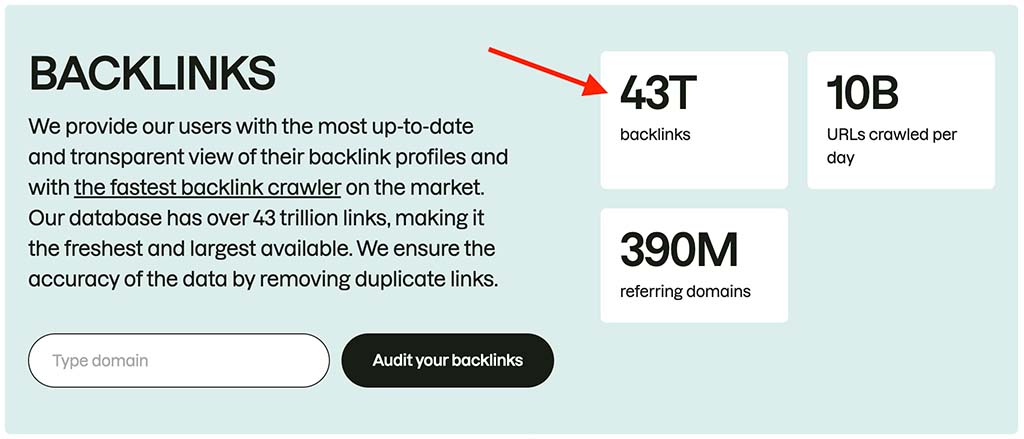
Semrush maintains a huge links database containing over 43 trillion backlinks from 390 million referring domains. Its crawler processes around 10 billion URLs daily, making it one of the most comprehensive backlink research tools available.
Ahrefs also impresses here: its links database contains 35 trillion historical external backlink records and around 494 billion pages. Its crawler processes approximately 5 million pages per minute.
Ubersuggest takes a different approach. Rather than operating its own large-scale backlink crawler, it sources its backlink data from Moz, whose index contains around 45 trillion links — slightly more than either rival’s headline figure (see our Ahrefs vs Moz vs Semrush comparison for more details). However, it’s unclear how much of Moz’s database Ubersuggest actually has access to, so we shouldn’t assume it offers the same depth of data.
There’s also an important difference in how frequently the three platforms update their backlink information:
- Ahrefs refreshes its backlink index every 15–30 minutes.
- Semrush updates its database at least hourly, with new information appearing in its interface every 15 minutes.
- Ubersuggest updates its backlink data on a monthly basis.
This makes Ahrefs and Semrush better suited to monitoring newly acquired or lost backlinks, although these refresh frequencies don’t guarantee that every new link will be discovered immediately.
Overall, both Ahrefs and Semrush are excellent choices for serious backlink research, thanks to their enormous databases and frequent updates. Ubersuggest’s slower refresh cycle puts it at a disadvantage.
10. Backlink analysis and link building
All three platforms let you examine a website’s backlink profile, see which sites link to it, and identify opportunities to acquire similar links for your own site. They also provide ‘backlink gap’ tools that highlight websites linking to your competitors but not to you.
However, there are some important differences in how these work.
Ahrefs provides the most generous competitor comparison feature. Its ‘Link Intersect’ tool lets you compare your site’s backlink profile against those of up to 10 competitors, while Semrush’s ‘Backlink Gap’ tool lets you compare four.
Ubersuggest is competitive here too, letting you compare your backlink profile against up to 15 competitors on its most expensive plan.
However, Semrush has a significant advantage when it comes to helping you actually build links. Its dedicated ‘Link Building Tool’ doesn’t just identify suitable websites to approach — it also surfaces contact details for them, lets you send outreach emails, and tracks your progress through a CRM-style interface.

With Ahrefs and Ubersuggest, this outreach work needs to be handled manually or through separate tools.
So, while Ahrefs and Ubersuggest are good at identifying backlink-building opportunities, Semrush’s built-in outreach functionality makes it the best option for running entire link-building campaigns.
11. Keyword research and search intent
Semrush, Ubersuggest, and Ahrefs all let you research keywords, check search volumes, assess ranking difficulty, and find related search terms. They also provide search intent data, helping you establish whether people are looking for information, researching products, or ready to buy.
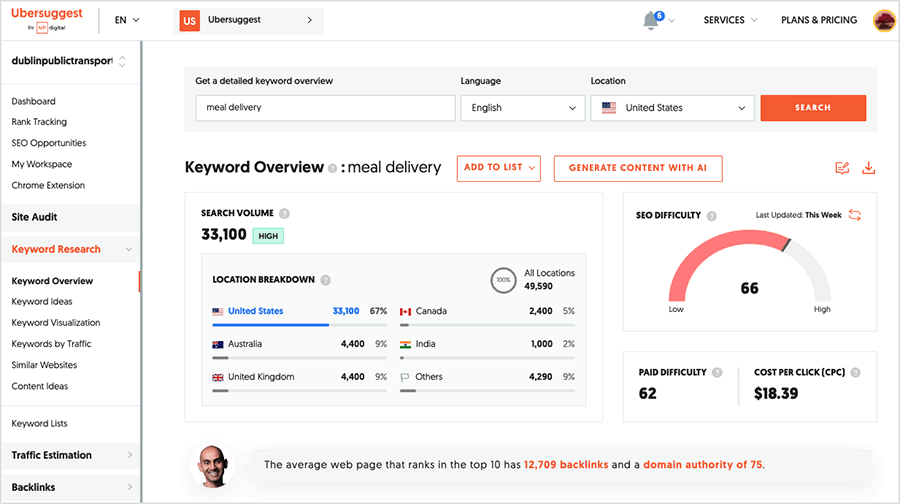
Ubersuggest covers these essentials well, providing keyword suggestions, difficulty scores, CPC data, and search trends. It also groups keyword ideas into categories like questions, comparisons, and related searches.
Ahrefs offers more advanced research features, including a handy “Traffic Potential” metric that estimates how much traffic a page could attract if it ranked for all the possible variants of a target keyword. It also provides detailed SERP analysis and search intent filters for branded and local searches (both of which are missing from Semrush and Ubersuggest).
Semrush offers similarly comprehensive keyword research tools, but its standout feature is its ‘Personal Keyword Difficulty’ (PKD) score. Unlike a standard keyword difficulty score, this estimates how hard it would be for your specific website to rank for a keyword. It does this by taking your site’s domain authority and topical relevance into account when calculating difficulty.
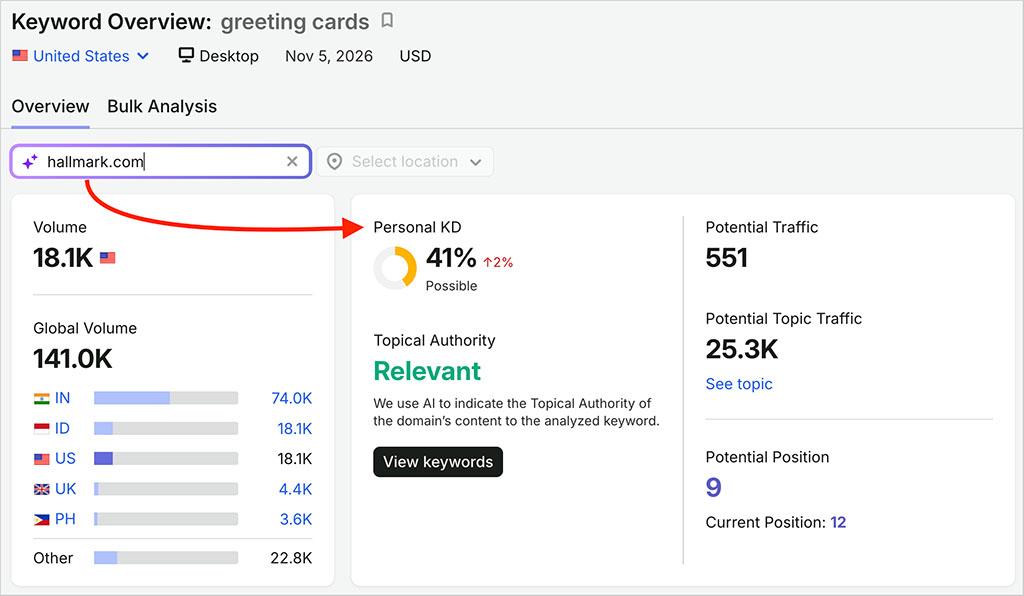
For me, Semrush’s Personal Keyword Difficulty score is a real USP — it makes finding realistic ranking opportunities much easier. But Ahrefs has some excellent features of its own, particularly its traffic potential estimates and detailed SERP analysis. There’s very little to separate the two overall.
12. Traffic estimates
A key use of SEO tools involves estimating how many visits a competing website receives each month, and which of its pages are most popular. This can help you identify successful pieces of content that can inspire the creation of pages and posts on your own site.
All three platforms provide organic traffic estimates, but Ahrefs and Semrush offer more detailed data than Ubersuggest (this includes metrics on historical trends and visitor location).
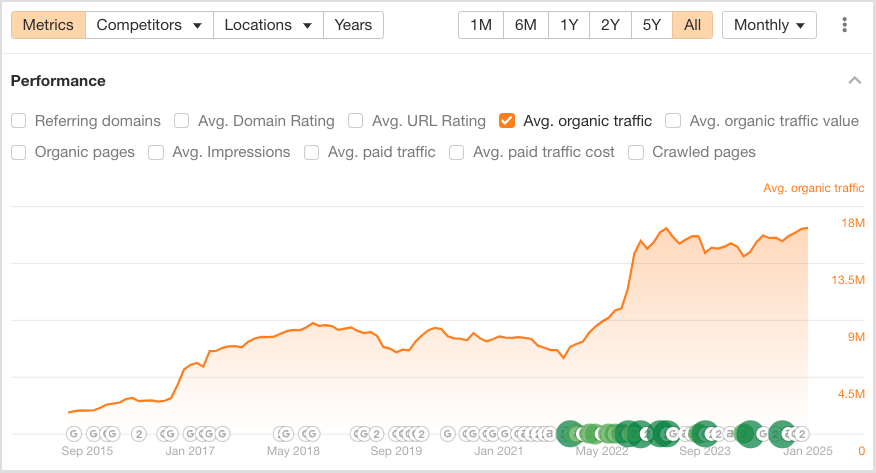
Semrush also offers a ‘Traffic Analytics’ tool that estimates visits from sources beyond organic search, including direct, referral, social, and paid traffic. However, accessing this functionality can involve additional costs.
In terms of accuracy, I’ve compared Ahrefs’ and Semrush’s estimates against actual traffic figures for websites I have access to. I’ve generally found Ahrefs to be slightly more accurate, although Semrush tends to perform better for larger, high-traffic sites.
13. Broken link building
Broken link building involves finding links to pages that no longer exist, creating replacement content for the topics involved, and persuading the website owners linking to the old, broken pages to link to yours instead.
It’s a good SEO tactic, and Ahrefs makes it particularly easy. Just enter a domain into its ‘Site Explorer’ tool and select ‘Broken backlinks’ to see which dead pages are still attracting links — and who’s linking to them.
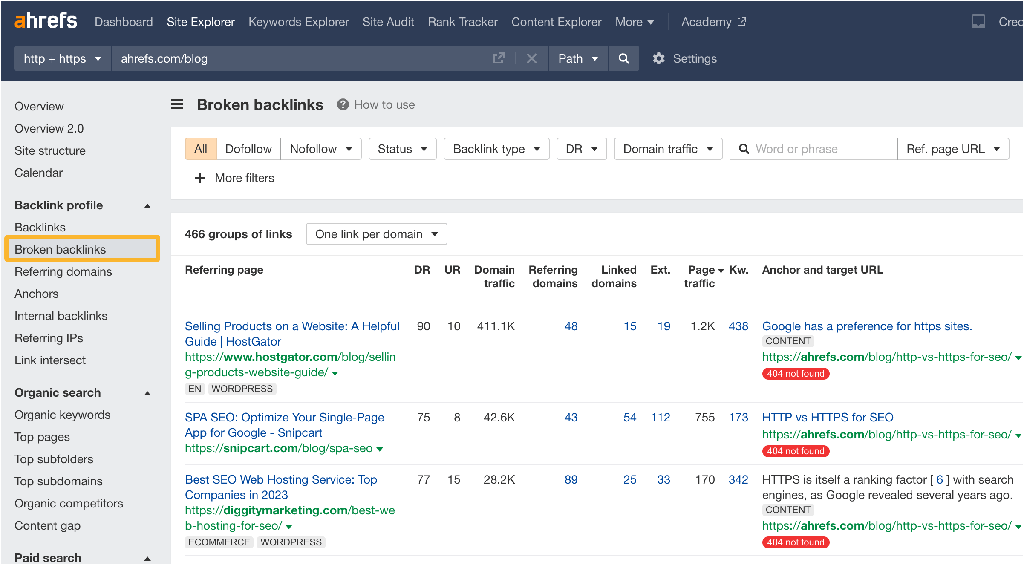
Semrush can help you find these opportunities too, but you’ll need to do a bit more digging through (and filtering of) its backlink reports to find them.
Ubersuggest can flag broken links on your own site, but doesn’t offer the same dedicated tools for hunting down broken backlinks on competing ones.
Best for broken link building: Ahrefs
14. Historical data
Historical SEO data helps you spot long-term trends, investigate traffic drops, and see how competitors’ search rankings have changed over time.
All three platforms provide access to historical data, but there are significant differences in how far back they go.
Semrush offers the most extensive coverage, with keyword ranking and traffic data going back to 2012 for certain markets. However, you’ll need a “Pro+” or “Advanced” plan to access its full historical database.
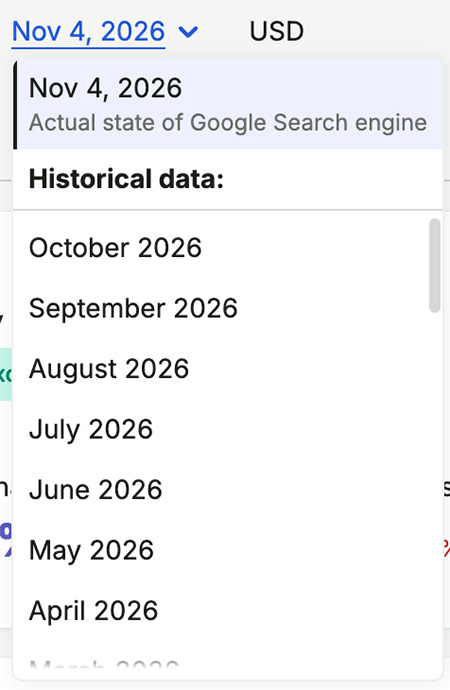
Ahrefs also provides extensive historical data, but how much you can access depends on your subscription. Its “Lite” plan gives you just six months of history, “Standard” provides a two-year history, and “Advanced” lets you look at historical data over the past five years.
Ubersuggest is reasonably generous for a budget tool, providing up to 24 months of organic traffic history and three years of backlink history across all three paid plans.
| Platform | Historical data access |
|---|---|
| Semrush | Back to 2012 for selected markets and reports (Pro+ and above) |
| Ahrefs | 6 months (Lite), 2 years (Standard), 5 years (Advanced) |
| Ubersuggest | 2 years of organic traffic data; 3 years of backlink data |
As you can see from the table above, it’s a win for Semrush here.
Best for historical data: Semrush
15. Site auditing
During a site audit, SEO tools check your website for problems that might be hurting its search rankings. These include broken links, slow-loading pages, duplicate content, missing metadata, and crawl errors.
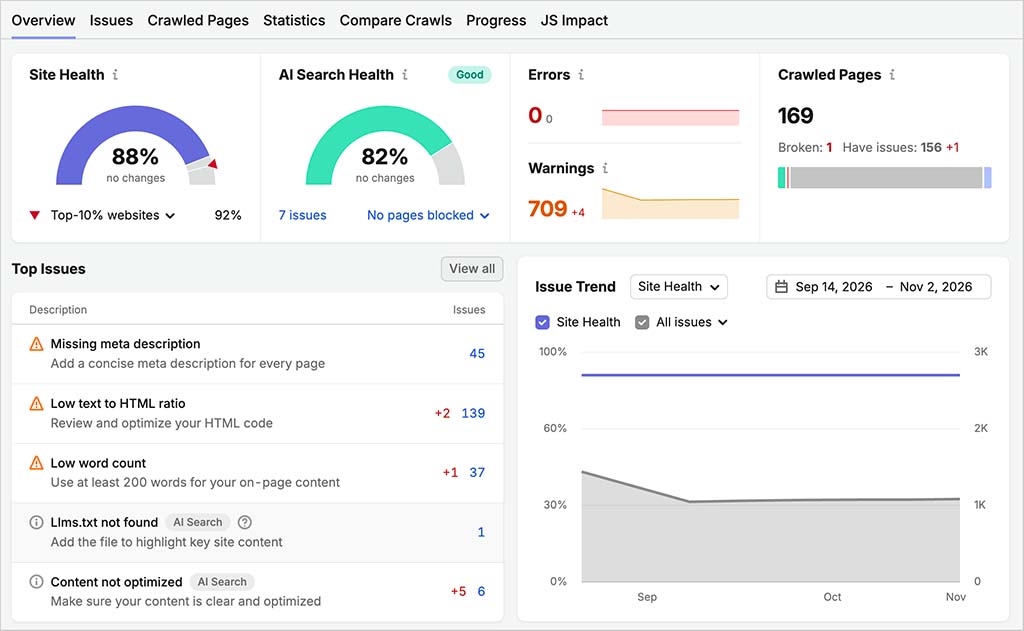
You’re then given an overall ‘site health’ score, along with recommendations for fixing any problems found.
Ahrefs and Semrush both provide excellent site auditing tools, capable of identifying a wide range of technical SEO issues. Ubersuggest’s auditing features are less comprehensive, but they’re easy to use and perfectly adequate for identifying common problems.
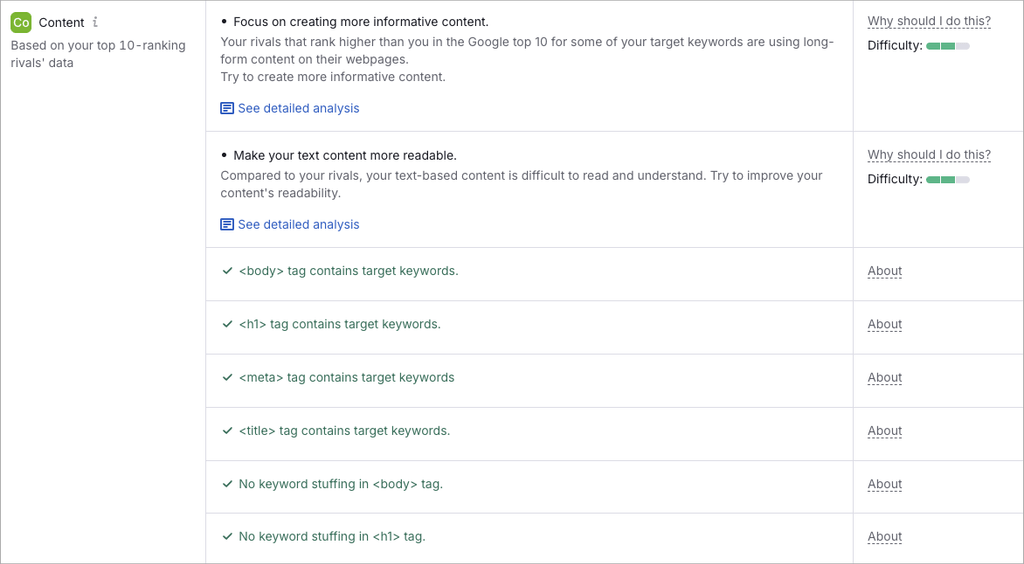
Semrush also gives you an ‘On Page SEO Checker’ (pictured in my screenshot below) — this provides useful content optimization recommendations that go beyond fixing technical problems. There isn’t really an equivalent feature in Ahrefs or Ubersuggest.
Both Ahrefs and Semrush now also check for issues that could affect your visibility in AI search results.
Semrush does this through its ‘AI Search Health’ score, which assesses how well your site is technically prepared for AI search. Clicking on an ‘issues’ link beside the score gives you a checklist of things you can do to improve your site’s visibility.
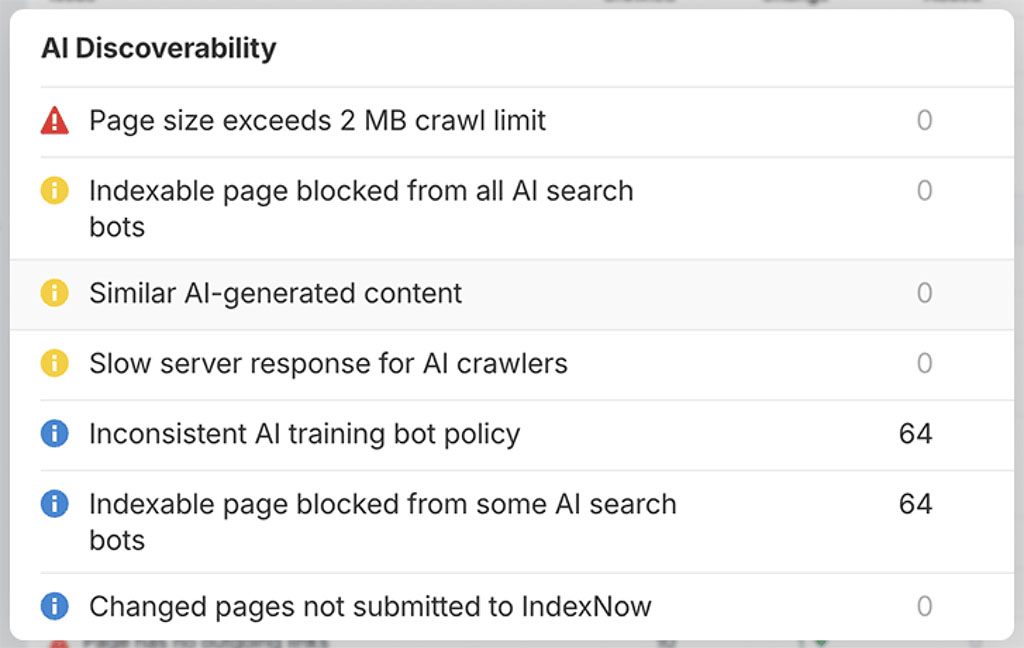
Ahrefs doesn’t give you a similar AI health score, but it does run ‘AI Discoverability’ checks on your site — these identify problems that might prevent AI crawlers from accessing or interpreting your content.
Overall, Ahrefs and Semrush beat Ubersuggest fairly comprehensively in this department, but I’d give Semrush the win here, because its AI health score and on-page SEO checker feature give it a slight edge over Ahrefs.
Best for site auditing: Semrush
16. PPC data
If you’re investing in pay-per-click (PPC) advertising, you’ll usually need to know what your competitors are up to. Which keywords are they bidding on? What do their ads look like? And how much traffic are those paid search campaigns bringing them?
All three platforms provide some PPC data, but Semrush gives you the most powerful functionality here.

Ubersuggest covers the basics, giving you cost-per-click estimates and paid keyword difficulty scores. Ahrefs goes further, letting you investigate competitors’ paid keywords, view their ads, and see which landing pages they’re promoting.
Semrush, however, provides the most extensive range of PPC research features through its dedicated “Advertising Toolkit.”
This lets you investigate:
- keywords competitors are bidding on
- ad positions and estimated traffic
- actual ads being displayed
- advertising history and trends
- landing pages used in campaigns
- Google Shopping ads.
It also provides tools for managing advertising campaigns, with higher-tier subscriptions adding display, video, and social advertising research.
The downside is that accessing this toolkit costs extra — at least $99 per month.
Best for PPC and competitor advertising research: Semrush
17. Add-ons, integrations and API access
If you want to extend your SEO software’s capabilities, Semrush is the most flexible of the three platforms.
Its ‘App Center’ gives you access to a wide range of additional marketing tools, covering everything from local SEO and social media management to influencer research, competitor research, conversion optimization, and AI content creation. Many of these apps cost extra, but they make Semrush much more than just an SEO platform.

All three tools also offer MCP integrations, letting you access their SEO data directly through compatible AI assistants like ChatGPT and Claude, rather than having to generate reports manually.
When it comes to API access, Ahrefs wins: it’s included on all its main paid plans, starting at $129 per month. Semrush requires a top-tier Advanced subscription for access to its main API, with API credits purchased separately. Ubersuggest, meanwhile, doesn’t offer a conventional public API.

Overall, Semrush wins for the sheer range of additional marketing functionality available, while Ahrefs has the edge for API access.
18. Customer support and user satisfaction
All three platforms offer email and live chat support, along with comprehensive online help centers.
Semrush has an edge when it comes to support options, offering phone assistance in addition to online support. Its help materials are also available in 14 languages, compared to eight for Ahrefs and English only for Ubersuggest.
Ahrefs does have one advantage, however: its live chat support is available 24/7.
As for user satisfaction, here’s how the three platforms score on popular software review sites:
| Review platform | Semrush | Ahrefs | Ubersuggest |
|---|---|---|---|
| TrustRadius | 8.5/10 (791 reviews) | 8.8/10 (403 reviews) | 8.0/10 (39 reviews) |
| G2 | 4.4/5 (4,293 reviews) | 4.5/5 (722 reviews) | 4.2/5 (160 reviews) |
| Capterra | 4.6/5 (2,330 reviews) | 4.7/5 (580 reviews) | 4.4/5 (94 reviews) |
| Average (out of 5) | 4.42 | 4.53 | 4.20 |
Ahrefs comes out on top across all three review sites, although Semrush isn’t far behind and has considerably more customer reviews. Ubersuggest’s ratings are respectable too, but based on a much smaller number of reviews.
19. Pricing and value for money
There’s a huge difference in what you’ll pay for Semrush, Ubersuggest, and Ahrefs — particularly when AI visibility tracking is factored in.
Let’s start with their standard SEO subscription prices.
SEO pricing
| Plan | Semrush | Ahrefs | Ubersuggest |
|---|---|---|---|
| Entry-level | $139/mo | $129/mo | $29/mo |
| Mid-tier | $249/mo | $249/mo | $49/mo |
| Top-tier | $499/mo | $449/mo | $99/mo |
Ubersuggest is by far the cheapest option, and it has another compelling advantage: lifetime subscriptions for its entry-level, mid-tier, and high-tier plans cost $290, $490, and $990 respectively. If you intend to use an SEO tool for several years, these could represent substantial savings.
However, as we’ve seen throughout this comparison, Ahrefs and Semrush provide much deeper SEO functionality, larger databases, and more generous reporting allowances than Ubersuggest.
AI visibility pricing
AI visibility pricing is a little more complicated.
Semrush offers a standalone AI Visibility Toolkit starting at $99 per month. Alternatively, you can subscribe to ‘Semrush One,’ which combines its SEO and AI visibility tools, with plans starting at $199 per month.
Ahrefs includes limited daily AI prompt tracking with its standard SEO subscriptions. However, full access to its ‘Brand Radar’ AI visibility research databases costs an additional $199 per month for one AI platform, or $699 per month for all platforms. Additional prompt tracking packages start at $50 per month.
Ubersuggest includes its full AI visibility functionality with its standard monthly and annual subscriptions, with prompt allowances, supported platforms, and update frequencies varying by plan. However, its lifetime subscriptions only include basic AI visibility features. To unlock the full set of AI features, lifetime users must pay an additional $9, $29, or $69 per month for the Individual, Business, or Enterprise plans respectively.
Which offers the best value?
Ultimately, this depends on what you need.
- For budget-conscious users, Ubersuggest is the clear winner. Its inexpensive subscriptions and lifetime deals make it hard to beat on price.
- For traditional SEO, Ahrefs offers excellent value, particularly for agencies managing multiple verified domains and users who need unlimited reporting.
- For SEO and AI visibility combined, Semrush offers arguably the best overall value. Its Semrush One plans provide comprehensive functionality in both areas without requiring the expensive AI research add-ons associated with Ahrefs.
All three platforms offer annual payment options, with discounts available for paying upfront.
Best for affordability: Ubersuggest
Best for traditional SEO at scale: Ahrefs
Best for combined SEO and AI visibility: Semrush
20. Free trials
Given the cost of SEO and AI visibility tools, you’re probably wondering if you can try them out for free before committing to a subscription.
The good news is that both Semrush and Ubersuggest offer seven-day free trials. And in Semrush’s case, we can do you one better: we’ve arranged an exclusive 14-day trial of Semrush One for Style Factory readers, giving you twice as long to put its SEO and AI visibility features through their paces.
Ahrefs is the odd one out here — it doesn’t offer a free trial at all. You can still experiment with some of its free SEO tools, but these provide only a taste of what the full platform can do.
Ahrefs vs Semrush vs Ubersuggest — at-a-glance summary
Data correct at the time of writing (November 6, 2026).
| Feature | Semrush | Ubersuggest | Ahrefs |
|---|---|---|---|
| Traditional search engines | Google, Bing, Baidu | Google primarily | |
| AI visibility tracking | Semrush One or AI Visibility Toolkit | Included; capabilities vary by plan | Basic tracking included; full Brand Radar research costs extra |
| AI platforms covered | ChatGPT, Gemini, Google AI Overviews, AI Mode, Perplexity | ChatGPT on lower plans; Gemini and AI Overviews on Enterprise | ChatGPT, Gemini, Perplexity, Copilot, Google AI Overviews and AI Mode |
| AI visibility research database | 317M+ prompts | Not disclosed | 538M+ prompts |
| Included AI prompt tracking | 50–200 prompts, checked daily | 10–20 prompts per project; monthly, biweekly or weekly updates | 5–20 prompts, checked daily |
| Additional AI prompt tracking | $60/mo for 50 extra prompts | $5/mo for 5 extra prompts | From $50/mo for 2,500 monthly checks |
| Full AI visibility research pricing | AI Visibility Toolkit from $99/mo; Semrush One from $199/mo | AI features included; advanced features and add-ons cost extra | Brand Radar: $199/mo for one AI platform; $699/mo for all |
| Brand sentiment analysis | Yes | Yes | Yes |
| Project limits | 5–40 | 1–15 | 5–50, plus unlimited verified projects |
| Reporting limits | 3,000–10,000 reports/day | 150–900 searches/day | 1,000 monthly credits on Lite; unlimited reports on higher plans |
| Keyword rank tracking | 500–5,000 keywords; daily updates | 125–300 keywords per project; weekly updates | 750–5,000 keywords; weekly updates |
| Monthly page crawl allowance | 100,000–1 million | Per-audit caps instead (1,000–10,000 pages) | 100,000–1.5 million |
| Backlink database size | 43 trillion | Uses Moz’s backlink database | 35 trillion historical records |
| Backlink data updates | At least hourly | Monthly | Every 15–30 minutes |
| Keyword database size | 29.2 billion | Uses third-party data, including Moz | 28.7 billion |
| Keyword research | Advanced; personalized difficulty scores | Good basic tools | Advanced; detailed SERP and traffic potential analysis |
| Traffic estimates | Organic and broader traffic intelligence | Organic traffic estimates | Organic traffic estimates |
| Broken link building | Supported | Limited | Dedicated tools |
| Historical data | Selected data back to 2012 | 2–3 years for selected metrics | 6 months–5 years, depending on plan |
| Site auditing | Advanced; AI Search Health score | Basic to intermediate | Advanced; AI Discoverability checks |
| PPC research | Extensive; separate Advertising Toolkit | Basic PPC data | Paid keywords and competitor ad research |
| App marketplace | Extensive App Center | No equivalent | No equivalent |
| API access | Advanced/top-tier plans; additional charges | No conventional public API | Included on main paid plans |
| MCP integration | Yes | Yes | Yes |
| User accounts included | 1 | 1–5 | 1 |
| Customer support | Email, live chat, phone | Email, live chat | Email, 24/7 live chat |
| Average customer rating | 4.42/5 | 4.20/5 | 4.53/5 |
| SEO subscription pricing | $139–$499/mo | $29–$99/mo | $129–$449/mo |
| SEO + AI visibility pricing | From $199/mo | From $29/mo (ChatGPT data only) | SEO subscription plus optional Brand Radar add-on |
| Lifetime subscriptions | No | Yes, from $290 | No |
| Free trial | Yes — exclusive 14-day trial | Yes — 7-day trial | No, but free tools are available |
Frequently asked questions about Ahrefs vs Semrush vs Ubersuggest
Which is better overall, Semrush, Ahrefs, or Ubersuggest?
Semrush is arguably the best choice for most professional marketers, thanks to its mix of comprehensive SEO tools, extensive keyword databases, and advanced AI visibility tracking features. Ahrefs is particularly strong for backlink research and agencies managing multiple websites, while Ubersuggest is a good alternative for beginners and small businesses that need essential SEO functionality at a low price point.
Which is best for tracking visibility in AI search results?
Semrush is the best all-round choice for AI search visibility tracking. Its Semrush One plans combine traditional SEO functionality with tools for tracking brand mentions, citations, and competitor visibility in AI-generated answers. Ahrefs offers a larger AI visibility research database through its Brand Radar tool, but accessing its full capabilities involves significant additional costs. Ubersuggest provides the most affordable AI visibility tracking, but its platform coverage and prompt monitoring allowances are more limited.
Which is cheapest, Semrush, Ahrefs, or Ubersuggest?
Ubersuggest is considerably cheaper than Semrush and Ahrefs. Its paid plans start at $29 per month, compared to $129 per month for Ahrefs and $139 per month for Semrush’s traditional SEO plans. Ubersuggest also offers lifetime subscriptions starting at $290. However, Semrush and Ahrefs provide more extensive SEO functionality, and users who need advanced AI visibility research may find Semrush’s combined SEO and AI plans better value.
Is Semrush worth the extra money compared to Ubersuggest?
For professional SEO work, Semrush is generally worth the extra cost. It provides much more extensive keyword research, competitor analysis, rank tracking, site auditing, and link-building functionality than Ubersuggest. Its AI visibility tools are also more sophisticated. However, if you only need basic keyword research, occasional site audits, and straightforward rank tracking, Ubersuggest may provide everything you need at a fraction of the price.
Is Ahrefs or Semrush better for SEO?
Both are excellent SEO platforms, but Semrush arguably has a slight overall advantage thanks to its wider range of marketing features, daily rank tracking, personalized keyword difficulty scores, and integrated link-building tools. Ahrefs is particularly strong for backlink analysis, broken link building, and working with multiple websites.
Which tool is best for small businesses and beginners?
Ubersuggest is arguably the best choice for beginners and small businesses on a tight budget. It provides accessible keyword research, rank tracking, backlink analysis, and site auditing tools without the high subscription costs associated with Semrush and Ahrefs. However, businesses planning to invest heavily in SEO or AI visibility may benefit from starting with Semrush, as it provides considerably more advanced tools.
Which is best for SEO agencies?
Ahrefs is particularly attractive to SEO agencies because it allows them to work with unlimited verified projects, offers generous backlink research capabilities, and provides unlimited reporting on its Standard and higher-tier plans. Semrush may be the better choice for agencies providing a wider range of digital marketing services, however, thanks to its PPC research, reporting, link-building, and bundled AI visibility tracking features.
Can I use Semrush, Ahrefs, or Ubersuggest for free?
Semrush and Ubersuggest both offer free trials, while Ahrefs provides a selection of free SEO tools rather than a trial of its full platform. Ubersuggest offers a seven-day trial, and Semrush normally provides a seven-day trial too. However, Style Factory readers can access an extended 14-day trial of Semrush One, which includes both SEO and AI visibility tracking features.

No comments